Cycling Provence: through the Luberon's most beautiful villages
For many people, Provence means lavender fields, wine and stone villages perched on hilltops. But few realise that the most picturesque part of Provence - the beautiful Luberon - is also a perfect destination for a cycling holiday. During our visit to southern France, we explored the Around the Luberon cycle route through nearly 20 charming Provençal villages and small towns spread across the region’s distinctive limestone hills. There are very few traditional cycle paths here - instead, the route follows quiet local roads with almost no car traffic. Thanks to the thoughtful route design, cycling remains comfortable throughout the journey, allowing riders to focus on the landscapes and the calm atmosphere of the region.
Join us on our new 🟢 Komoot account!
Cycling Partners



Route on the map
GPX file (GPS track): cyclingthread.com-luberon-2026.gpx
The Around the Luberon cycle route - table of contents
- Where is the Luberon in Provence?
- Top hilltop villages to visit in Provence
- The cycle route around the Luberon
- Riding around the Luberon on an e-bike
- Best bike rental services in the Luberon
- Cyclist-friendly accommodation in Provence
- Cycling Cavaillon and how to get there
- Route signage on Provençal cycle paths
- Puget among the most beautiful villages
- So many historic washhouses in Provence
- The best-preserved dovecot in France
- Lourmarin - the highlight of the day
- A "2 minus 1" road in Provence
- Beautiful Cucuron at the end of the day
- Many donkeys along our route
- Cycling EuroVelo 8 in Provence
- Provence cares about cycle travellers...
- ... and protects the local architecture
- The excellent former railway Véloroute du Calavon
- The capital of the Luberon region
- A cycling route through the vineyards
- Bonnieux - a pearl of the Luberon
- A visit to Rent Bike Luberon
- The turbulent history of beautiful Lacoste
- Ménerbes - another amazing village
- Exploring the ruins of Oppède-le-Vieux
- The Around the Luberon route - completed!
- Not the best alignment for EuroVelo 8
- Two museums - olive oil and lavender
- A Roman bridge you can ride
- The largest candied fruit factory in Europe
- The incredibly colourful landscapes of Provence
- Gordes - a must-see attraction in Provence
- The unique Village des Bories
- The plague wall near Cabrières-d'Avignon
- One of the best cycling regions in France
- Want to learn more about Luberon?
Where is the Luberon in Provence?
Before getting on the bikes, it is worth organising some geographical knowledge about France. Provence is a large historical region in south-eastern France, stretching from the Alps to the Mediterranean Sea. The Luberon region is one of its most famous parts - a small, peaceful and natural area located in the Vaucluse department, between cities such as Avignon, Aix-en-Provence and Forcalquier. The Luberon massif itself is a limestone mountain range around 70 kilometres long, crossing the Luberon region before continuing for another 30 kilometres into the neighbouring Alpes-de-Haute-Provence department. And it is around this entire massif, across two departments, that the Around the Luberon cycle route has been created - a cycling route we consider one of the most beautiful cycle routes in Europe we have ever had the chance to ride.
Top hilltop villages to visit in Provence
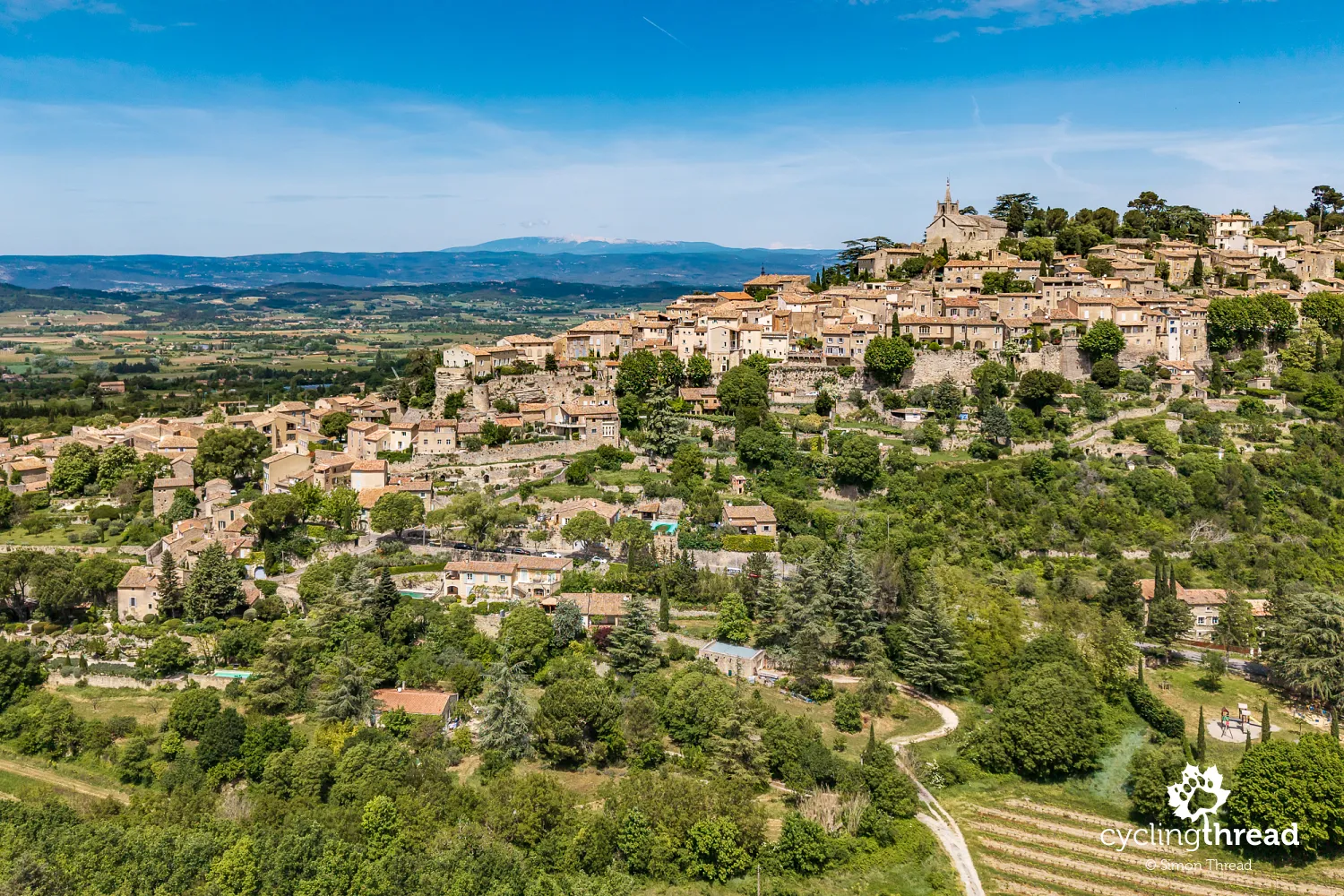
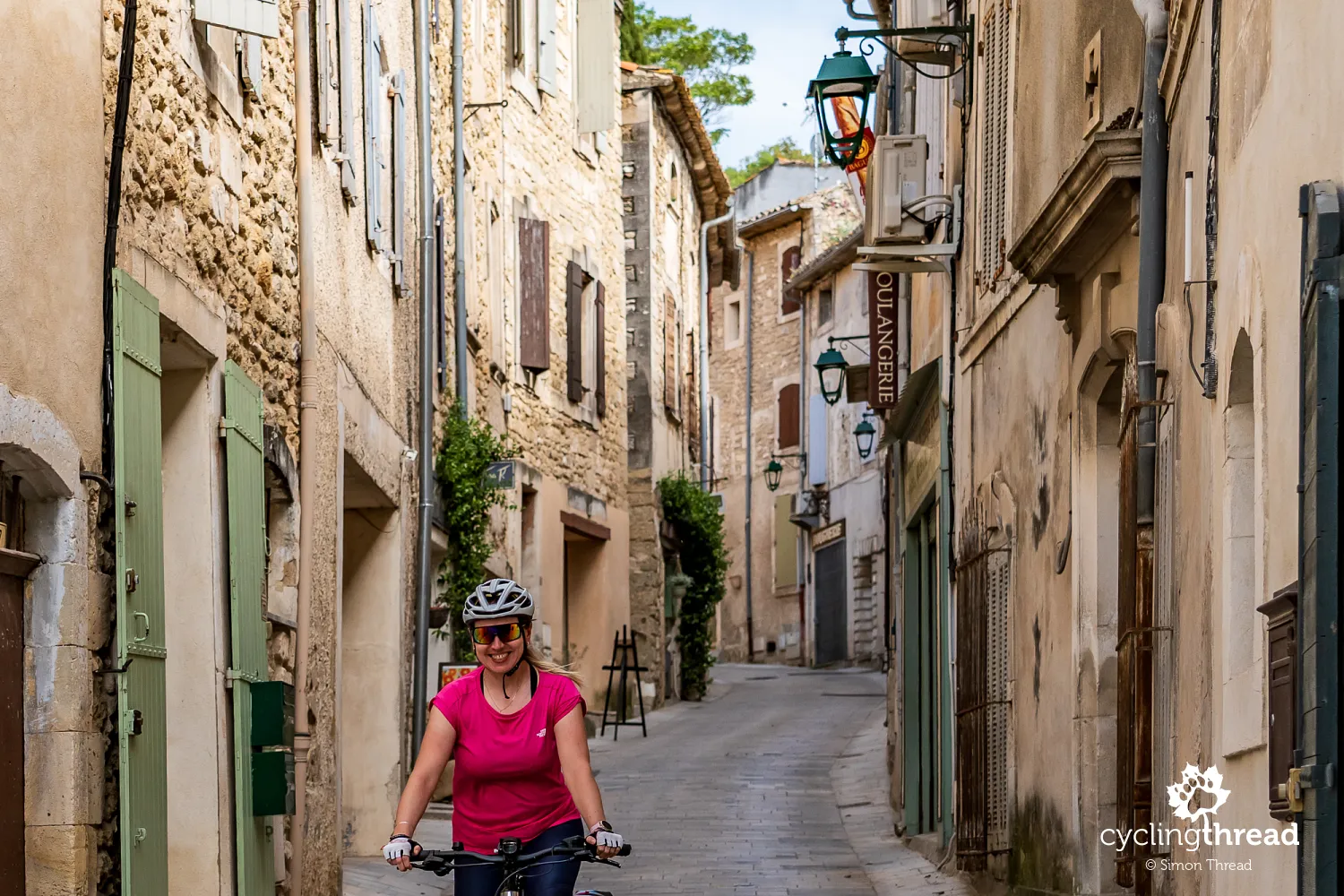
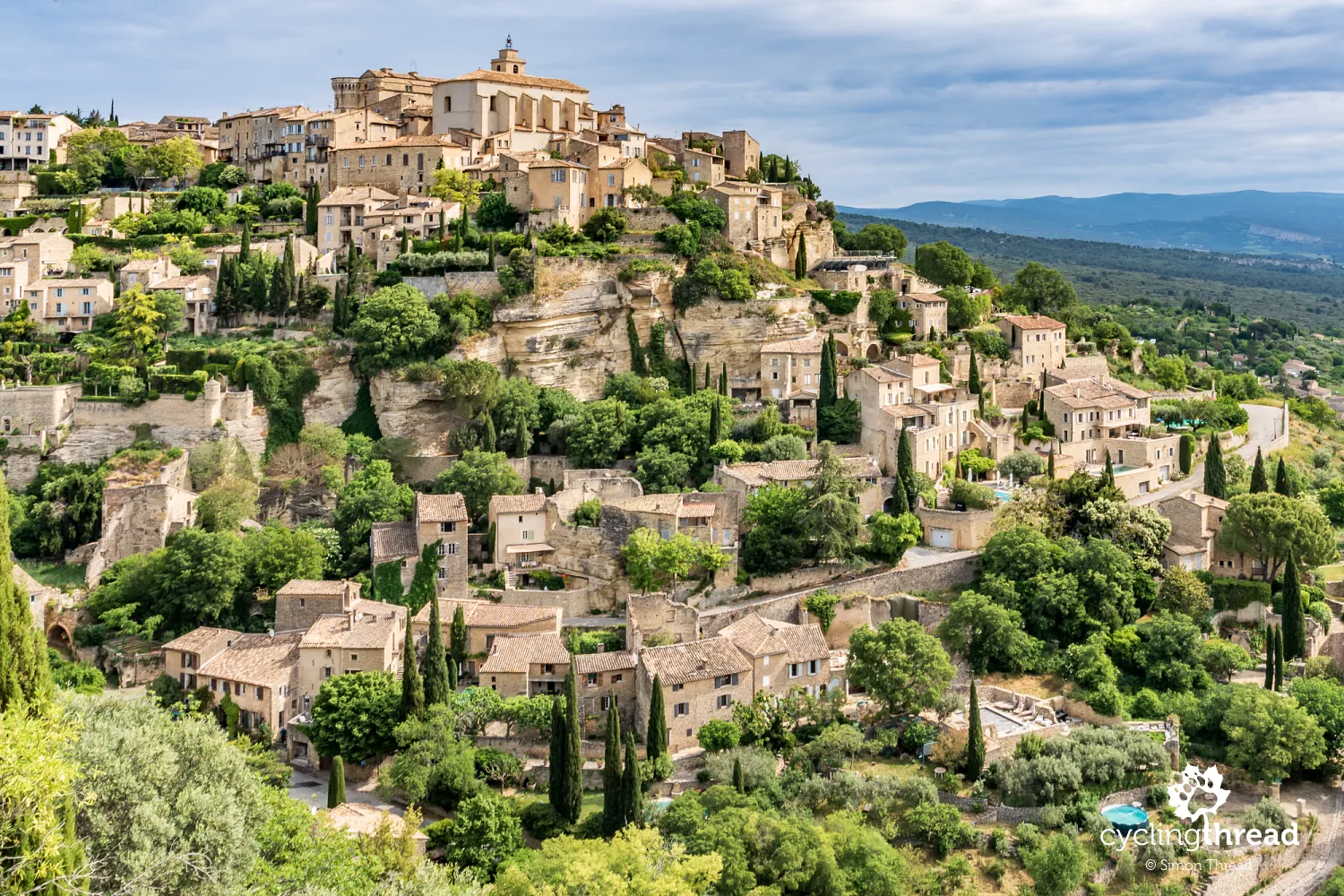
What makes the Luberon truly special are the villages perched along the hillsides, usually on the sunny southern slopes. The view of Gordes from its famous viewpoint is certainly one of the most beautiful we have ever seen. Alongside Gordes, the places that stayed in our memory the most were Bonnieux, Cucuron, Lourmarin, Roussillon and Oppède, although in reality every village and small town we visited in the Luberon became a memorable stop along the route. And while they all share the same stone-built Provençal character, each one felt different. Some were quiet and almost sleepy, while others were full of restaurants, local markets and tourists wandering through narrow streets. From some places we remember wide views over valleys and hills, while others stayed with us because of their small squares shaded by plane trees, old stone washhouses and fountains, or steep alleys climbing between pale stone houses.
The cycle route around the Luberon
The main idea behind the Around the Luberon by Bicycle route is to create a cycling loop around the Luberon massif. For us, however, it was equally important to explore the Luberon region itself and experience some of the most beautiful landscapes in Europe. That is why we added the Véloroute du Calavon to the classic route around the massif - because we enjoy discovering former railway cycle routes - as well as a section of the local Les Ocres à Vélo route. This is also why our map shows not only the large loop around the Luberon, but also a smaller loop on the western side of the massif. Thanks to this extended route through Provence, we managed to visit 17 of the 21 most beautiful villages and towns of the Luberon listed on the excellently prepared official website of Destination Luberon.
Riding around the Luberon on an e-bike
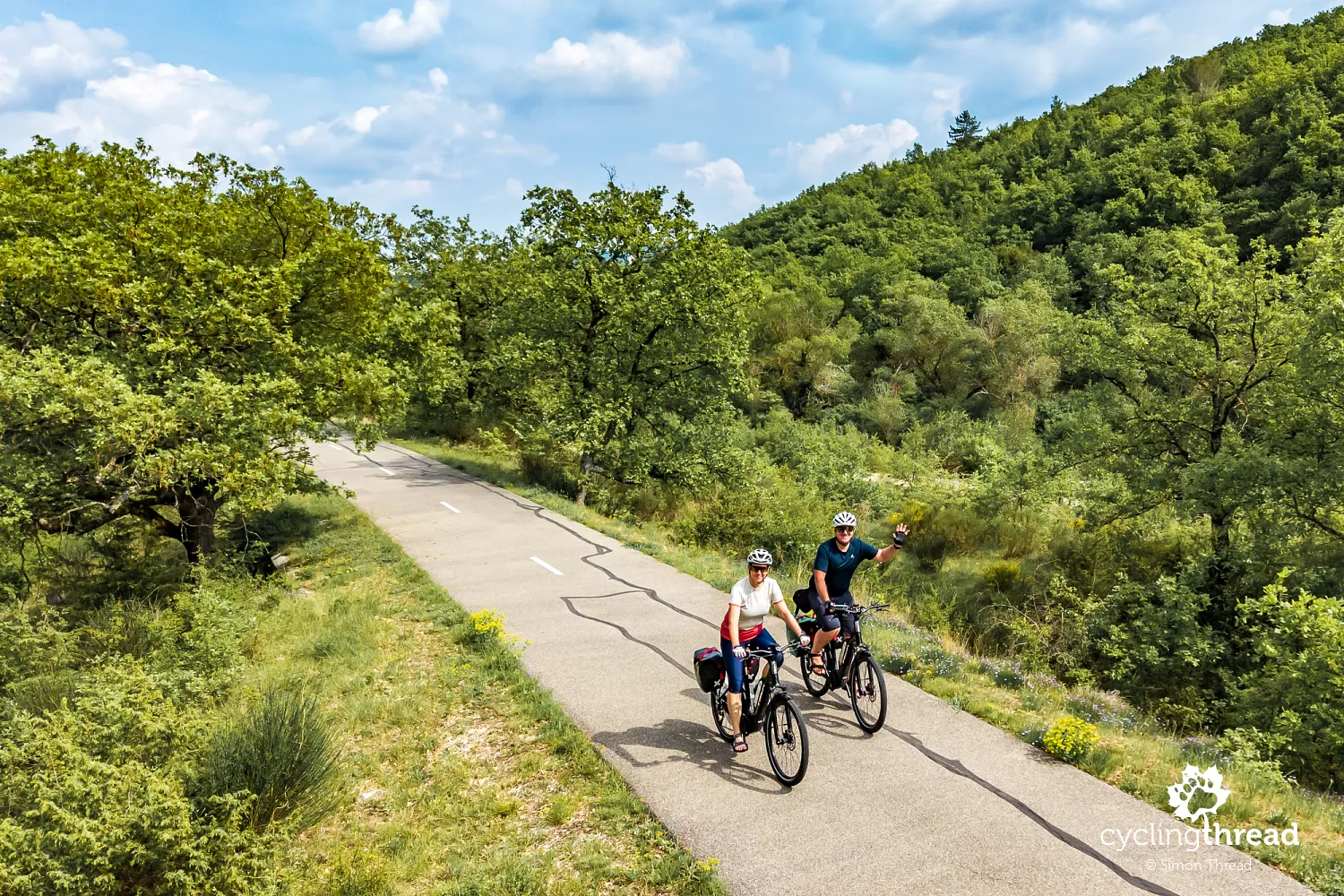
When travelling to Provence, it is worth remembering that this is a region with very varied terrain. During our trip, the only almost flat sections were parts of the former railway Véloroute du Calavon. The rest of the route meant regular climbs and descents - sometimes gentle, sometimes reaching gradients of around 6%. These are still manageable values for an average cycle traveller, but since we were flying to the Luberon from abroad and planning to rent bikes locally, for the first time in our cycling lives we decided to use e-bikes. And although the route can easily be completed on regular bicycles as well, we did not regret that decision for a second. We both agreed that electric bikes made exploring the Luberon easier - allowing us to see more places in a more comfortable and relaxed way.
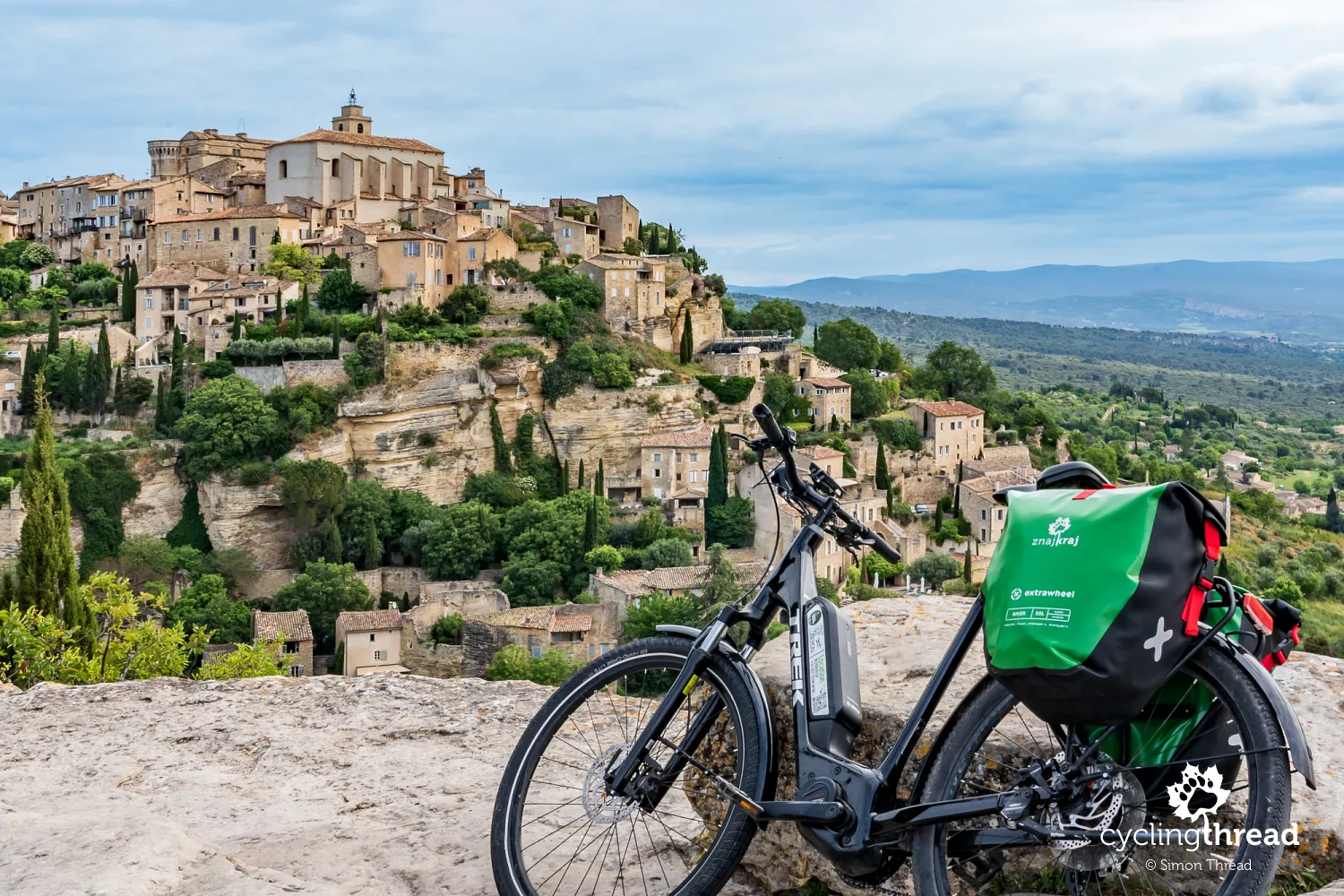
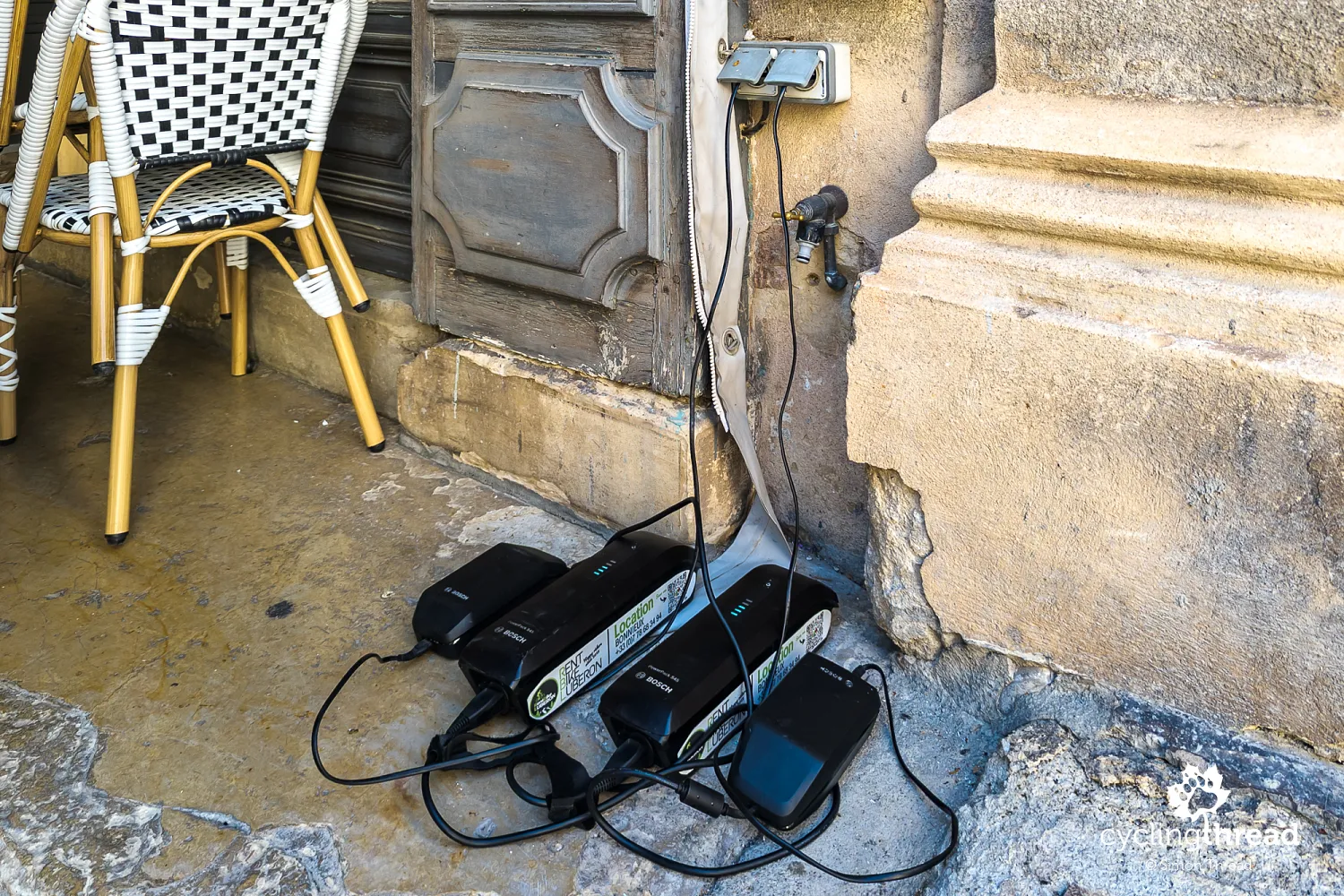
What is important, renting bicycles on site does not necessarily mean having fewer things to think about. It simply creates a new set of unknowns. Would our panniers fit the racks on the rental bikes? Would the saddles remain comfortable during a full week of riding? Would we miss the handlebar grips we are used to? And then there were mirrors - a small detail perhaps, but one that makes everyday cycling much easier. On top of that came spare inner tubes, a repair kit and extra space in the panniers for the e-bike charger. In the end, however, out of all these new concerns there was only one thing I could not solve - the high-mounted front lights made it impossible to attach our handlebar bags properly. As for mirrors, with almost no car traffic on the Provençal roads, we hardly missed them at all. So in the end… it really was not that bad ;)
Best bike rental services in the Luberon
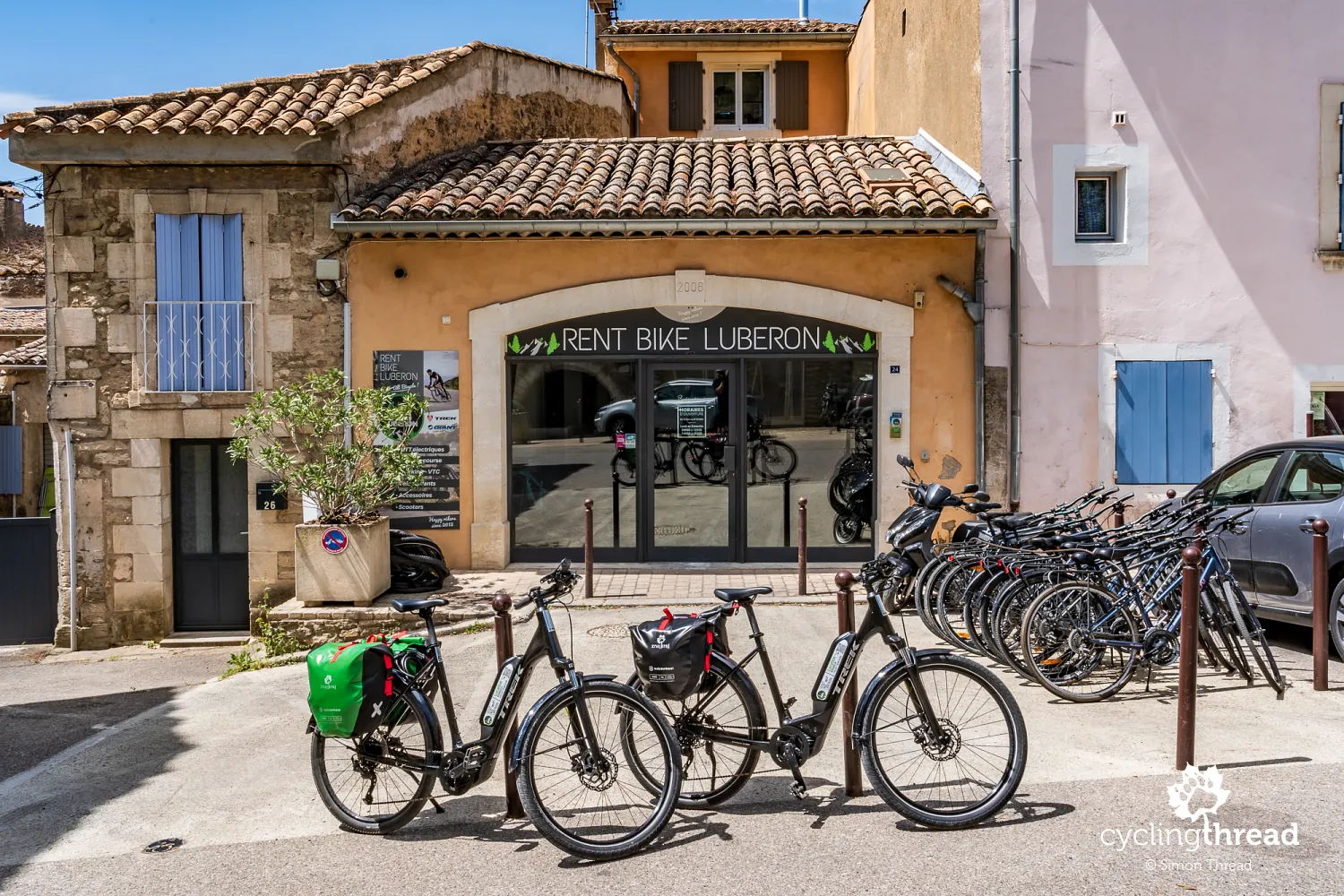
The Luberon is a very popular destination among cyclists, so finding a bike rental service was not difficult at all. We chose Rent Bike Luberon in Bonnieux, because this was where we found bicycles best suited to the character of our route - Trek Allant+ 5 models. The saddles turned out to be extremely comfortable (unfortunately, I forgot to note the exact model), and the rental service provided each bike with a spare inner tube, repair kit and multitool. Another excellent part of the offer was the free delivery and collection of bicycles anywhere in the Luberon region. When we arrived at our hotel in Cavaillon, our treks with fully charged batteries were already waiting for us in the underground garage.
Cyclist-friendly accommodation in Provence
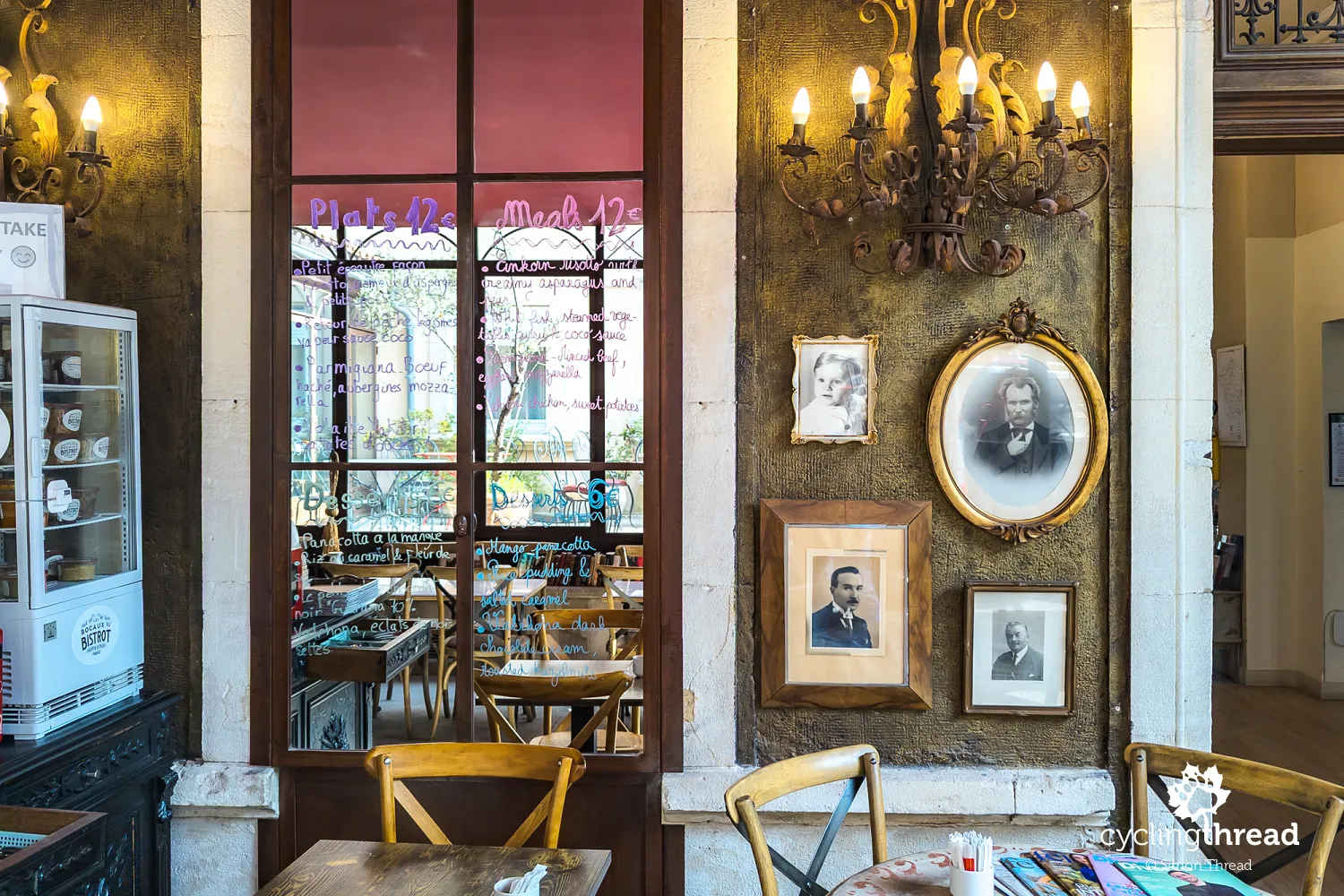
And speaking of hotels - accommodation in the Luberon, Provence and in fact across France is another thing cycle travellers do not need to worry about too much. Naturally, as long as you choose places belonging to the French cyclist-friendly network "Accueil Vélo". All you need to do is visit the France Vélo Tourisme website, display the "Autour du Luberon à vélo" route on the map, and then browse the list of cyclist-friendly accommodation in the Luberon region by enabling the "Refresh on move" option. After that, it is simply a matter of choosing hotels and booking accommodation - either directly through hotel websites or by comparing them with offers available on a popular booking platform. As a perfect starting point for a cycling trip through the Luberon, we especially recommend Hôtel du Parc in Cavaillon - a stylish hotel whose underground garage became a safe place for our rented bicycles, as well as for the suitcases carrying all our panniers and cycling equipment.
Cycling Cavaillon and how to get there
The best place to start a cycling trip through the Luberon is certainly Cavaillon. The town lies at the western edge of the Luberon massif, the Around the Luberon route passes directly through it, and it is also the starting point of the former railway Véloroute du Calavon. Equally important, however, is the fact that Cavaillon can be reached very easily by direct TER regional trains from Marseille Provence Airport - the nearest major airport served by many popular airlines - as well as from Marseille itself. TER trains stopping at Vitrolles Aéroport Marseille Provence station run approximately every 90 minutes, and the journey to Cavaillon takes around 70 minutes. Of course, regional TER trains also carry bicycles on this route free of charge.

Cavaillon turned out to be a perfect introduction to the atmosphere of Provence. The small and peaceful town has everything a traveller might need - several accommodation options, restaurants and, naturally, a few interesting places to visit. Part of the town’s character comes from the Saint-Jacques cliff rising above the main square and the old centre. We also noticed some very pleasant cycling infrastructure along several streets in central Cavaillon. The two-way cycle paths were impressively wide and separated from car traffic by small water-filled barriers.
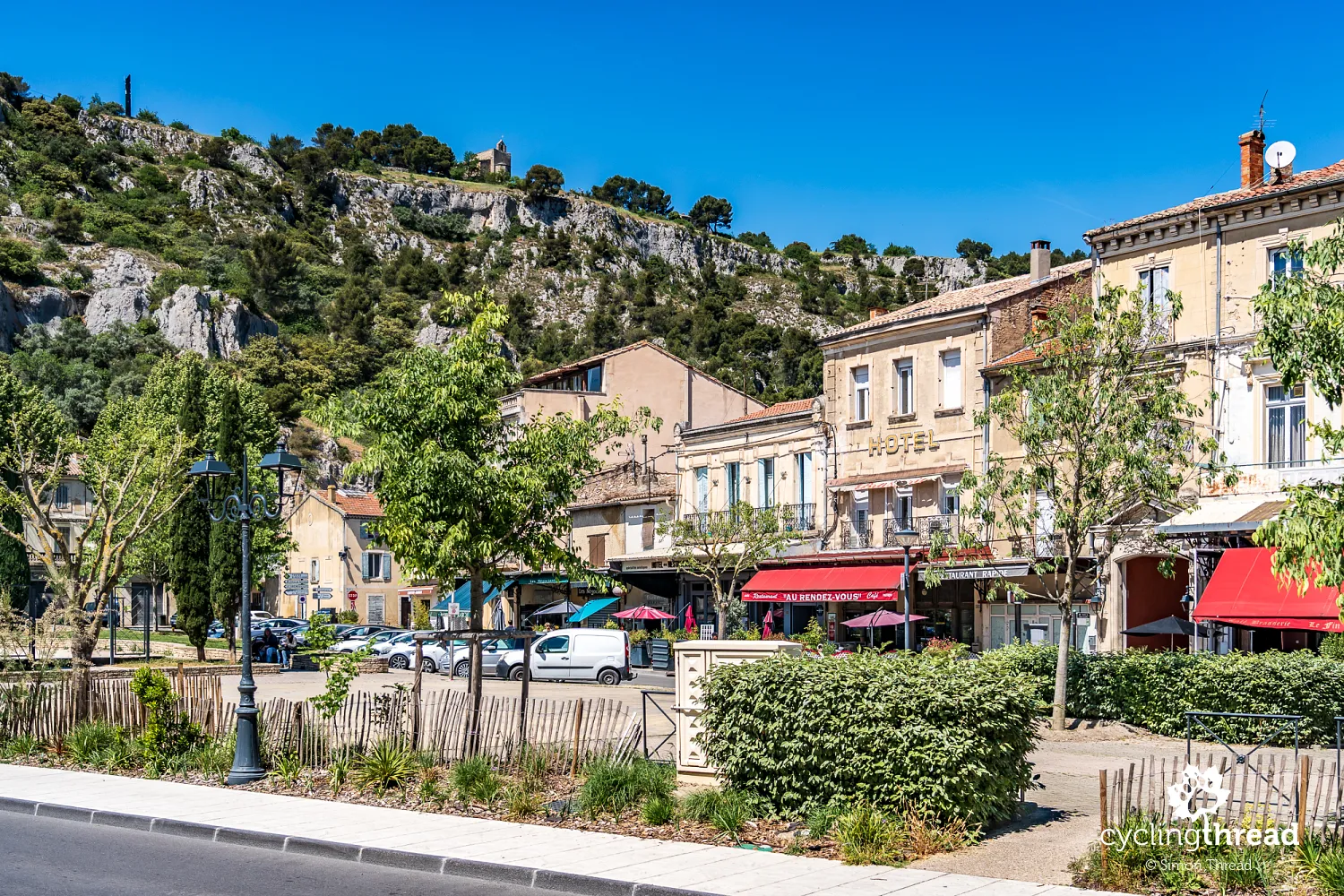
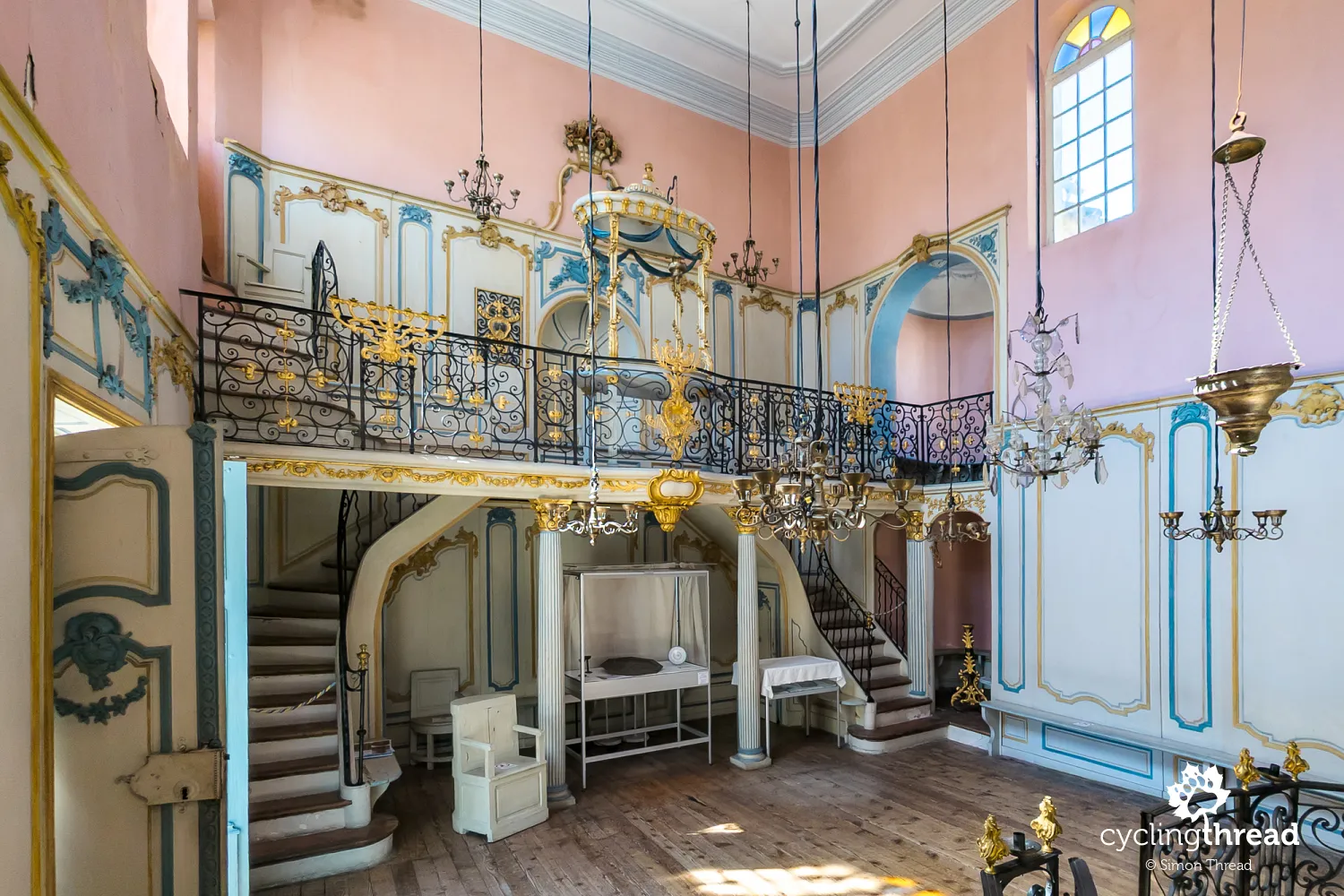
While walking around Cavaillon, we visited Cathédrale Notre-Dame-et-Saint-Véran, one of the town’s most important historic buildings, whose Romanesque interior fits perfectly with the character of Provençal towns. We also joined a guided visit to the former synagogue - a reminder of the centuries-long presence of Jewish communities in this part of Provence. Unfortunately, Musée de l’Hôtel-Dieu, the local archaeological and ethnographic museum, was closed during our stay. Its collections include local history, traditional crafts and everyday life in the region. A pity, because these smaller local museums often reveal the true character of a place better than the biggest tourist attractions.
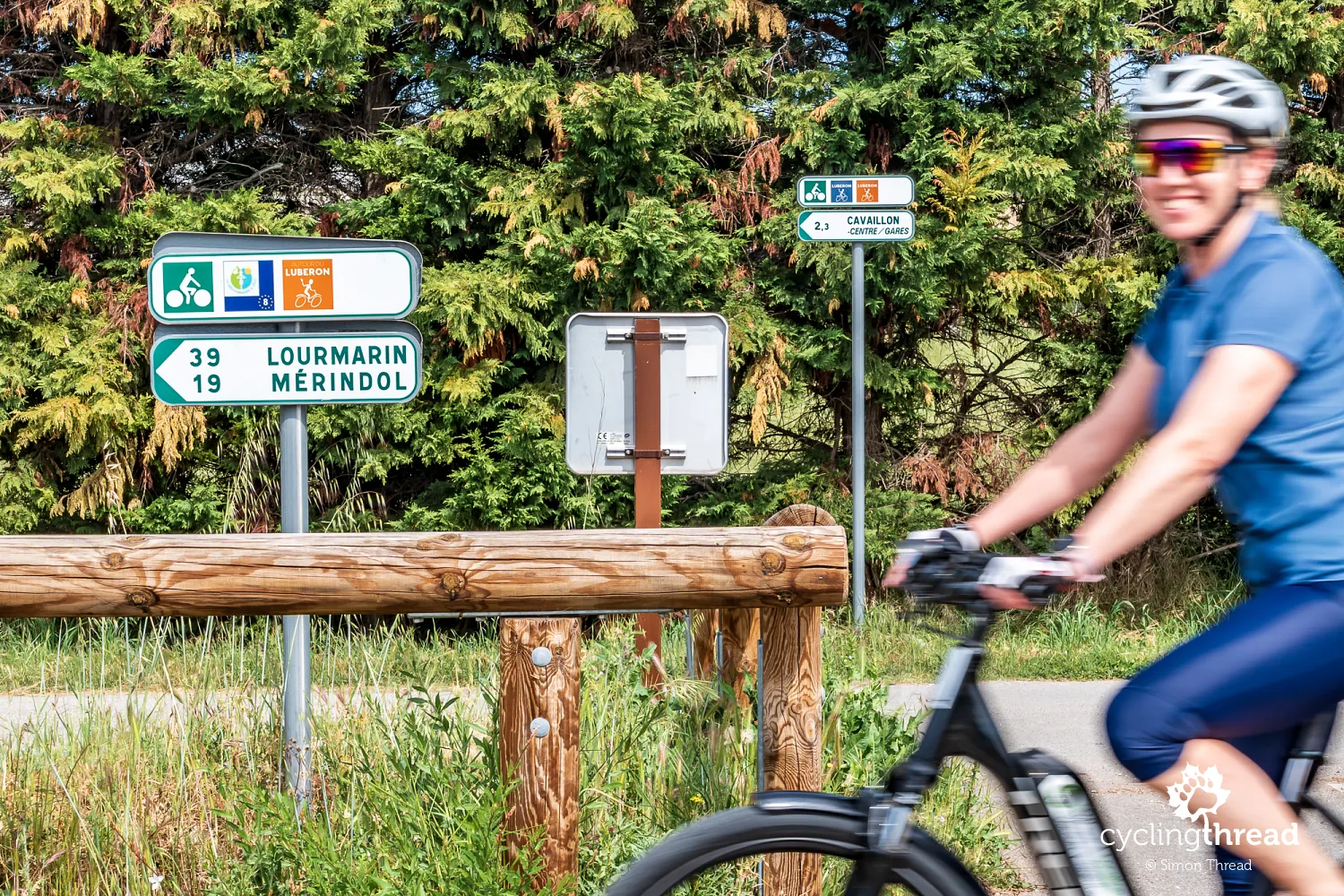
Route signage on Provençal cycle paths
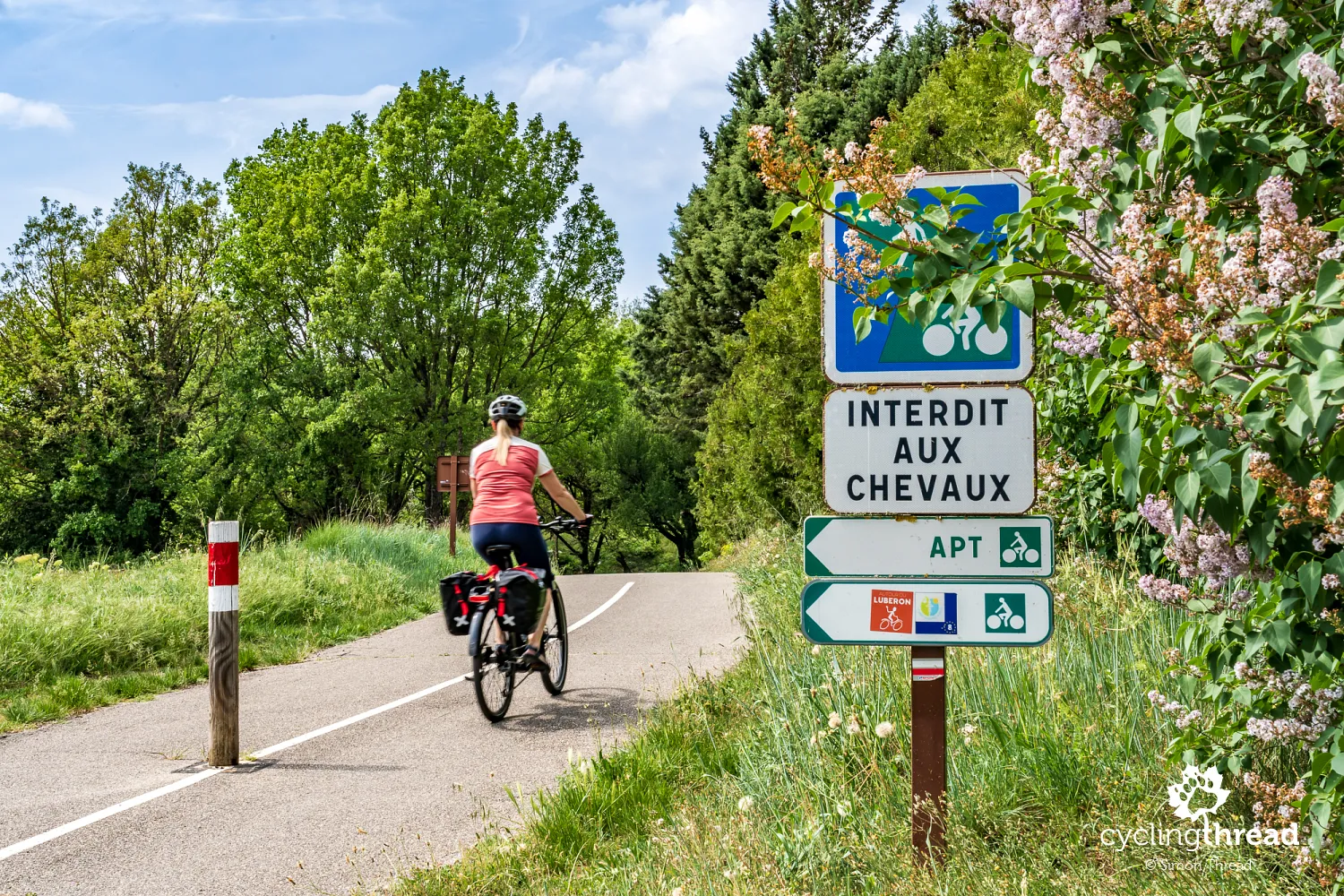
Right from the beginning, we were guided by the distinctive signage of the French cycle route network. The upper line on the direction signs shows the direction of the route itself, while the lower line points towards the next important town along the way. Additional signs with route symbols constantly confirmed that we were following the correct route. Interestingly, the Around the Luberon route uses two different logo colours - dark blue for the clockwise direction and orange for the counterclockwise one. This solution makes navigation much easier, especially in towns and on sections where both route variants follow the same roads, as happens around Cavaillon. It is also worth mentioning that almost every junction and roundabout featured a clearly visible cycle route sign, making navigation remarkably simple. A really well-designed system.
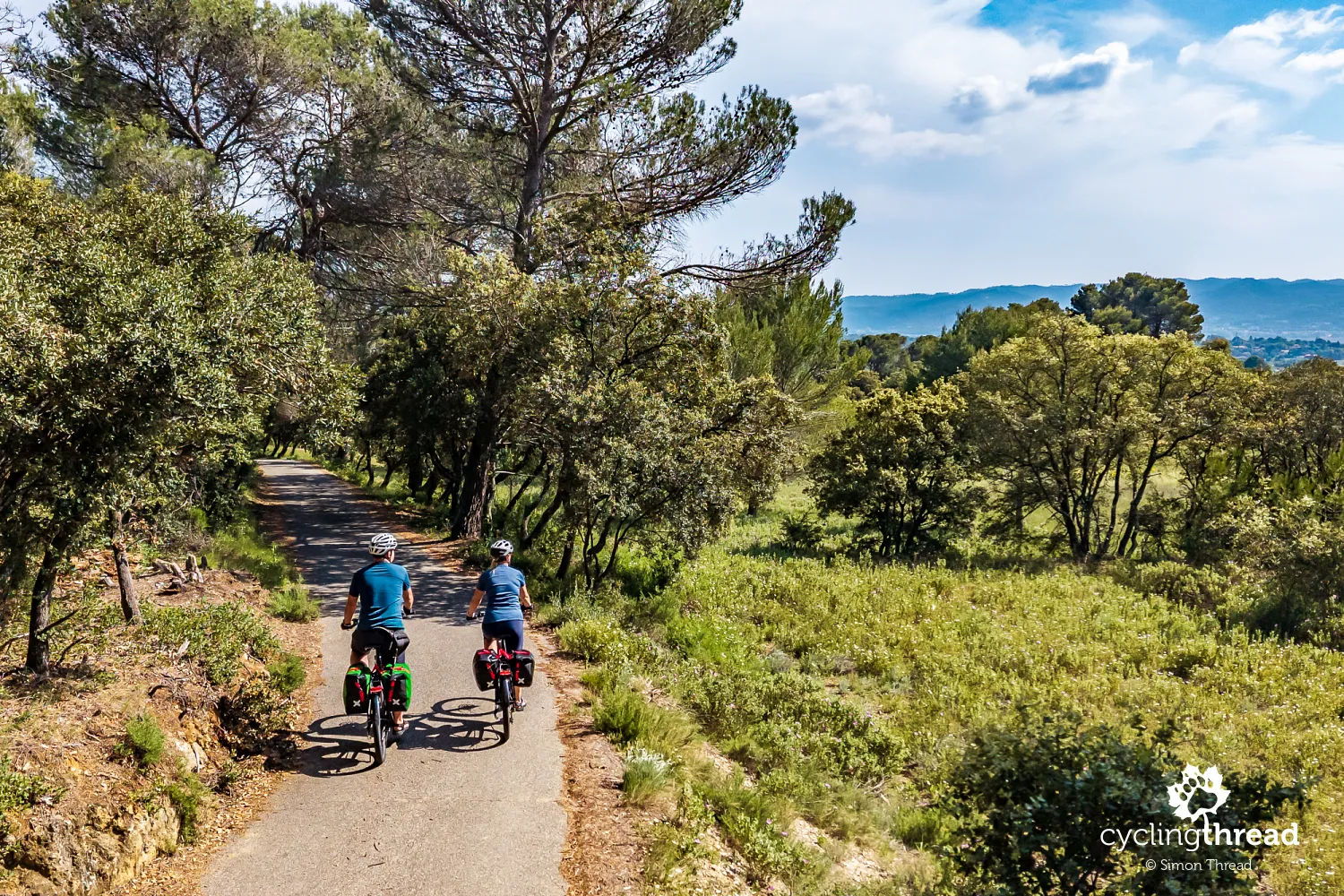
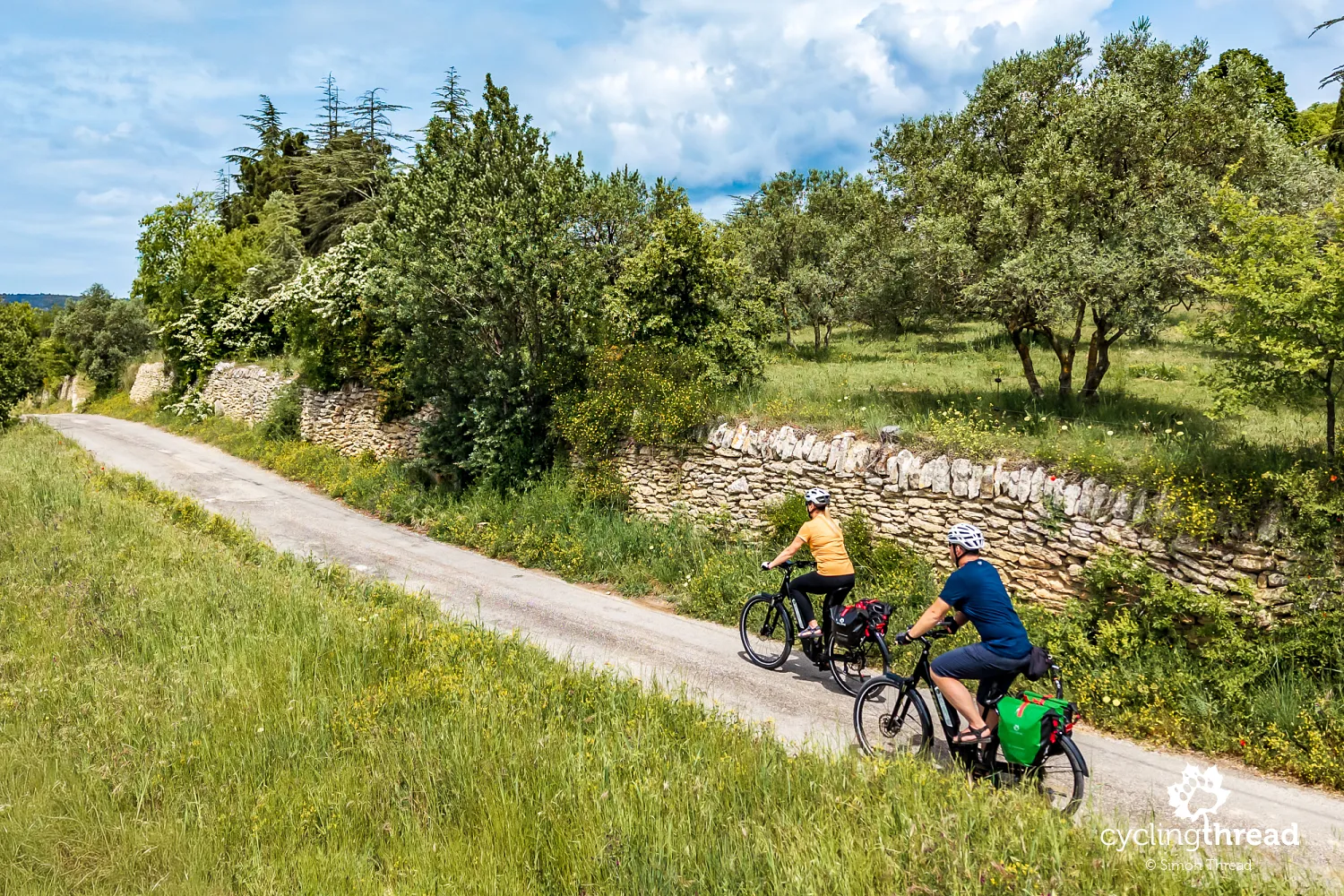
The very first section between Cavaillon and Mérindol immediately showed us one of the things we would enjoy throughout the journey - the route follows incredibly quiet local roads, where at times we almost felt as if we were cycling on infrastructure designed exclusively for bicycles. Most of the route is based on exactly these kinds of roads - public asphalt roads that, because of their location, are barely used by cars and mostly serve only a handful of nearby houses. And although I am usually a strong supporter of separated cycling infrastructure, in many parts of the Luberon it would simply be unnecessary.
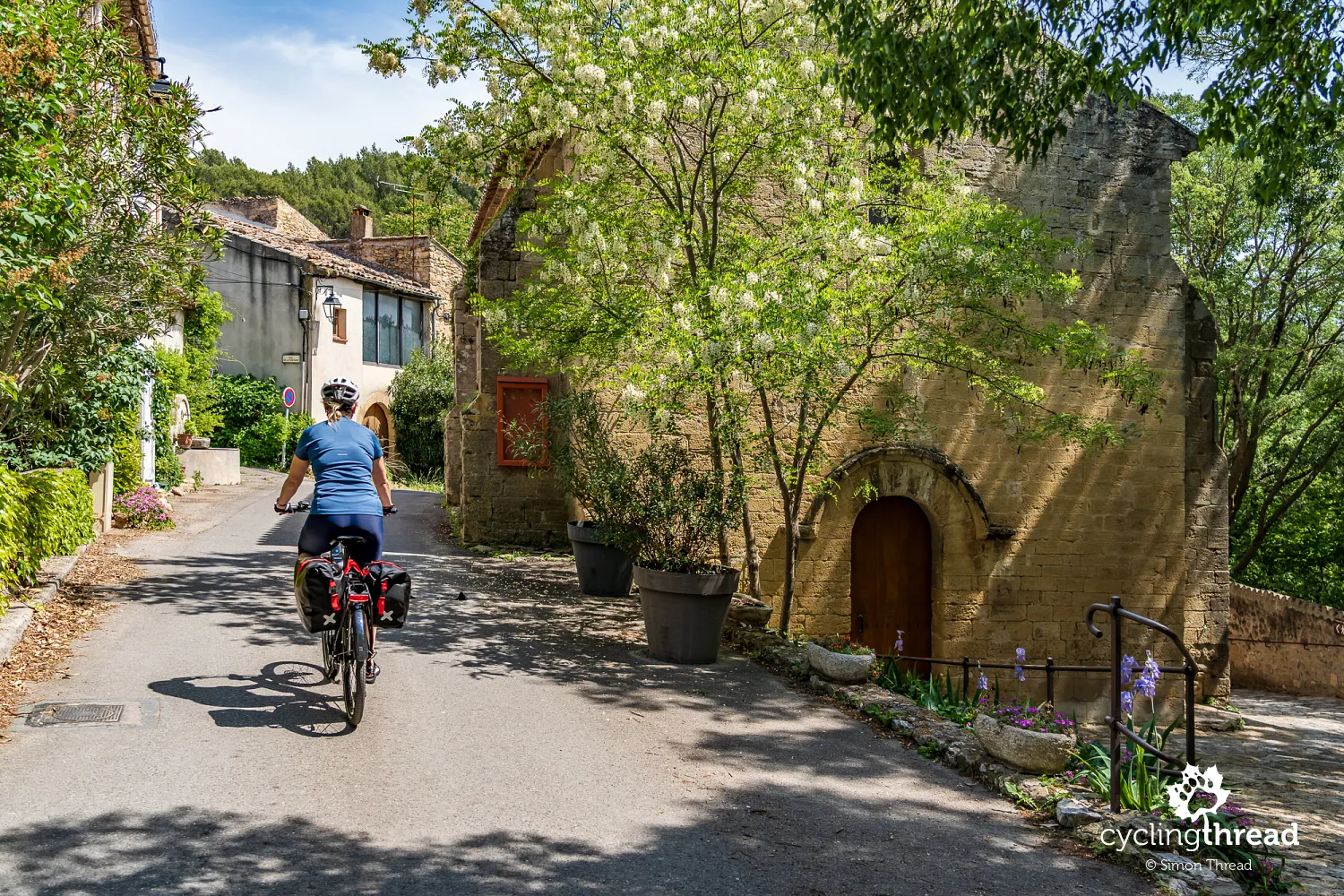
Puget among the most beautiful villages
We began discovering the most beautiful villages of the Luberon in Puget, a tiny village located at the southern foot of the massif. In the centre we visited Église Notre-Dame de l’Immaculée Conception, which has remained the village’s most important monument since the 13th century. The church stands in the heart of a small historic centre surrounded by old stone houses that together create something resembling a miniature medieval village core. Below the church, an old stone washhouse and fountain have also survived, reminding visitors of the everyday life of former generations in Provence. After only a few minutes walking through Puget, we already felt that these small and peaceful villages capture the true atmosphere of Provence better than anywhere else.
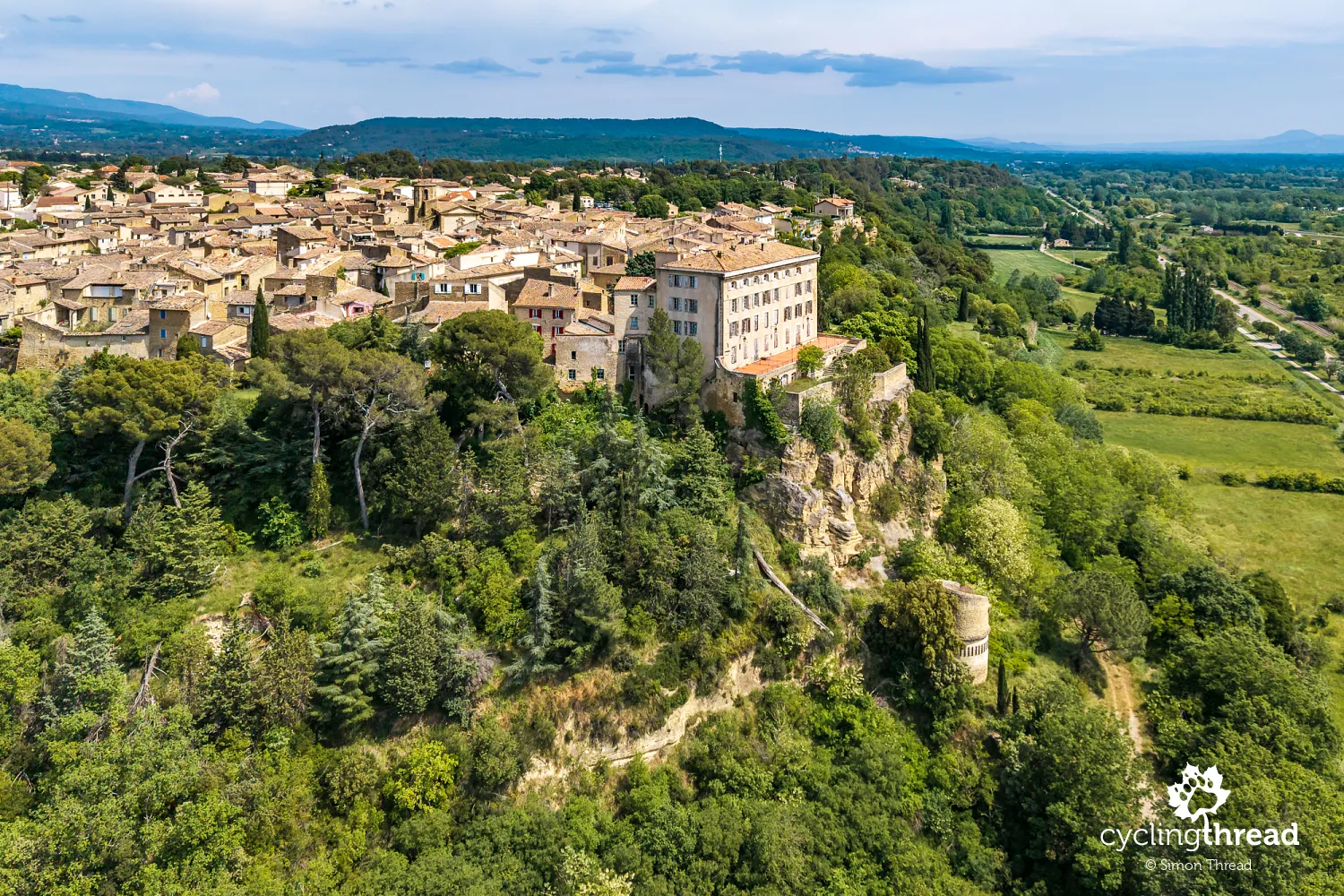
Soon afterwards, we were welcomed by the beautiful silhouette of Lauris, dramatically perched on a high cliff above the Durance River. Rising above the stone buildings of the village is an 18th-century château, rebuilt on the site of former medieval fortifications and surrounded by large terraces overlooking the Durance valley and the Alpilles hills. Among them are the characteristic Arcades terraces and the garden of dye plants - the only one of its kind in Europe - preserving the memory of traditional natural dye production in the Luberon. Walking through the old centre of Lauris means following narrow lanes between stone houses, fountains and stairways carved directly into the rock. Particularly picturesque is Église Notre-Dame-de-Purification with its elegant openwork bell tower and the old washhouse standing beside the church.
So many historic washhouses in Provence
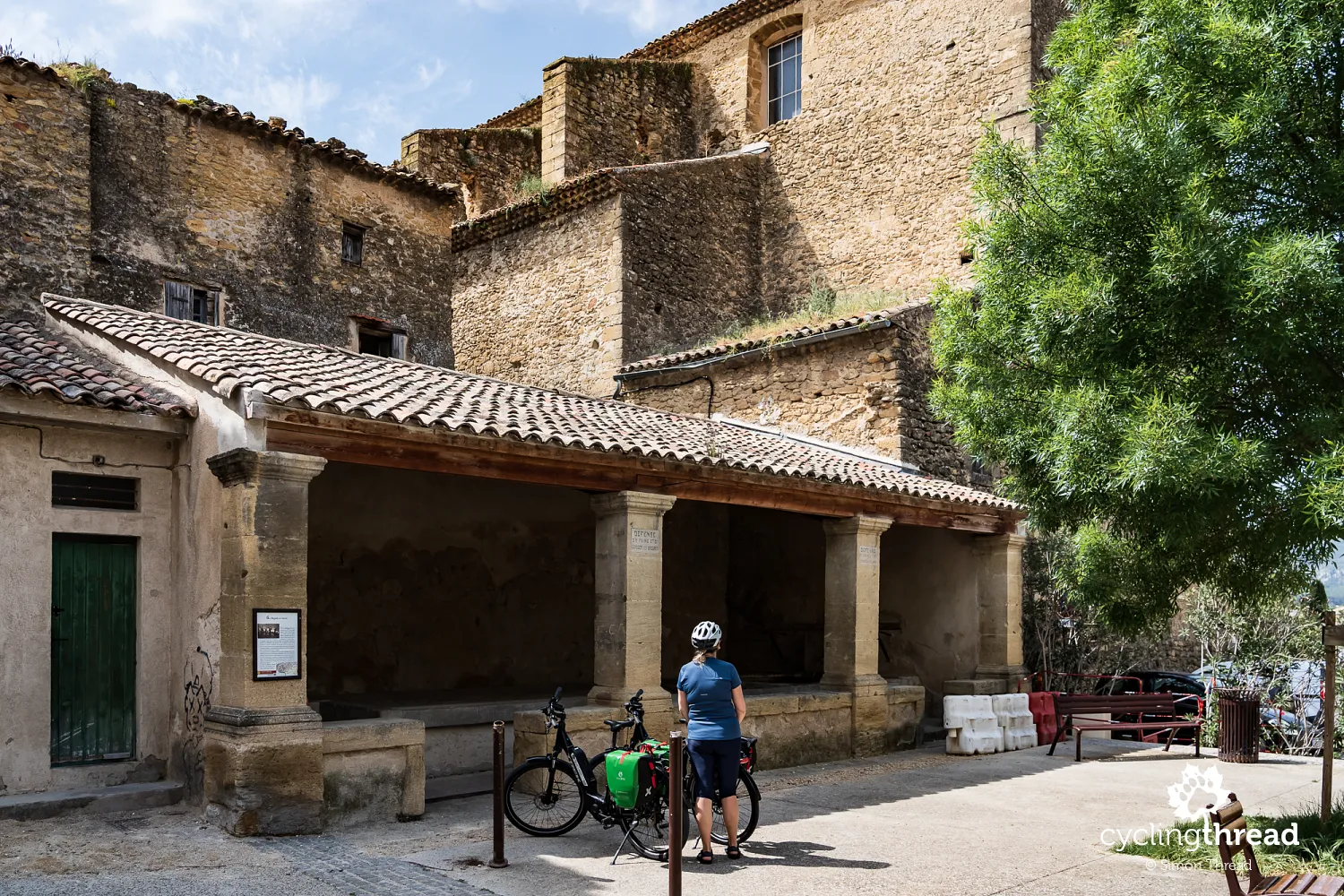
In fact, we had probably never seen so many historic washhouses anywhere before - at times it felt as if the people of Provence had been medieval champions of cleanliness and order. These characteristic stone lavoirs were an important part of everyday life in almost every village for centuries. Most often we found them on village squares or beside churches, usually protected by stone roofs shielding people from sun and rain. Women gathered there regularly to wash clothes, rinse fabrics and exchange local news, which made the washhouses important centres of social life as well. Many of them still survive today in Provençal villages - sometimes carefully restored, sometimes hidden quietly between old stone houses - reminding visitors of daily life before washing machines and running water. The washhouse in Lauris even features a detailed description of the traditional washing process, from soaking and scrubbing fabrics to rinsing and drying. It is definitely worth reading.
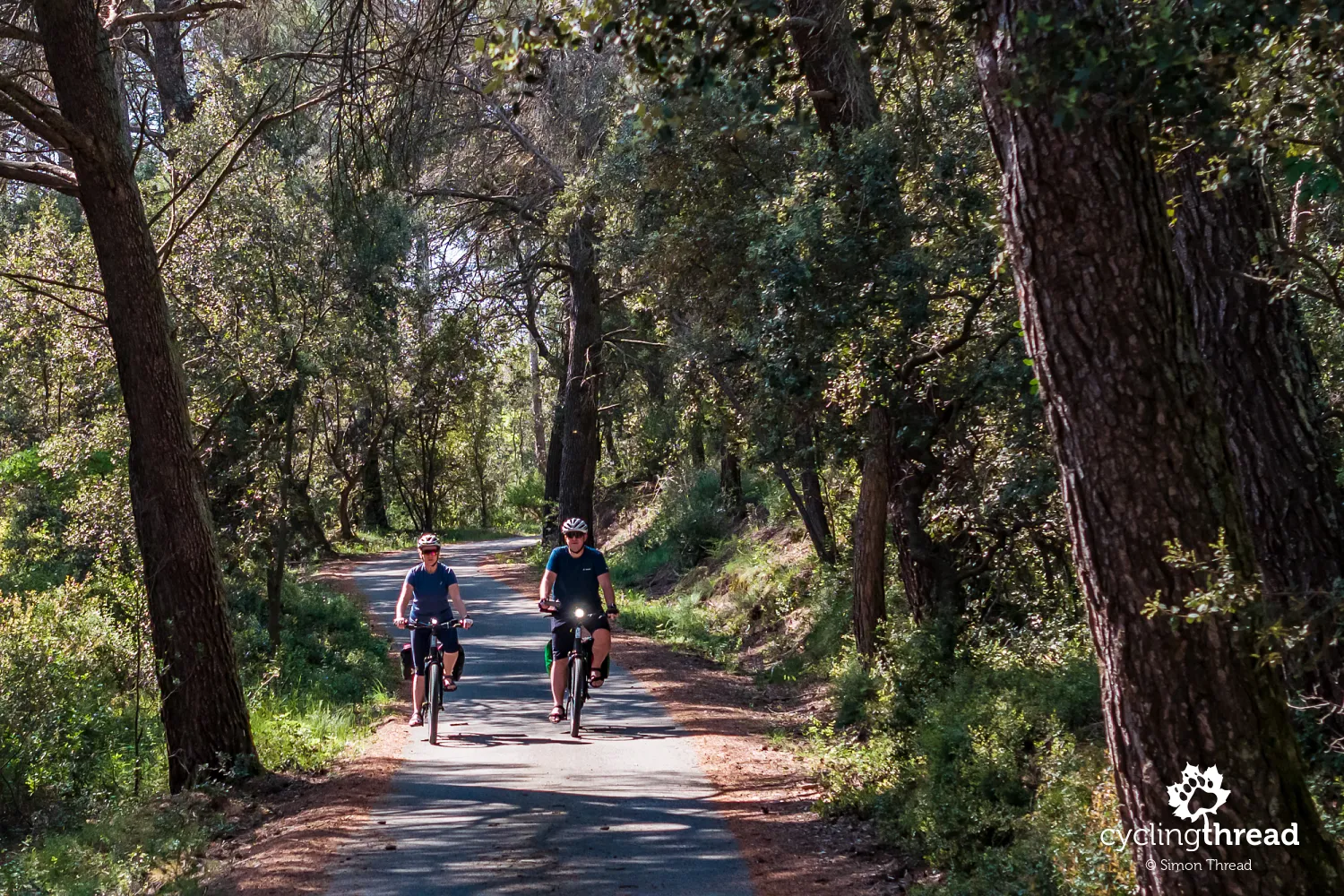
Beyond Lauris, on the way towards Lourmarin, the Around the Luberon cycle route once again follows one of those quiet local roads that almost feel like cycling infrastructure created especially for bicycles. Here the landscape becomes more mountainous, leading through dense Mediterranean forests filled with Aleppo pines and evergreen holm oaks that completely change the atmosphere of this part of the Luberon. In the warm air we could smell the characteristic resin scent of pine trees, mixed in places with the intense aroma of blooming rockroses growing along the roadside.
The best-preserved dovecot in France
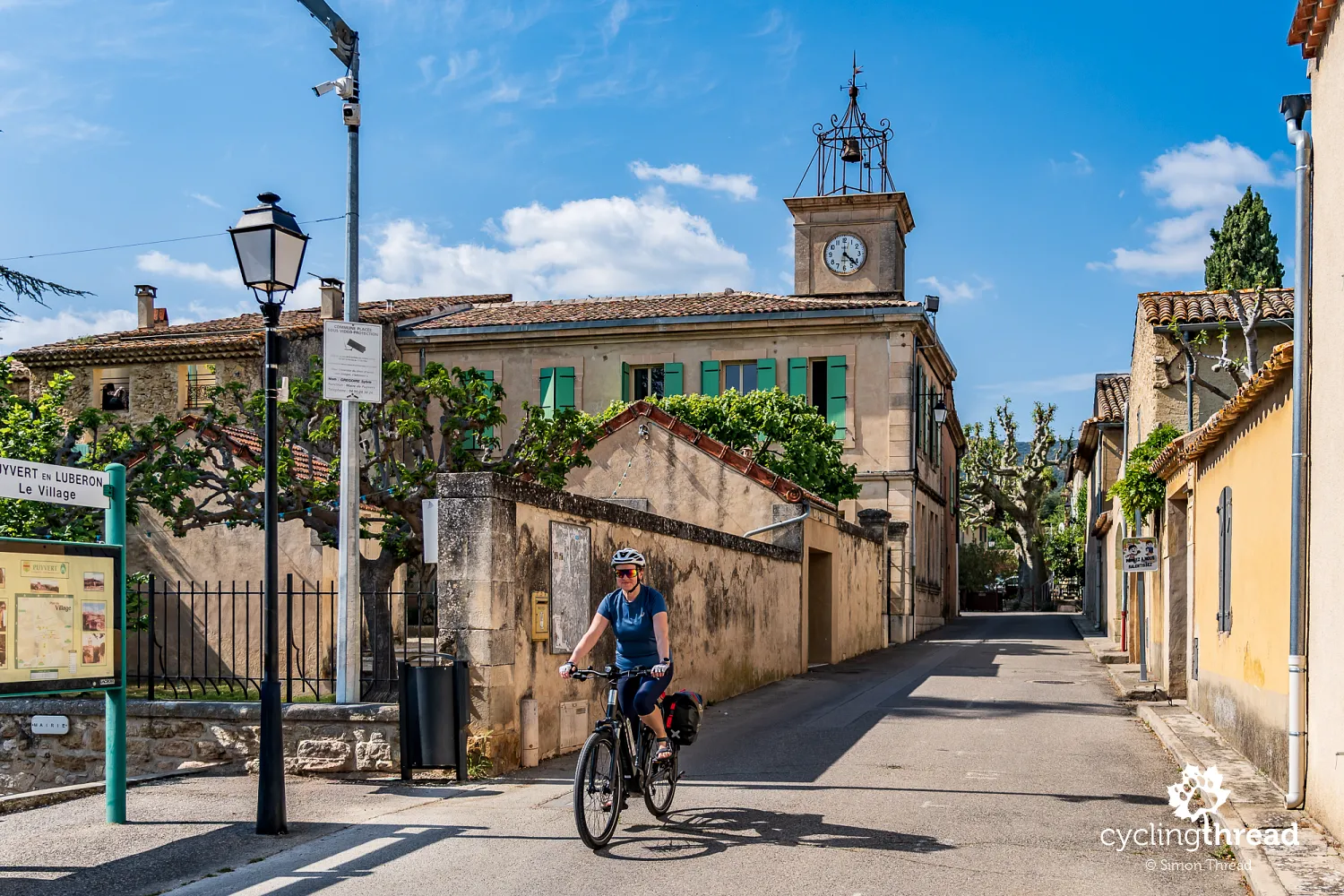
We passed through Puyvert on a quiet afternoon. In the centre, a small clock tower immediately catches the eye and - naturally - yet another stone washhouse hidden beneath plane trees. The most characteristic landmark of the village, however, is the Jas de Puyvert dovecote, the only remaining part of a 14th-century château that once stood on the Jas hill. Even from a distance, its proportions and silhouette dominating the surrounding landscape are striking. The interior is even more impressive - after restoration carried out by the Regional Natural Park of the Luberon, around 3,000 glazed terracotta nesting niches in several colours have survived here, fixed directly into the walls. It is considered one of the most interesting and best-preserved dovecotes in France. The nearby hillside also offers wide views over the Petit Luberon and the Durance valley.
Lourmarin - the highlight of the day
The clear highlight of our first day was certainly Lourmarin. We arrived there late on a Sunday afternoon and immediately fell into the wonderfully relaxed atmosphere of the town. The narrow streets of the old centre were full of people walking between restaurants, small shops and galleries, yet everything moved at a calm southern rhythm, without crowds or hurry. One place we remember especially well was a cobbled street with Chez Gaby and its tables set beneath old Provençal buildings. This was where we stopped for dinner and spent some time simply watching everyday life in Lourmarin - people strolling through the streets, conversations over wine and the characteristic evening sounds of a small southern town. Lourmarin felt livelier than many other places along our route, while still keeping its intimate atmosphere.
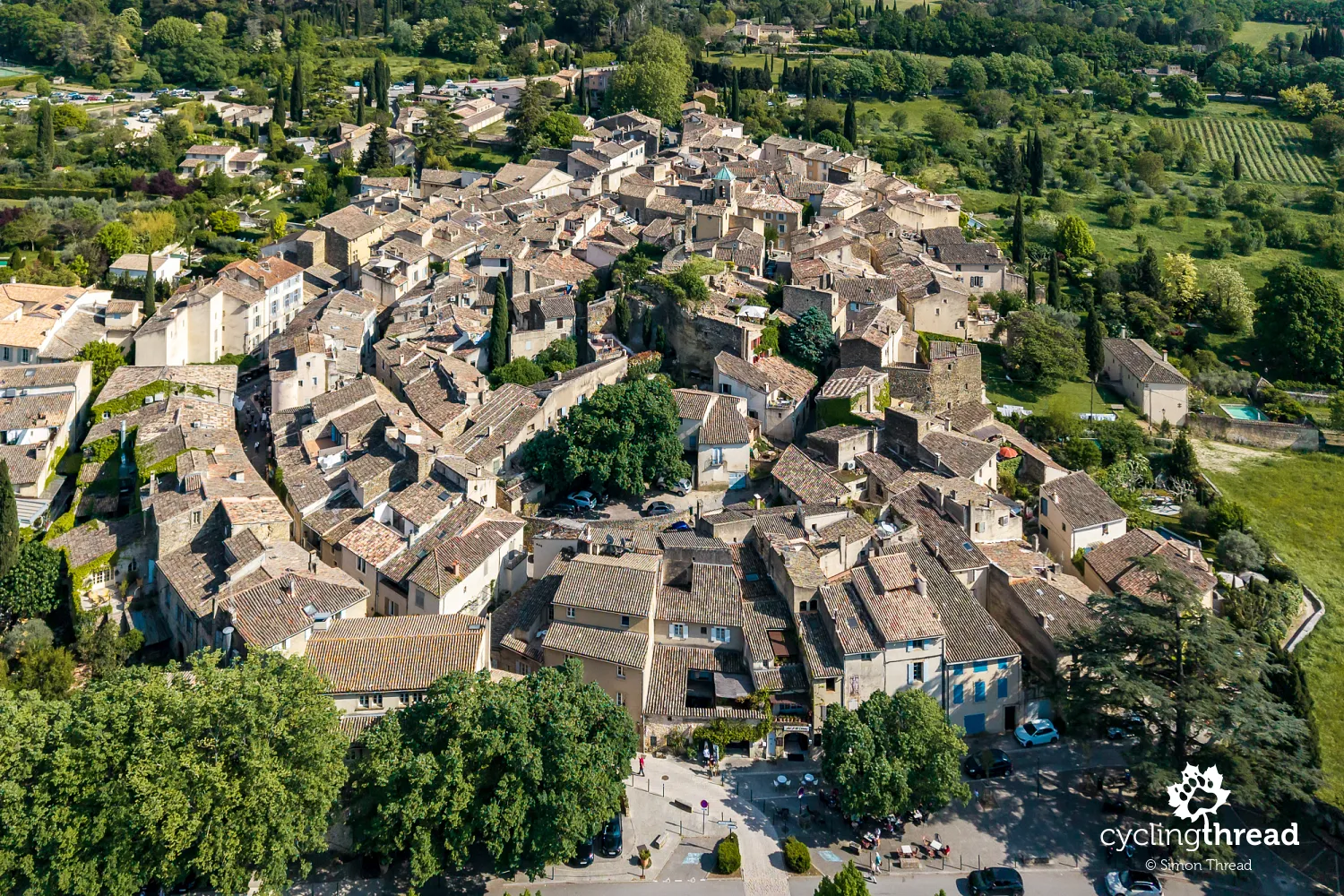
Lourmarin also has a fascinating history that sets it apart from many other villages in the Luberon. Already in the Middle Ages, it was an important trading centre located on routes connecting the Durance valley with the interior of Provence. Even today, the old town remains full of narrow streets, stone houses and small squares shaded by plane trees, which become natural gathering places for both residents and visitors during hot summer days. The town was also closely connected with Albert Camus, who was buried in the local cemetery. For many years, Lourmarin has attracted not only tourists, but also artists, writers and people searching for a quieter side of Provence.
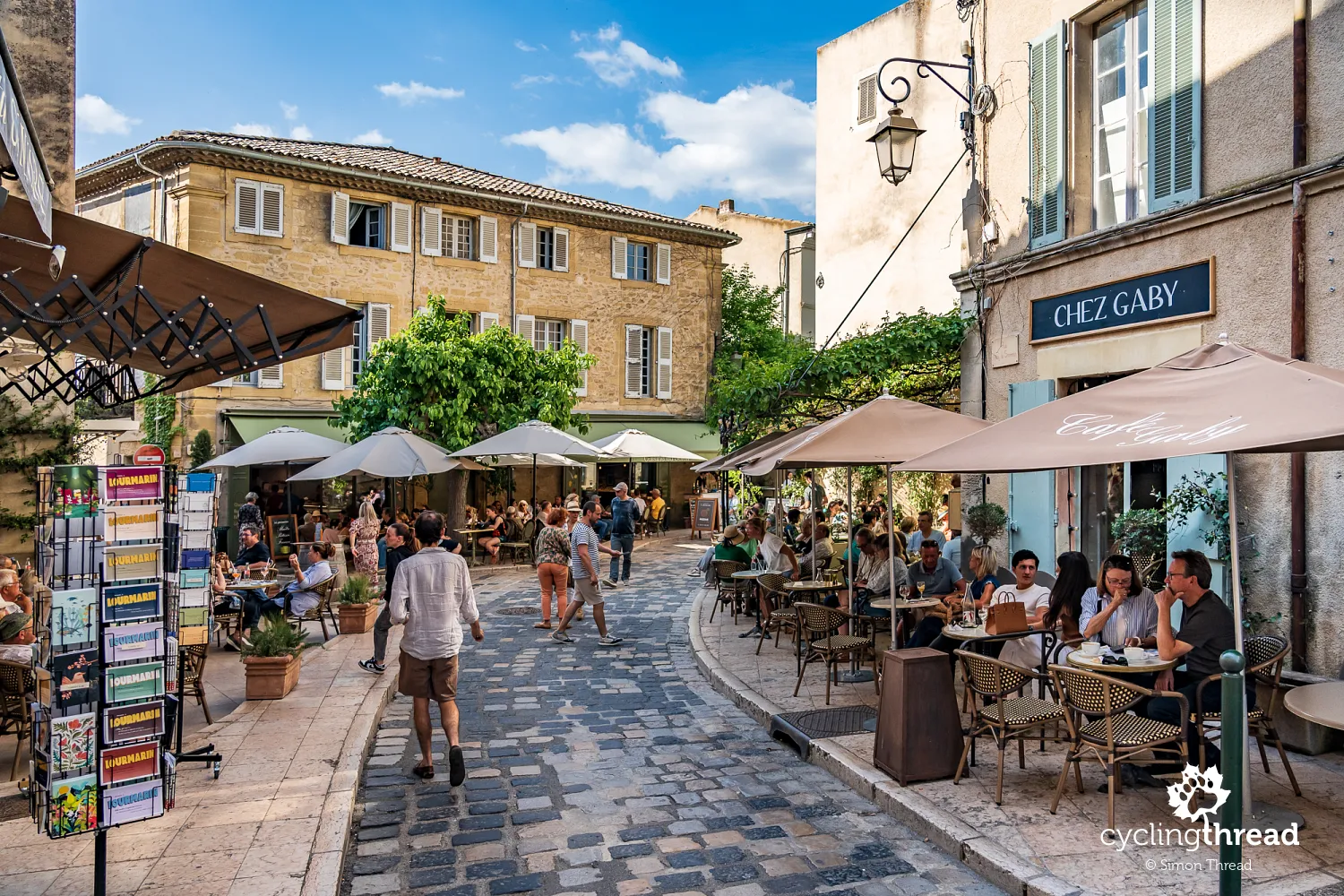
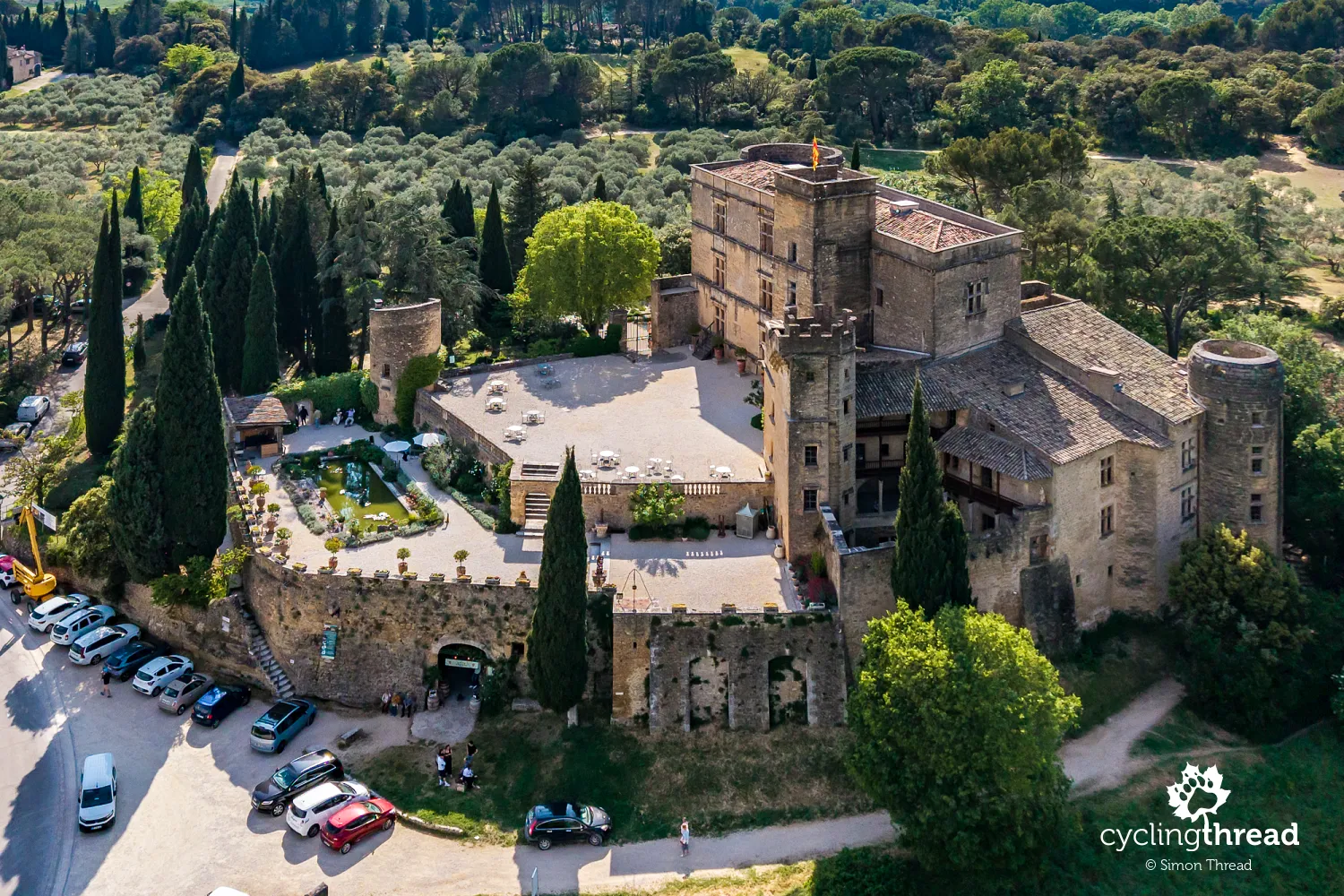
Not far from the old town stands Château de Lourmarin, considered one of the first Renaissance châteaux in all of Provence. Unlike the austere stone fortresses typical of the region, it resembles an elegant residence far more than a defensive structure. Its oldest section dates back to the Middle Ages, but later reconstruction gave the building a lighter and more representative appearance, with decorative windows, arcades and an inner courtyard. Today, the château is open to visitors and regularly hosts exhibitions, concerts and cultural events. The building itself was saved from ruin only in the 20th century thanks to the efforts of local art and history enthusiasts. The area around the château also offers lovely views over the rooftops of Lourmarin and the vineyards surrounding the town.
A "2 minus 1" road in Provence
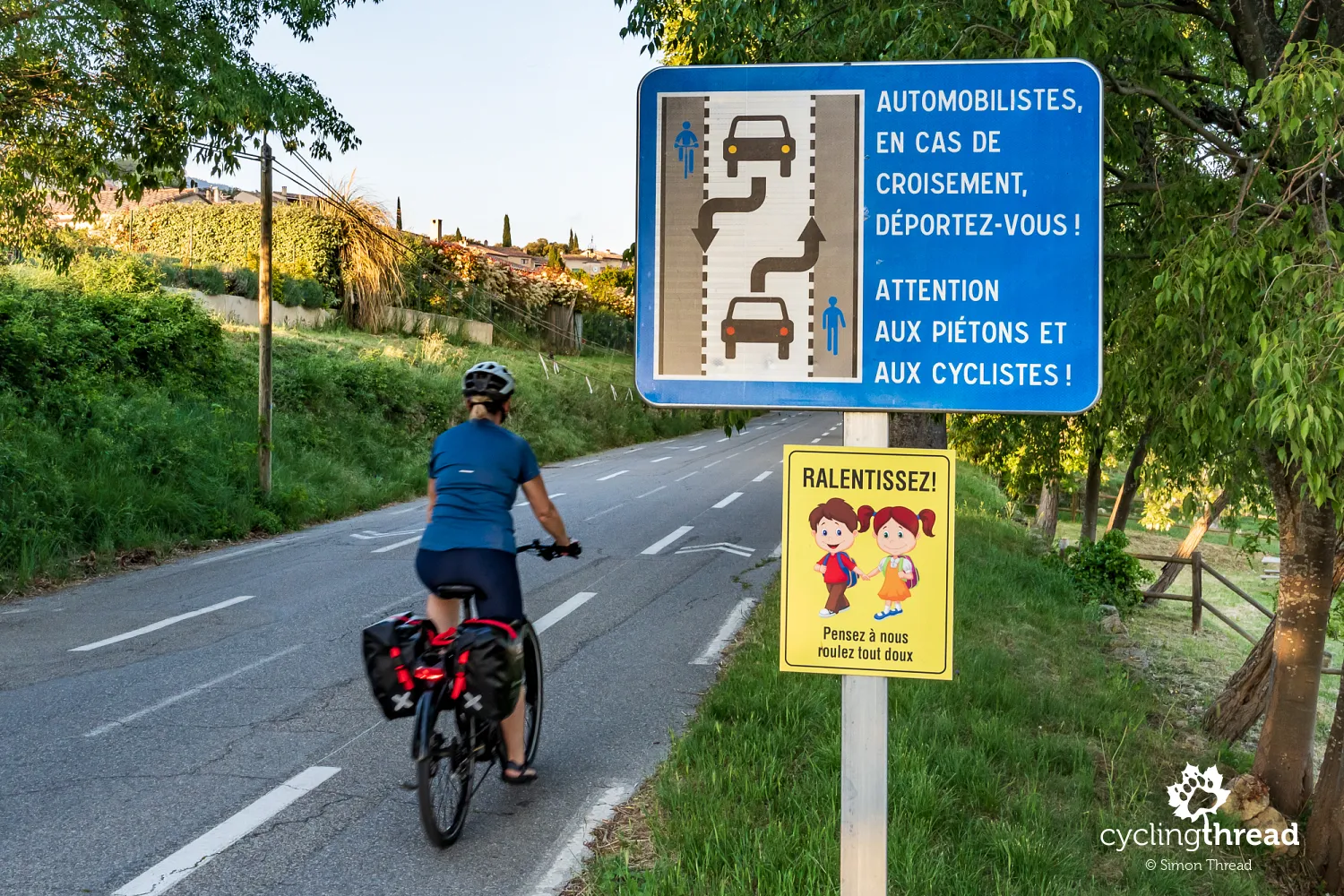
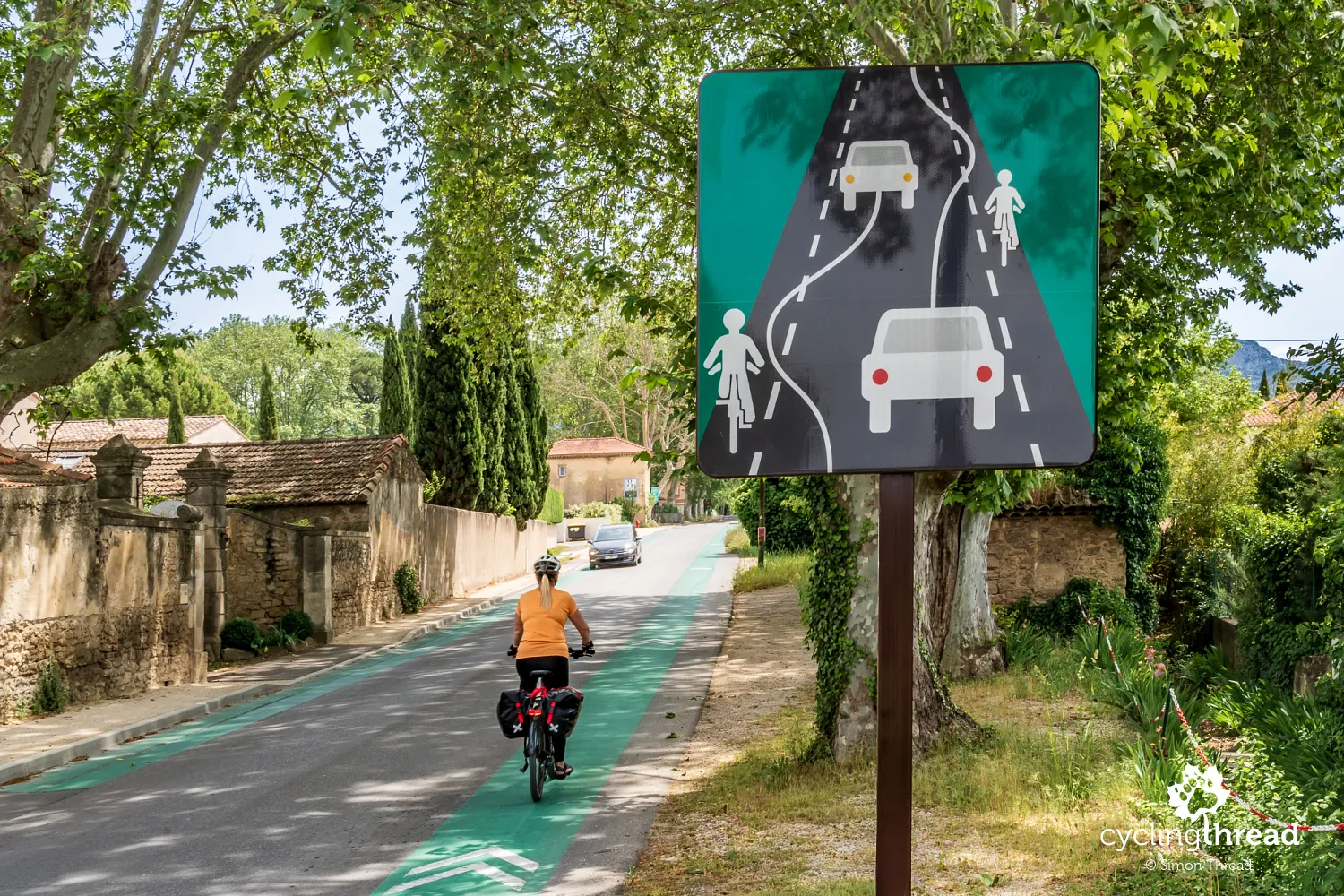
On the climb towards the small village of Vaugines, we came across one of the French road solutions designed to improve cyclist safety. It is the so-called "2 minus 1" road, known in France as chaussée à voie centrale banalisée. The road layout uses one shared central lane for cars and two advisory cycling lanes on both sides. When two cars meet, they temporarily move into the side lanes while giving priority to cyclists riding there. This type of solution is mainly used on very quiet local roads with little car traffic and is intended to calm traffic and encourage slower driving speeds. In practice, cyclists feel noticeably safer here than on a normal narrow road without any markings. I already mentioned a similar solution during our cycling trip in the Netherlands along the Waterline Route.
Beautiful Cucuron at the end of the day
We finished the day in beautiful Cucuron. To reach our accommodation, we had to cycle through the narrow streets of the historic centre, where a remarkably calm and almost cinematic Provençal atmosphere survives between stone houses and small squares. Above the village, the ruins of a former defensive castle can still be seen, reminding visitors of Cucuron’s medieval history and its position along important regional routes. In the centre, an old stone fountain and characteristic Provençal townhouses with blue shutters also draw attention. By evening, the town had become almost completely empty, which made our short walk through its streets feel especially peaceful.
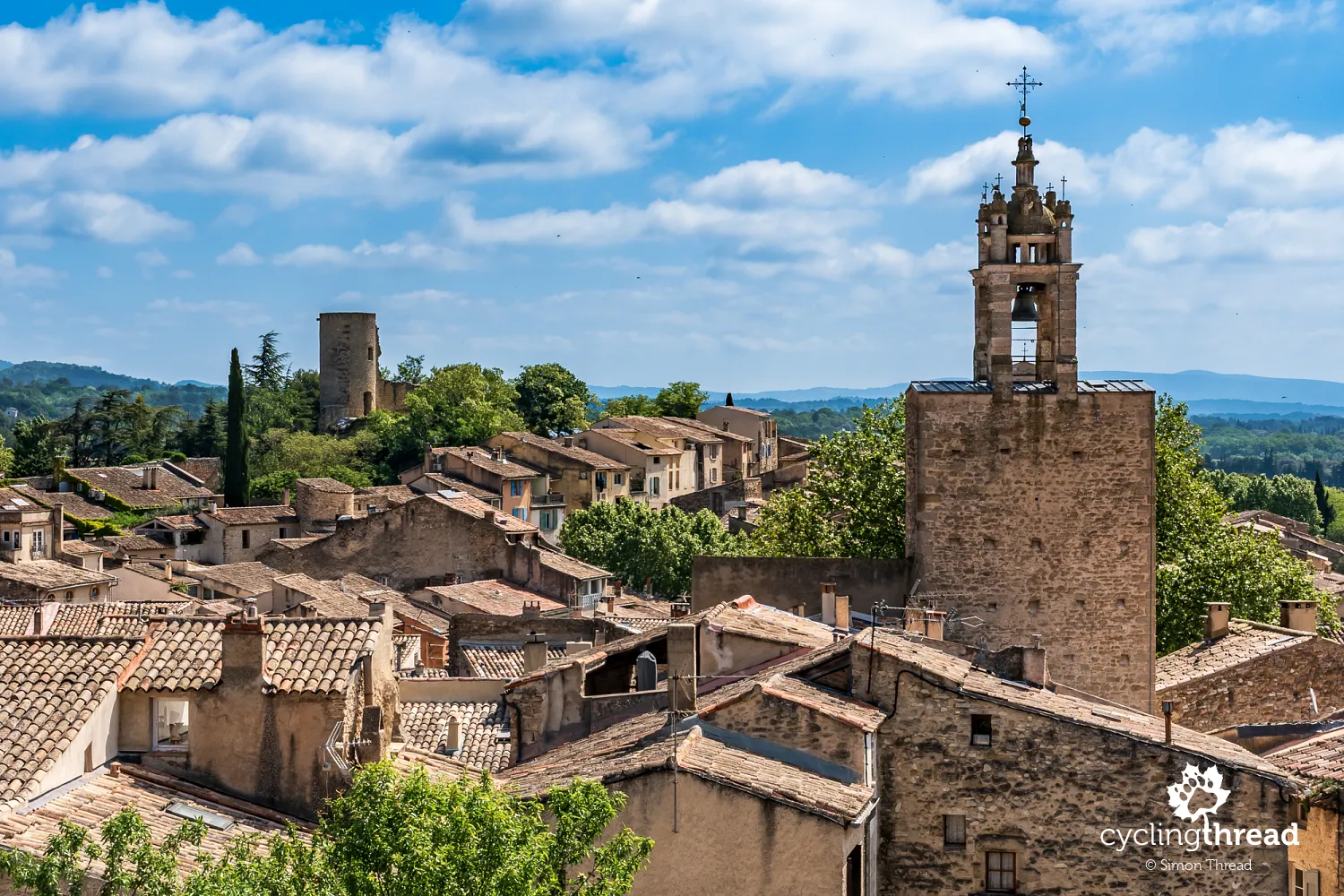
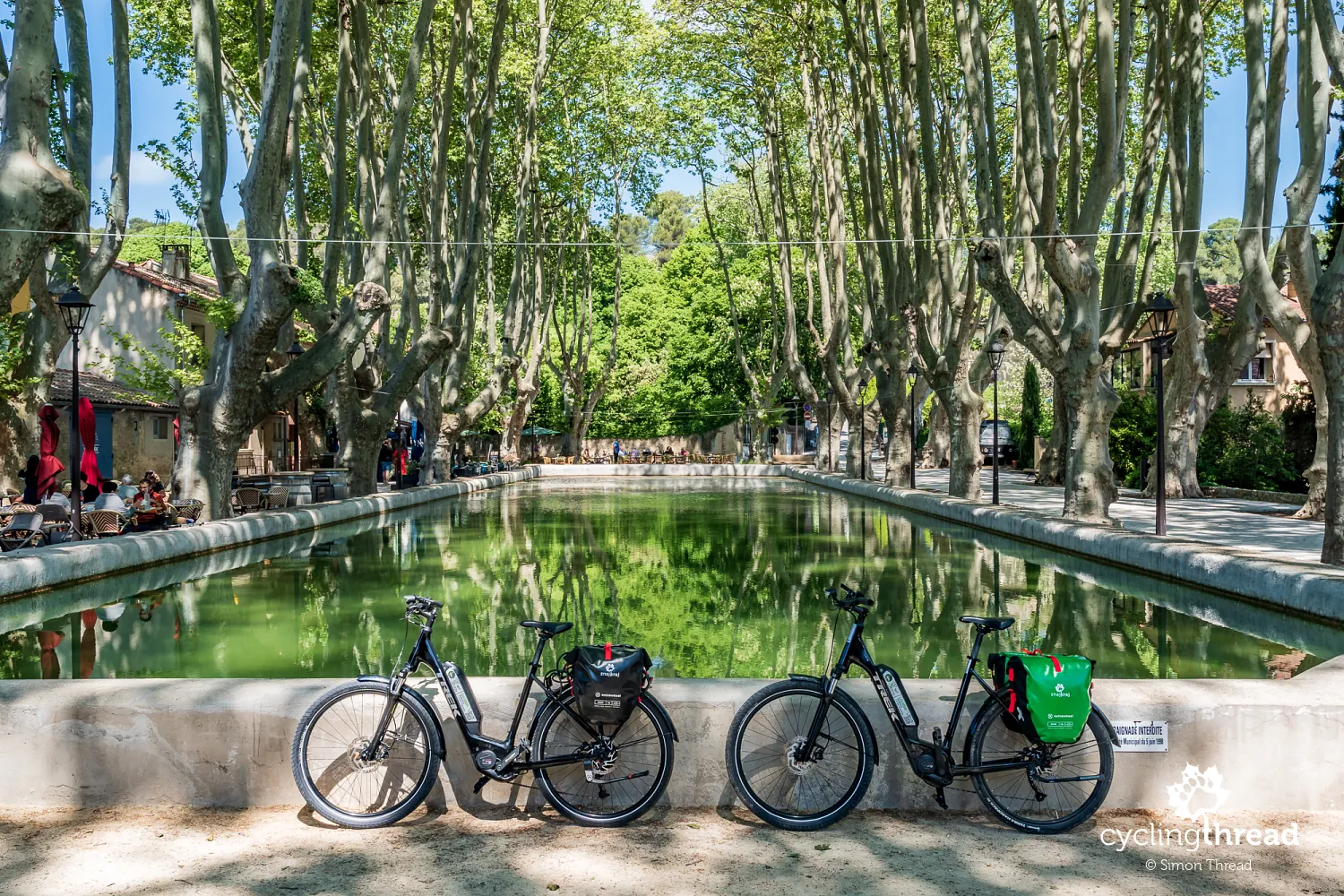
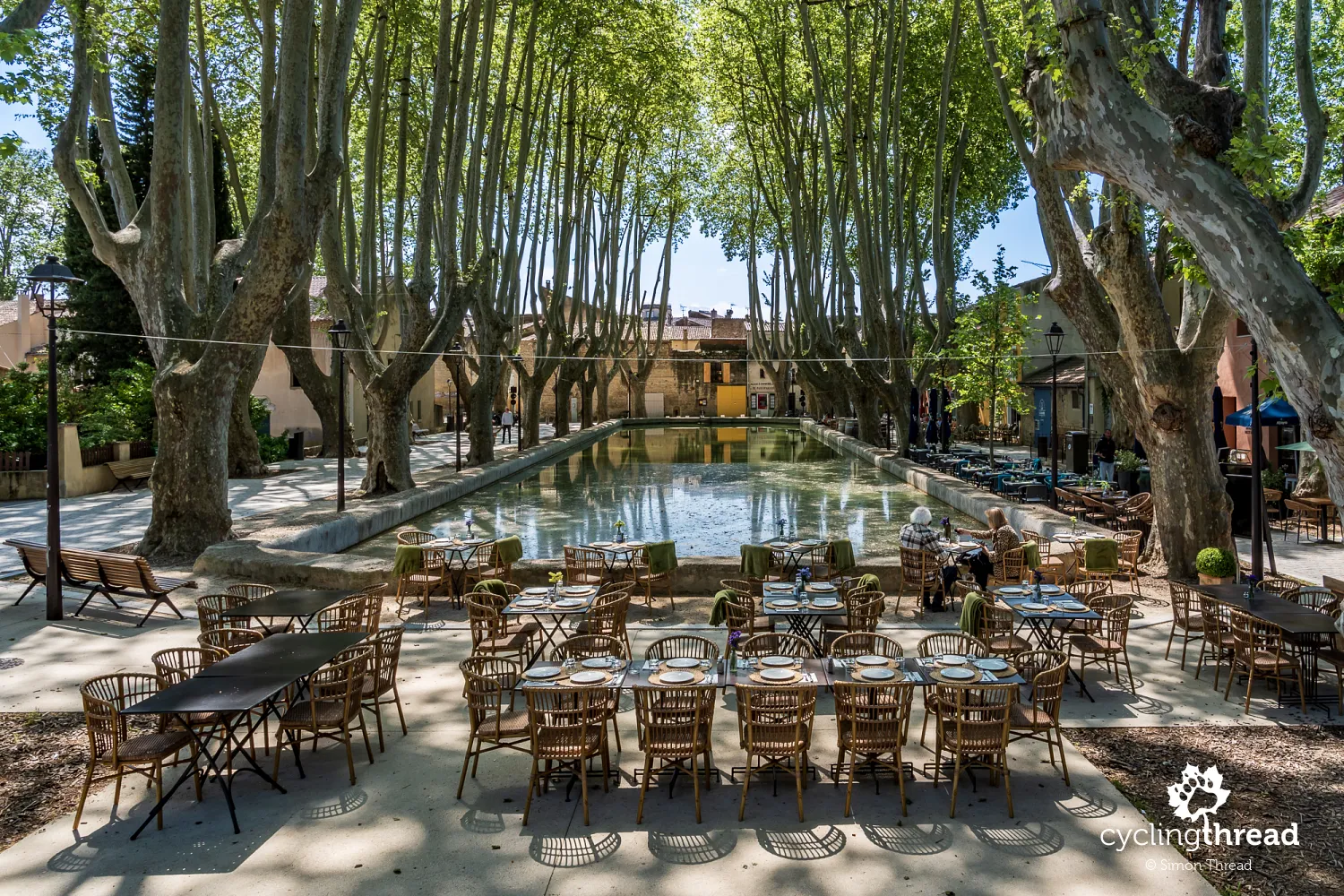
The most characteristic place in Cucuron is undoubtedly the large Bassin de l’Étang pond surrounded by rows of plane trees. In the past, it served as a fire reservoir and an important water source for local residents, while today it has become the natural social centre of the village. Restaurants and cafés line the water’s edge, filling with both locals and visitors in the evenings. It was here that several scenes from A Good Year by Ridley Scott, starring Russell Crowe, were filmed, helping Cucuron become better known outside France. And standing beside the water beneath the enormous plane trees, it was very easy to understand why this place had been chosen for a film showing the peaceful and romantic side of Provence.
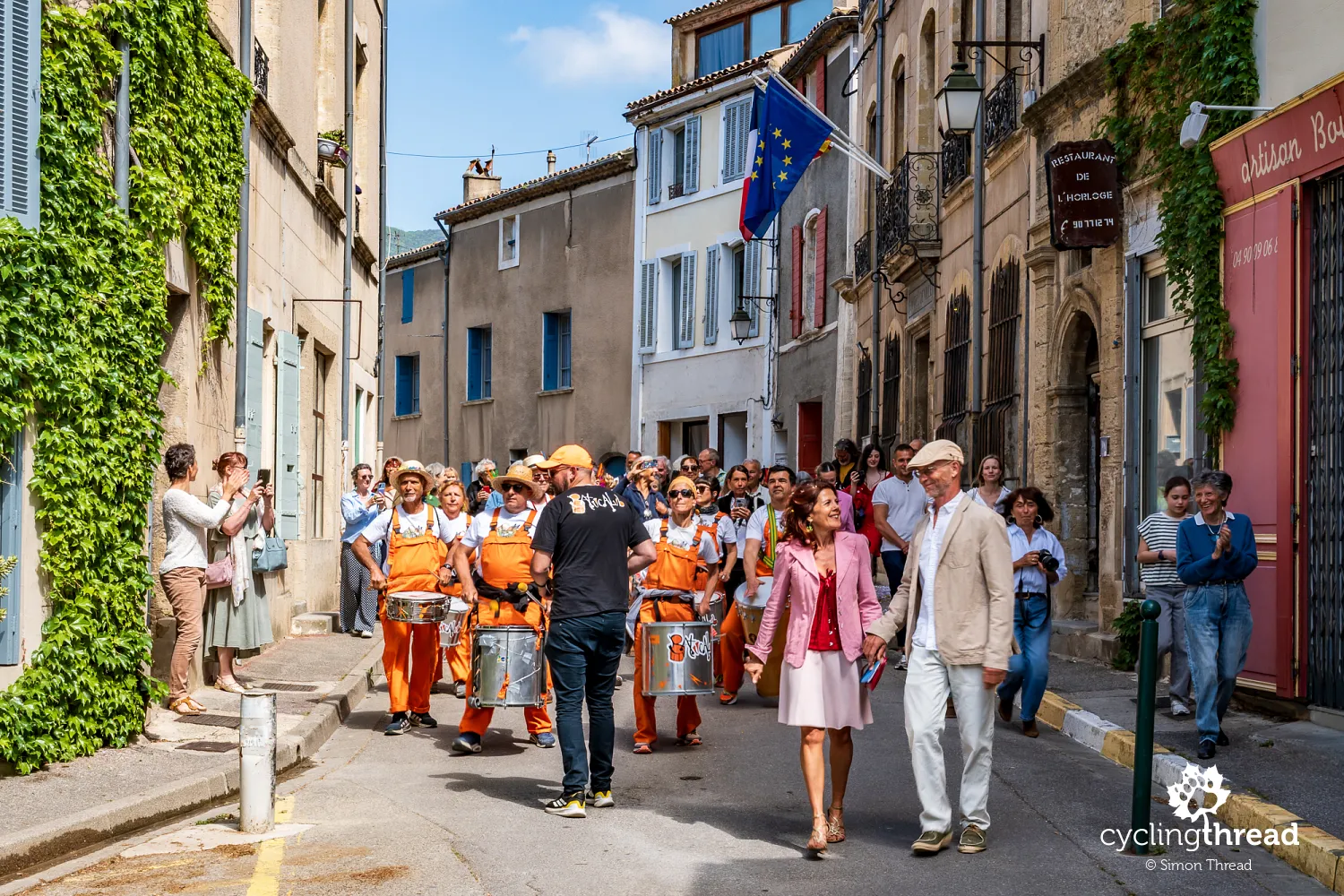
Before reaching the famous pond, we unexpectedly came across a wedding ceremony taking place inside the historic town hall. After it ended, the newlyweds, guests and a small orchestra marched through the old streets of Cucuron in a joyful procession full of music and smiles. Residents watched from windows and doorways, a few tourists stopped to take photographs, and the whole event felt wonderfully natural and local - more like a village celebration than a private ceremony. It was one of those travel moments impossible to plan and later impossible to forget. A beautiful moment - all the best to the newlyweds!
Many donkeys along our route
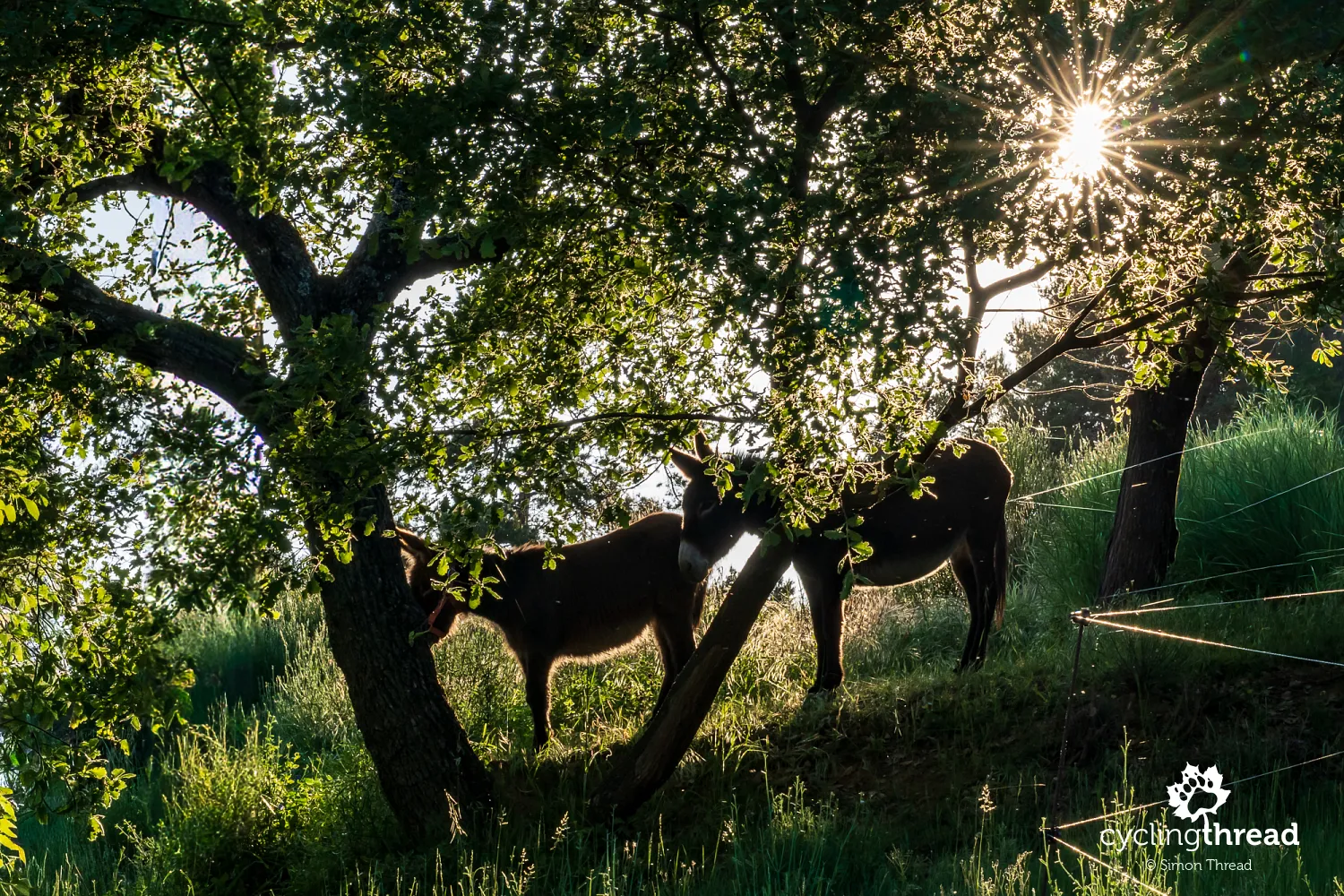
One surprisingly common sight during our journey around the Luberon massif were… donkeys. We often saw them on small pastures beside old stone farms, sometimes directly next to quiet local roads winding between vineyards and olive groves. In Provence, sturdy Provençal donkeys were once highly valued for transporting wood, olives and sacks of lavender across the steep hills of the region. Many used to carry characteristic wooden panniers and could move along narrow stone paths much more confidently than horses. Today, donkeys have become more of a peaceful symbol of rural Provence and one of those small details that remain in your memory long after a cycling trip through the Luberon has ended.
We spent the next several dozen kilometres cycling around the eastern side of the Luberon massif. We passed quite quickly through Manosque, stopping only for a short meal and to charge the e-bike batteries in a small bistro. Unfortunately, we arrived exactly during the afternoon rush hour, which noticeably reduced the comfort of cycling. Part of the reason was also that around the eastern side of the Luberon massif - within the Alpes-de-Haute-Provence department - the Around the Luberon cycle route follows busier roads than those we had experienced earlier and later in the Vaucluse department. The difference was visible almost immediately - more cars, more local traffic and much less of the calm atmosphere that had previously defined the Luberon for us.
Cycling EuroVelo 8 in Provence
One surprising thing near Manosque is the presence of the international EuroVelo 8 route running around the Mediterranean Sea through this part of Provence. What surprises most, of course, is how far the official route moves away from the sea itself. In reality, however, this decision makes perfect sense because it allows the route to follow much quieter roads, more interesting landscapes and some of the most characteristic towns and villages of inland Provence. Instead of the crowded coastline, EuroVelo 8 passes through the Luberon massif, its lavender fields and peaceful valleys. Thanks to this, the route in this part of France feels much more like a classic landscape touring route than a typical seaside cycle path following the coast.
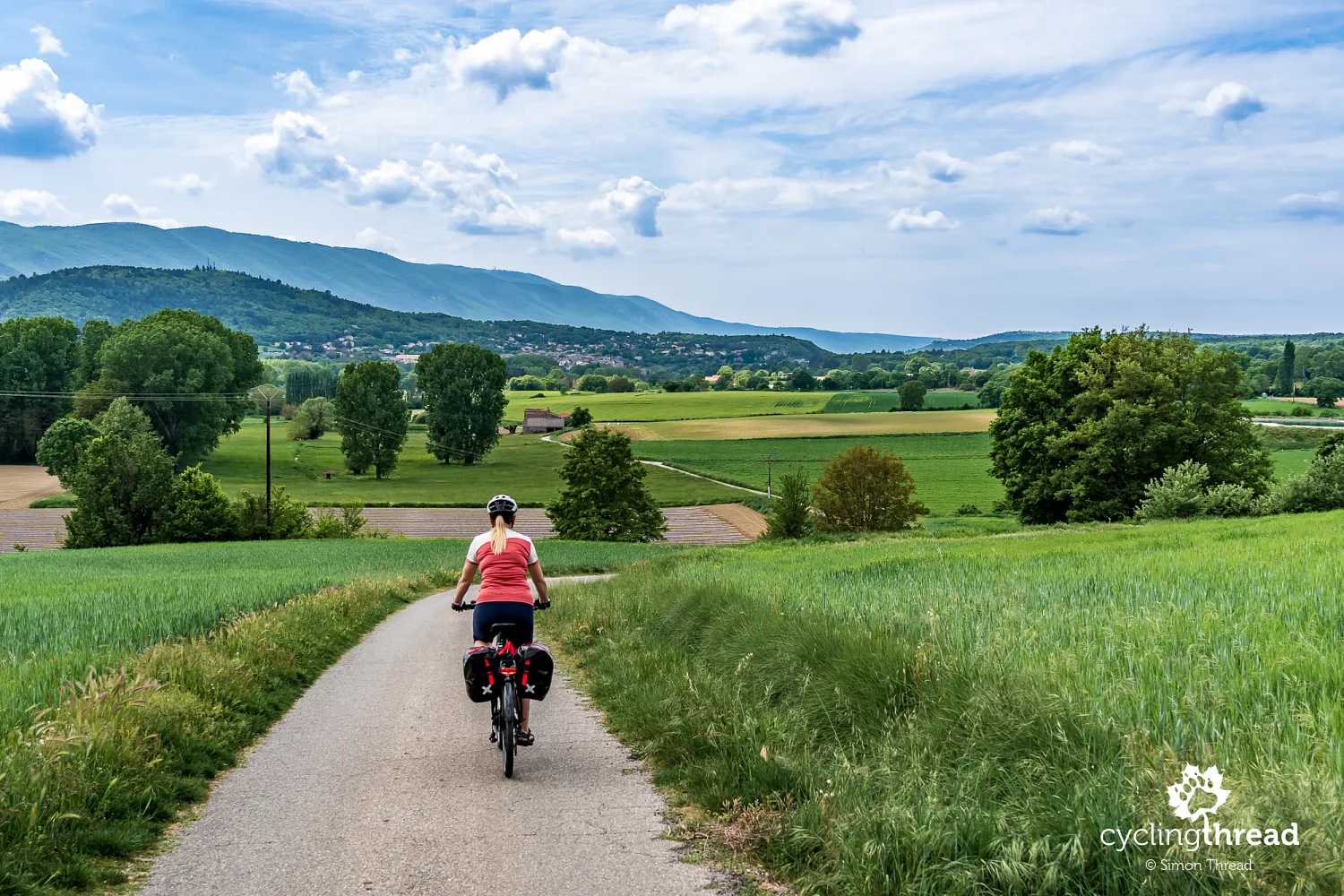
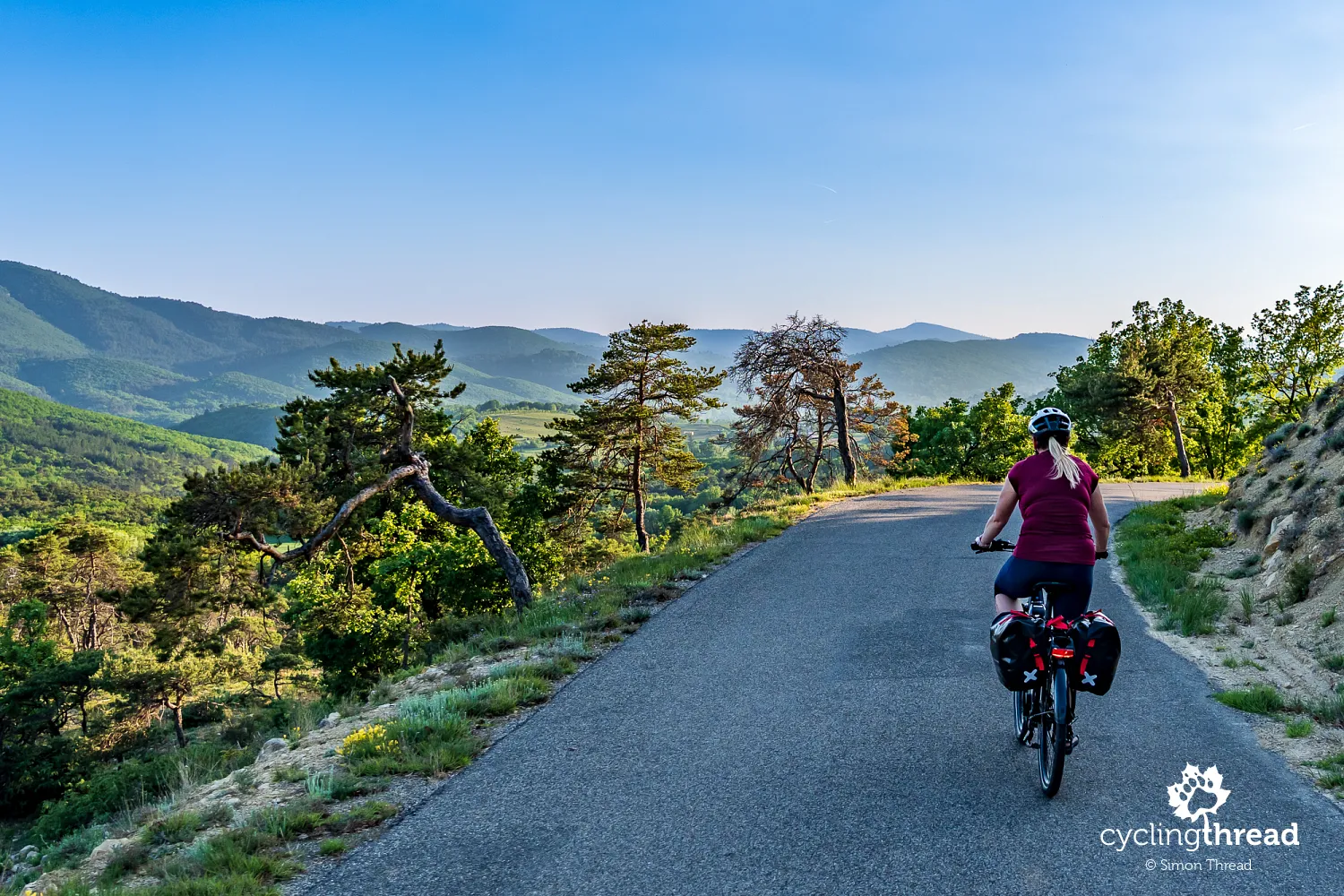
Fortunately, we quickly left the surroundings of Manosque behind, and the Around the Luberon cycle route led us onto one of its most beautiful sections. The road from Villeneuve to Forcalquier is a wonderfully open and noticeably more mountainous stretch, with many wide views towards the Luberon massif. Here the route crosses open hills, fields and small groves, constantly revealing new panoramas of southern Provence. And when the road is illuminated by the slowly setting sun, the landscape becomes truly exceptional - the limestone hills turn warm golden colours and the whole region feels even calmer than during the day.
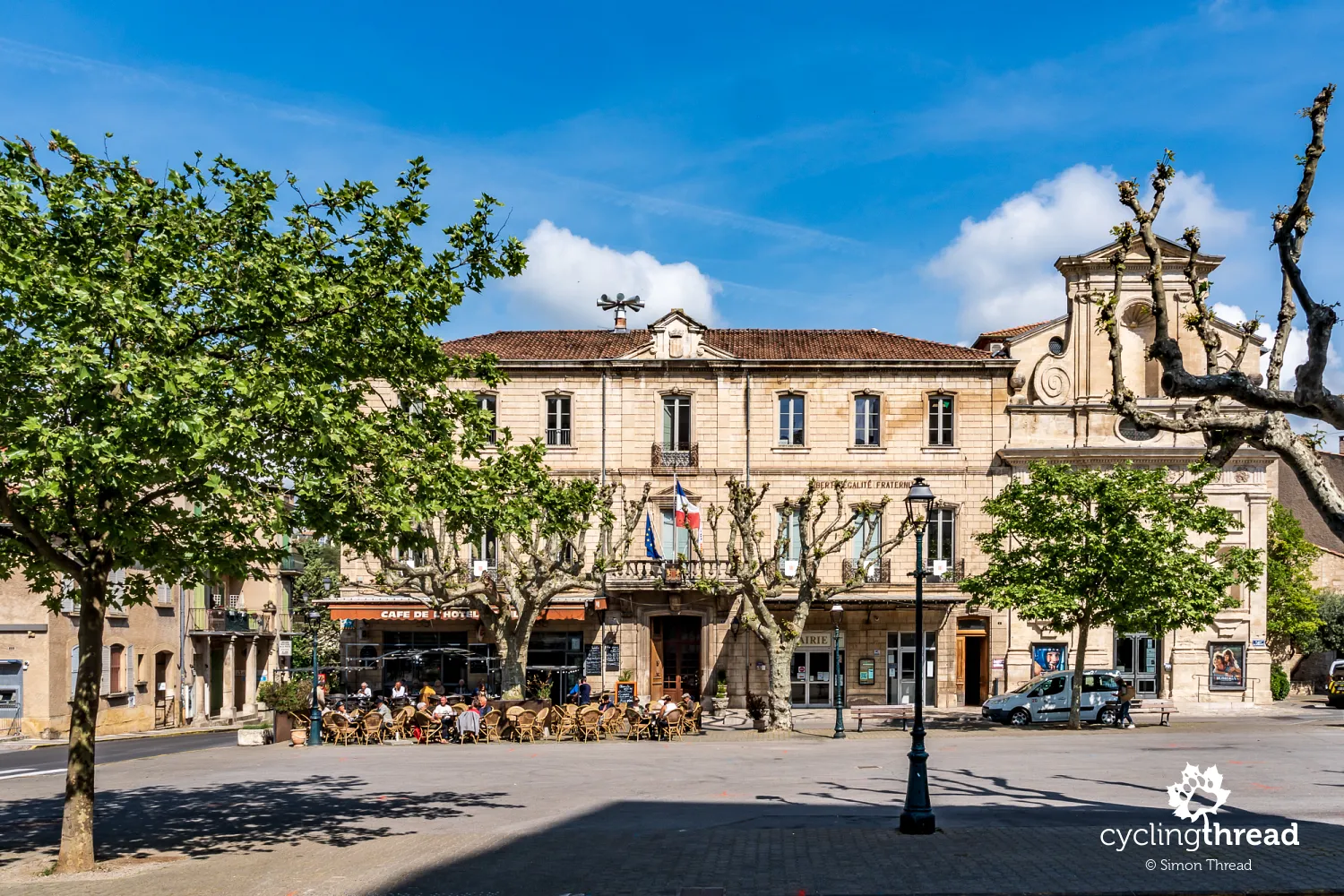
We ended the following day with an evening walk through Forcalquier, one of the most characteristic towns in the eastern part of the Luberon massif. Forcalquier feels noticeably more "mountainous" than many villages located closer to the southern slopes of the massif, and its historic centre spreads across a hillside filled with steep streets, stairways and narrow passages between stone houses. In the evening, life in the town concentrated around Place du Bourguet, the historic market square that has served as the commercial centre of Forcalquier for centuries. The square is surrounded by old merchant houses with arcades, restaurants and small shops on the ground floors, while one building especially draws attention - the Hôtel de Ville, originally a residence of wealthy local notables before later becoming the town hall. Its characteristic façade with a clock tower reflects the former prosperity of the town, which for centuries played an important role in the trade and administration of Haute-Provence.
Provence cares about cycle travellers...
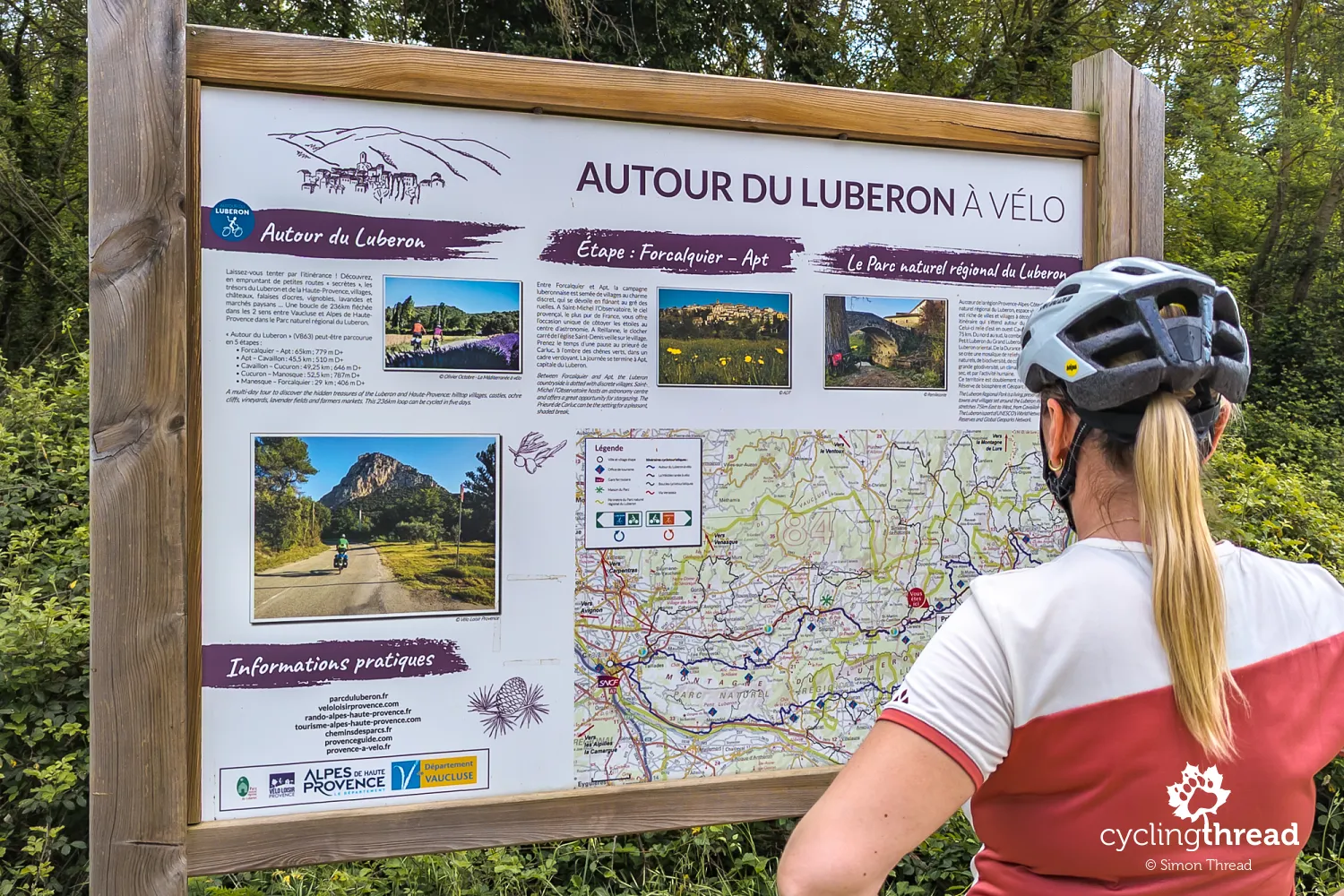
One of the more interesting historical places along the Around the Luberon cycle route is Prieuré de Carluc - a former priory located in a peaceful valley near Céreste. Fragments of the medieval monastery have survived here, together with rock-carved tombs and a characteristic stone chapel surrounded by Mediterranean vegetation. Right next to the ruins stands a large information board with a clear map of the area and descriptions of the region’s most important places. We encountered these well-designed and easy-to-read information points very often along the Around the Luberon route - near villages, monuments and viewpoints. It is clear that Provence genuinely thinks about cycle travellers, and good signage together with easy access to information always makes travelling through the region much easier.
... and protects the local architecture
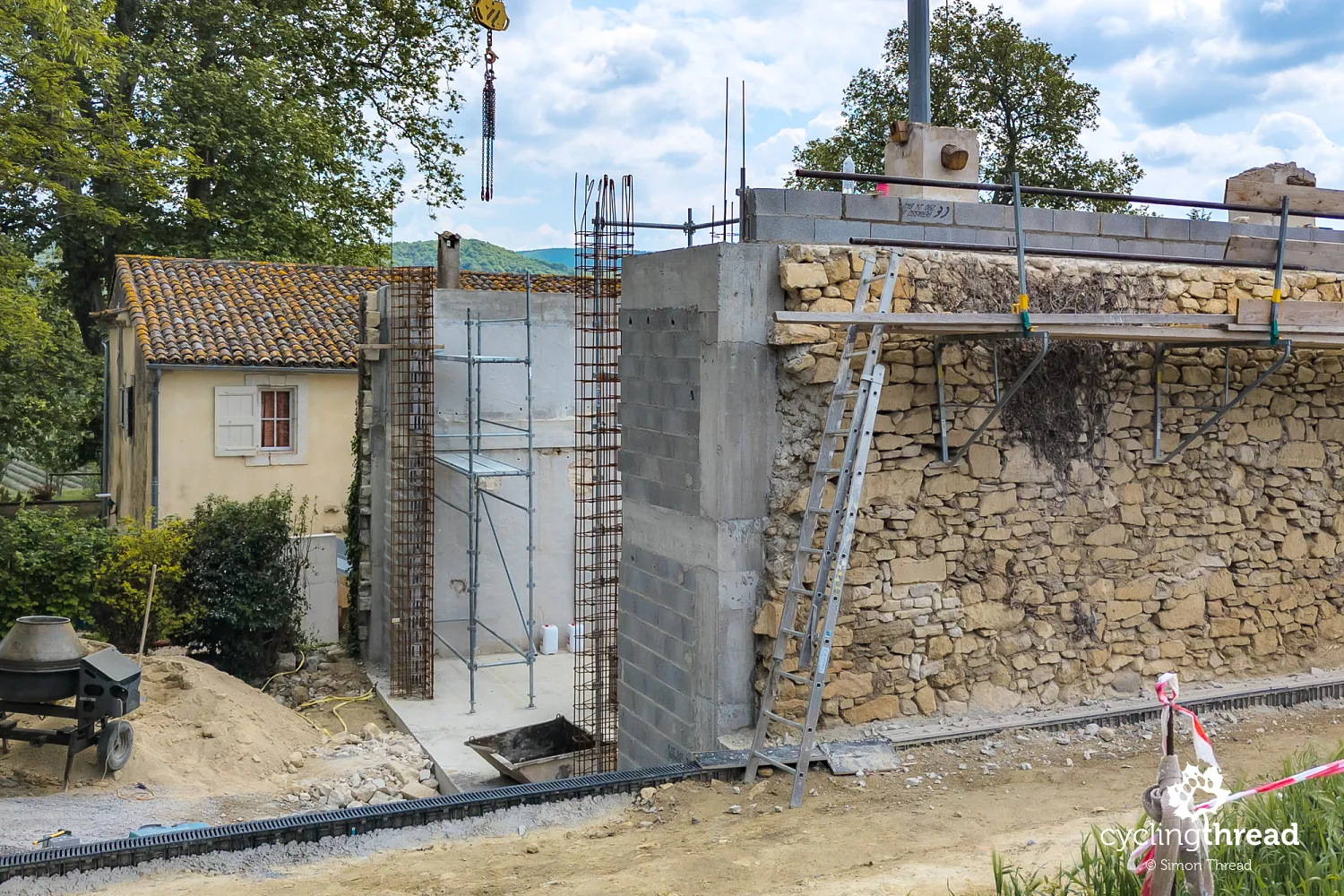
Somewhere near Céreste, we were reminded once again how consciously Provence protects the local architectural character of the region. Earlier we had already noticed that almost all houses and farm buildings here share the same traditional Provençal stone-built appearance. This time, however, we spotted a newly constructed farm building that beneath its natural stone façade actually concealed a modern structure made of concrete and contemporary building materials. It is a good example of how architecture works in the Luberon - modern technologies are fully used, but remain invisible because preserving the visual harmony of the landscape is considered most important. In many municipalities, detailed urban planning regulations define façade materials, roof tiles and even building proportions, while the Regional Natural Park of the Luberon also plays an important role in protecting the traditional character of the region.
The excellent former railway Véloroute du Calavon
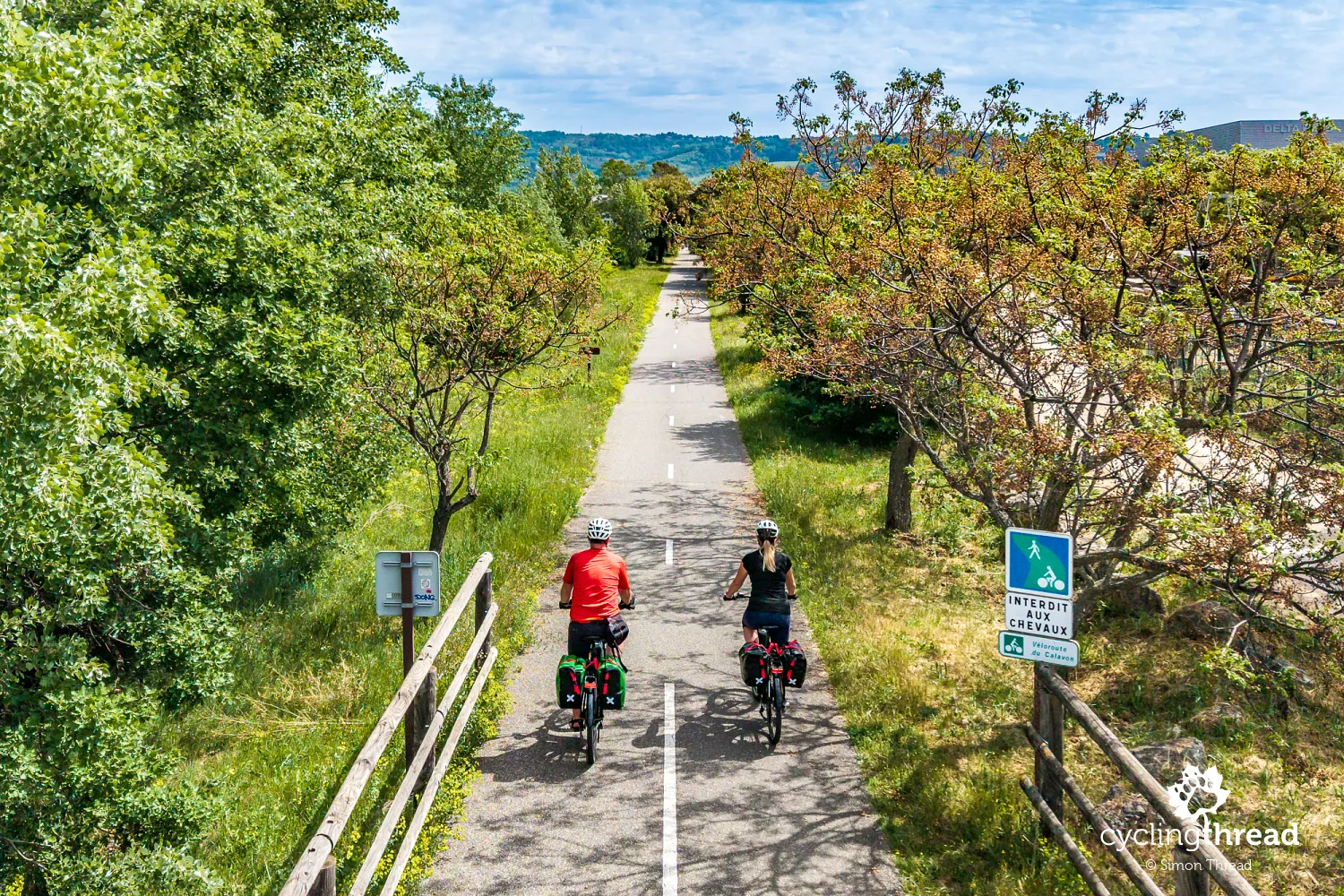
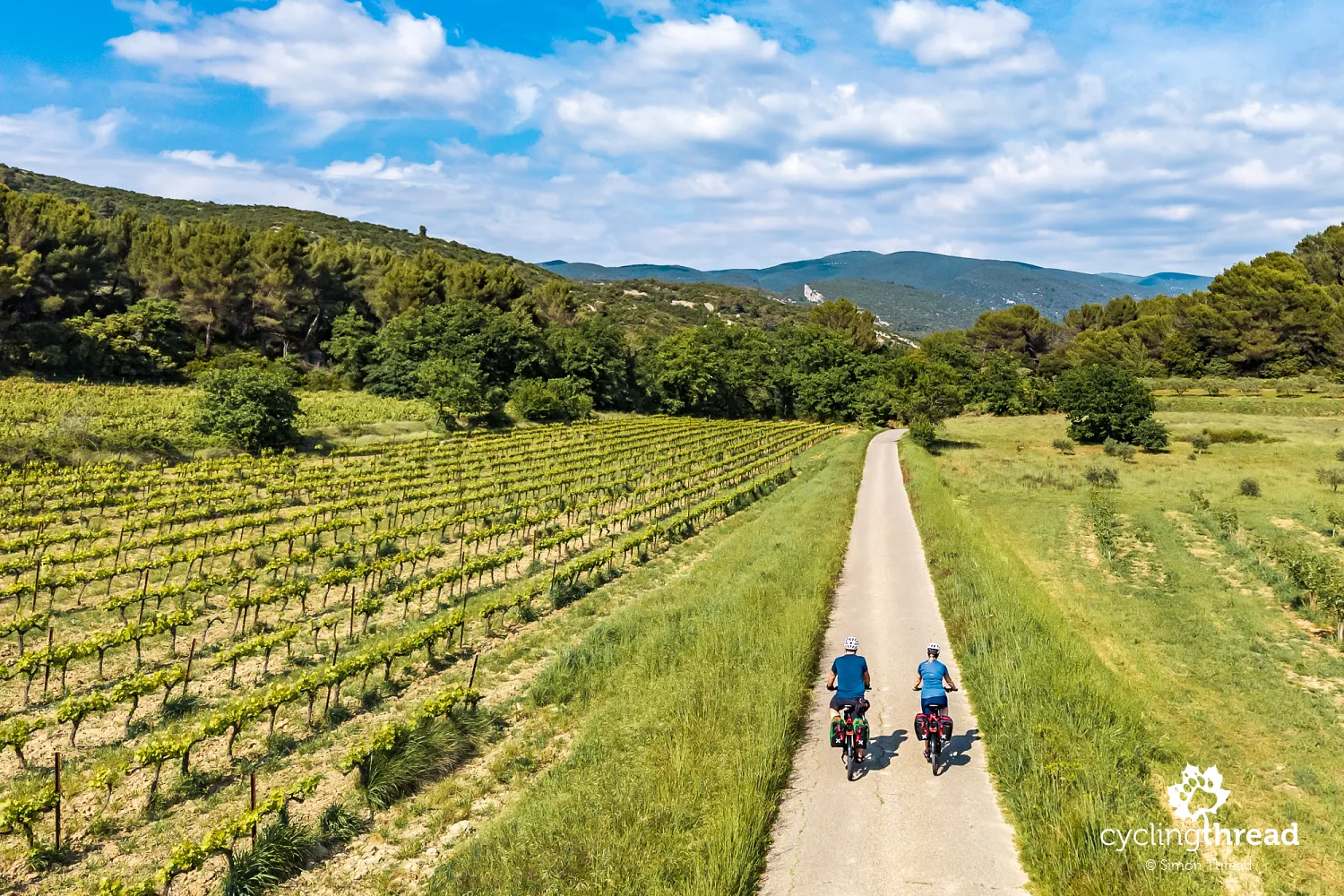
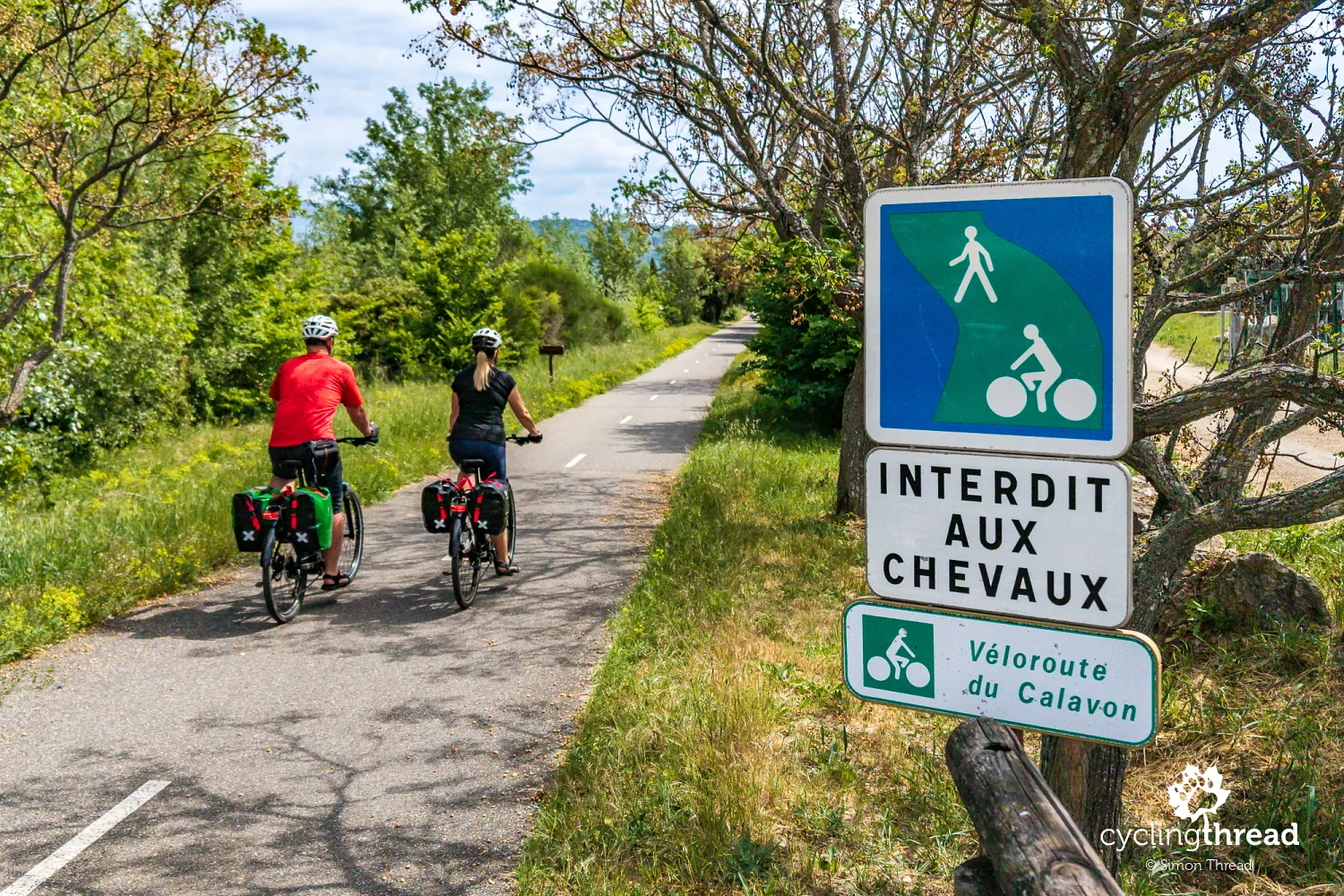
Our return towards the heart of the Luberon came with a perfect cycling highlight. Near Saint-Martin-de-Castillon, we joined the Véloroute du Calavon - a 43-kilometre cycle route built along a former railway line running through the Calavon valley all the way to Cavaillon. It is certainly the most comfortable and best-prepared cycling route in the entire region, and another example of cycling infrastructure worth travelling for. The path has a smooth asphalt surface, very gentle gradients and runs completely away from car traffic, making it a pleasant change after the hillier roads surrounding the Luberon massif. Remains of the old railway infrastructure are still visible in many places - along the route we passed former bridges, railway embankments and fragments of historic railway buildings.
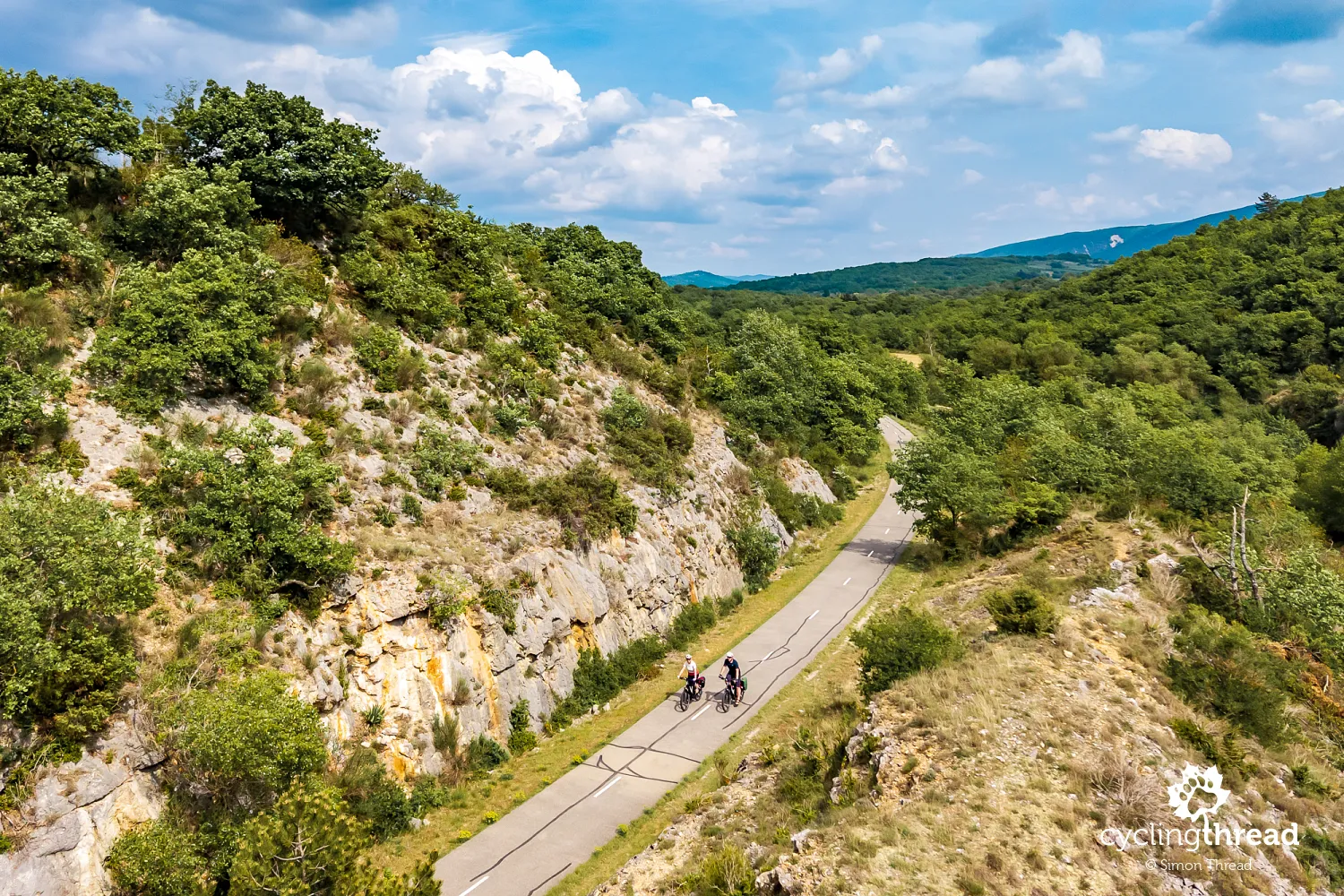
During our journey through the Luberon region, we used the former railway Véloroute du Calavon four times. Besides the section leading us towards Apt, the following day we cycled another - and actually the largest - part of the route between Robion and Apt, this time in the opposite direction. On top of that came the first and final kilometres of our trip in Cavaillon, where the Véloroute du Calavon reaches its western terminus. The most spectacular scenic section begins a few kilometres beyond Saint-Martin-de-Castillon, where the route passes through rocky gorges carved by the Calavon River. The most remarkable structure along the route is the ancient Pont Julien - a Roman bridge more than 2,000 years old, which we would cross the following day.
The capital of the Luberon region
The Véloroute du Calavon brought us directly into Apt, often described as the capital of the Luberon region. By the afternoon, the old town had already settled into a calm atmosphere, with restaurants and small shops selling Provençal products still open. Apt immediately feels larger and more urban than many of the tiny villages scattered around the Luberon massif. Since Roman times, it has been an important trading centre located along historic roads crossing the Calavon valley. Even today, the town preserves a more urban street layout, larger squares and numerous townhouses reflecting its former importance. Finding accommodation in Apt was also very easy - we chose the affordable Hotel L'Aptois, naturally belonging to the Accueil Vélo network.
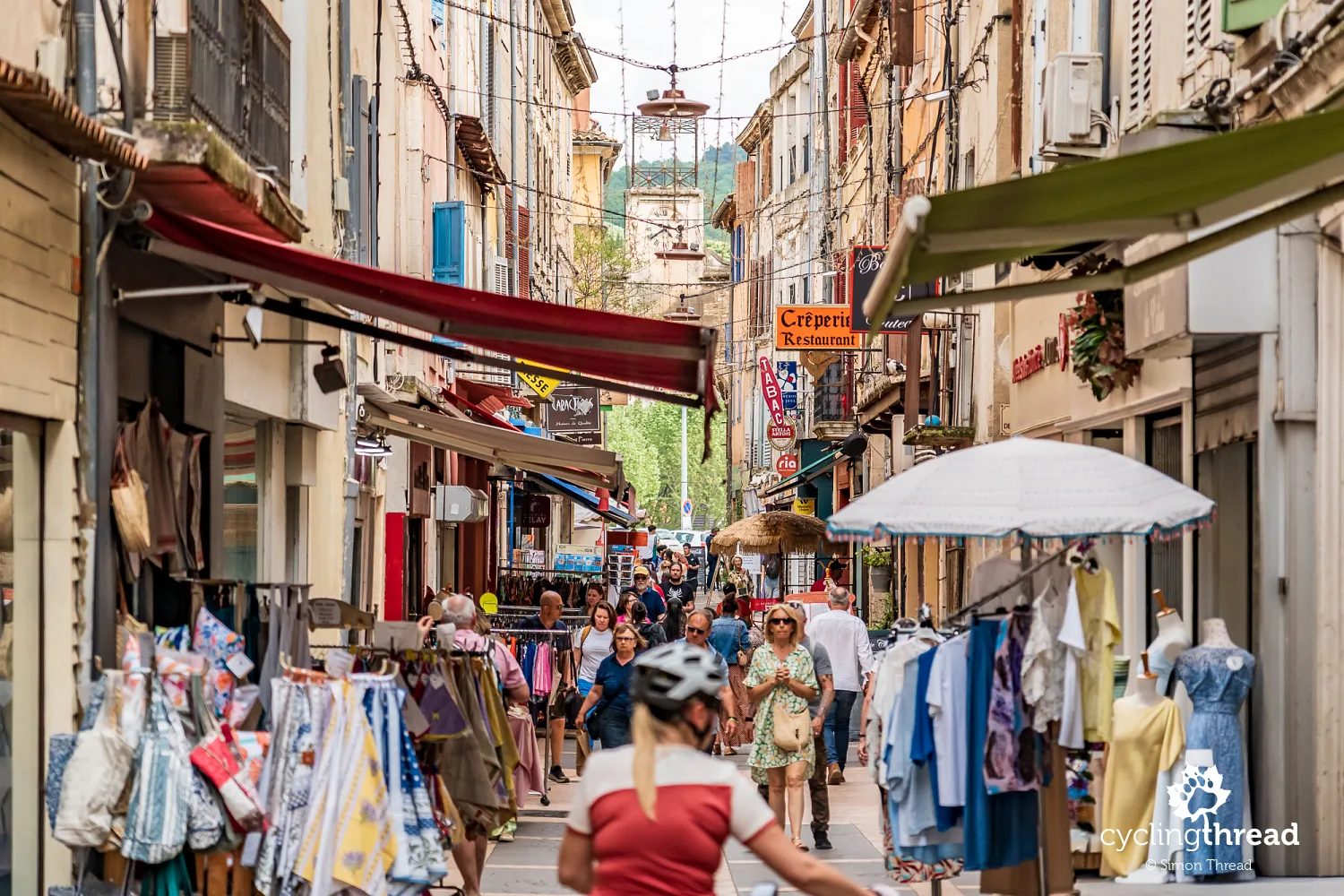
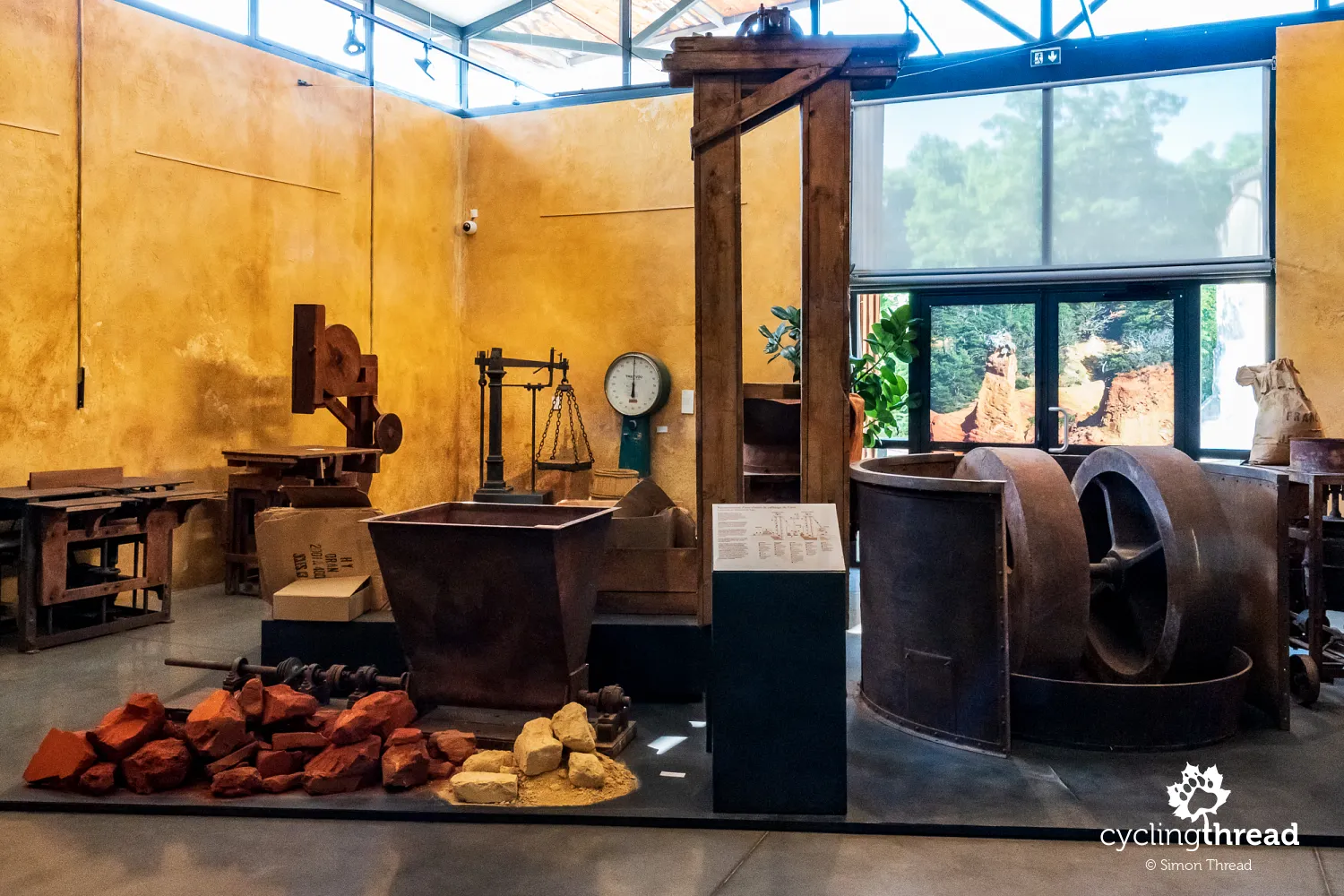
Apt is also famous for one of the best-known markets in all of Provence, organised here every Saturday morning for centuries. In many ways, the entire town developed historically around trade and commerce. The area around Apt was also an important centre of ochre extraction - a natural pigment responsible for the characteristic red, orange and yellow colours of the surrounding rocks and soil. Thanks to this, nearby Roussillon and the Calavon valley today offer some of the most distinctive landscapes in Provence. Apt is also home to Musée de l’Aventure Industrielle, where one exhibition explains the history of ochre mining and its importance for the region, while another focuses on the production of candied fruits, for which Apt has been famous throughout France for several centuries.
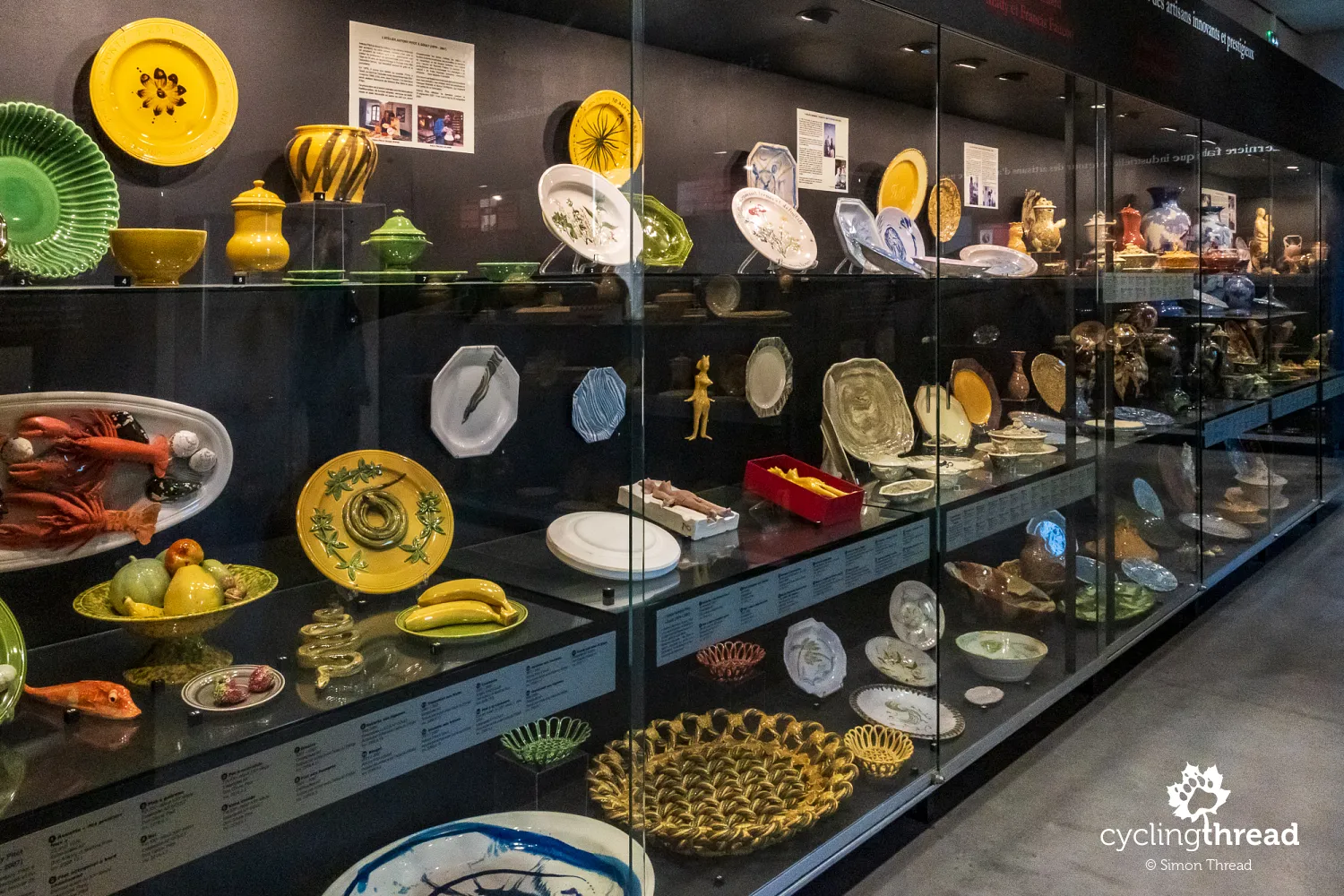
Apt is also the headquarters of the Regional Natural Park of the Luberon, which covers much of the massif and the surrounding villages. The park has long been responsible for protecting the landscape, traditional architecture and local heritage of the region. The town is also home to Maison du Parc du Luberon - an information centre with a small exhibition dedicated to the nature, geology and history of the Luberon. Thanks to this, Apt serves not only as the largest town in the region, but also as its administrative and tourism centre. We visited all of these places and exhibitions before setting off again the following morning.
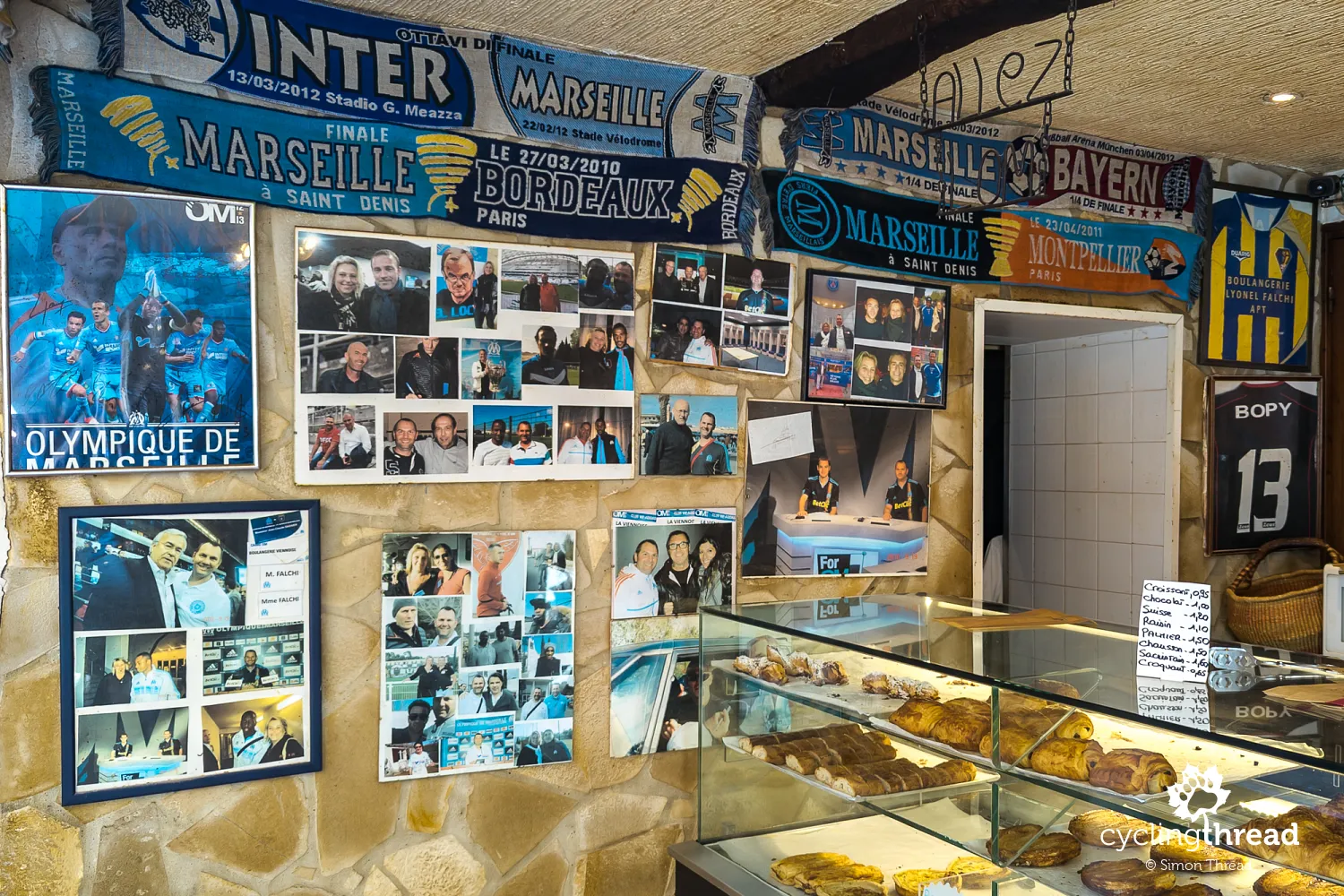
While walking through the old town of Apt, we stepped into a small bakery where my football-loving green-and-white heart immediately felt at home. One entire wall was dedicated to Olympique de Marseille, with blue-and-white scarves, shirts, photographs with players, pictures from Stade Vélodrome and countless club souvenirs covering almost every bit of space above the counter filled with croissants and tarts. The owners turned out to be passionate supporters of the Marseille club, and the collection looked more like a small OM museum than decoration inside an ordinary bakery. It was also a reminder of how strongly the region feels connected to the great club from Marseille, even though the lively Mediterranean city itself lies almost one hundred kilometres away.
A cycling route through the vineyards
On the way towards Bonnieux - beginning with probably the hardest climb of the entire route - we pass several vineyards that at this time of year still lack their full spectacular appearance. One of them is Château des Tourettes, an estate owned since 1997 by Maine and Jean-Marie Guffens-Heynen, a Belgian winemaking couple previously known mainly for their work in Burgundy. The vineyards here lie at around 420 metres above sea level, which creates quite unusual growing conditions in the hot climate of Provence - cooler nights and slower grape ripening. After taking over the estate, the owners almost completely redesigned the vineyards, replanting some of the old vines and replacing others entirely. They also chose grape varieties uncommon for the region, which is why their wines are now sold under the broader "Vin de France" label instead of the local Luberon appellation.
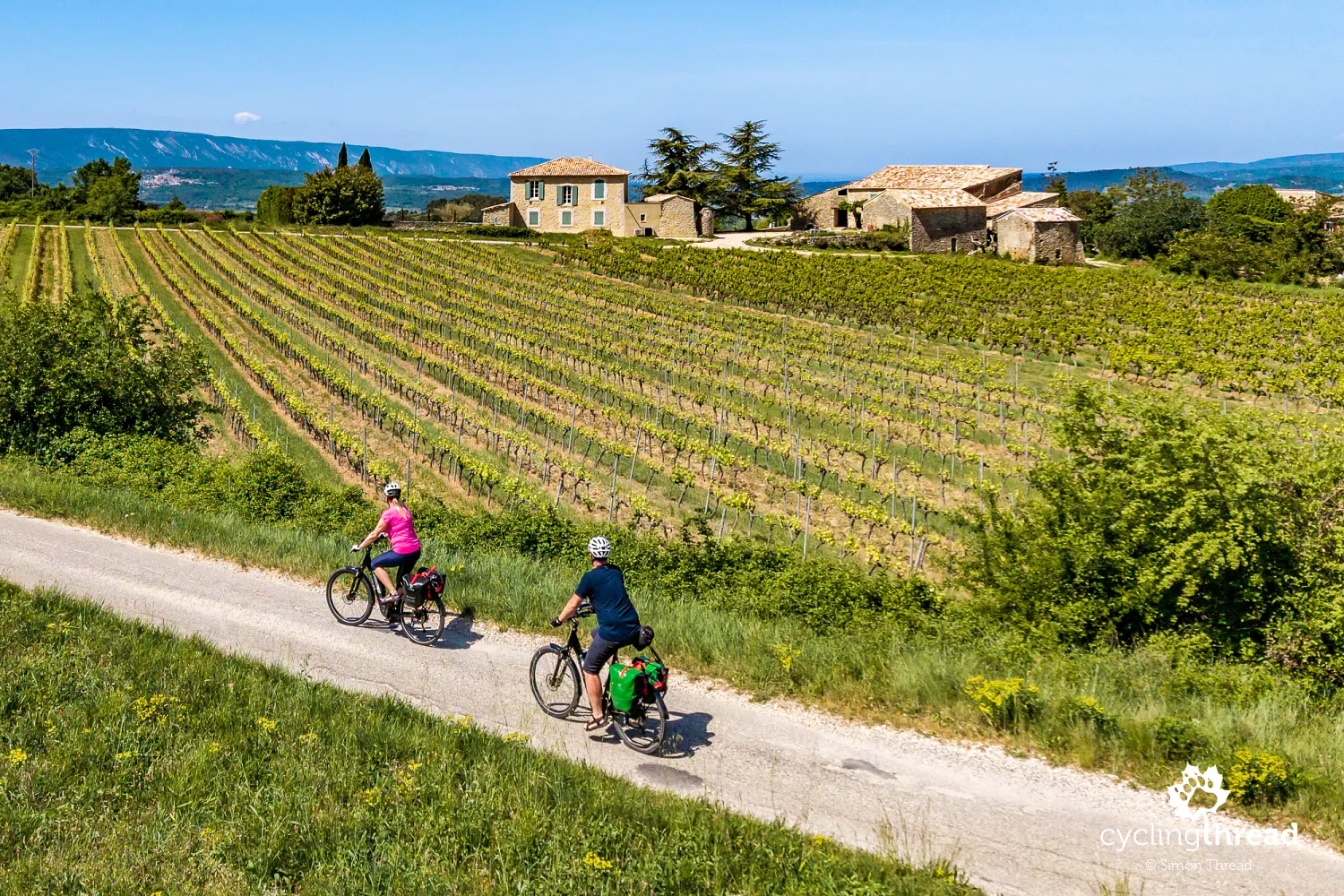
Wines from the Luberon region have their own distinct character, clearly different from many other wines of southern France. Vineyards here are located higher than in much of Provence - often between 300 and 500 metres above sea level - allowing grapes to mature in slightly cooler conditions. As a result, the wines usually feel fresher and lighter than many of the heavier red wines produced in hotter parts of the south. The region mainly produces red and rosé wines from varieties such as syrah, grenache and mourvèdre, although white wines from the Luberon are becoming increasingly popular as well. Many small family-run vineyards operate here as part of everyday local life - while cycling, you constantly pass tiny domaines, farms and roadside wine shops hidden among hills and lavender fields.
Bonnieux - a pearl of the Luberon
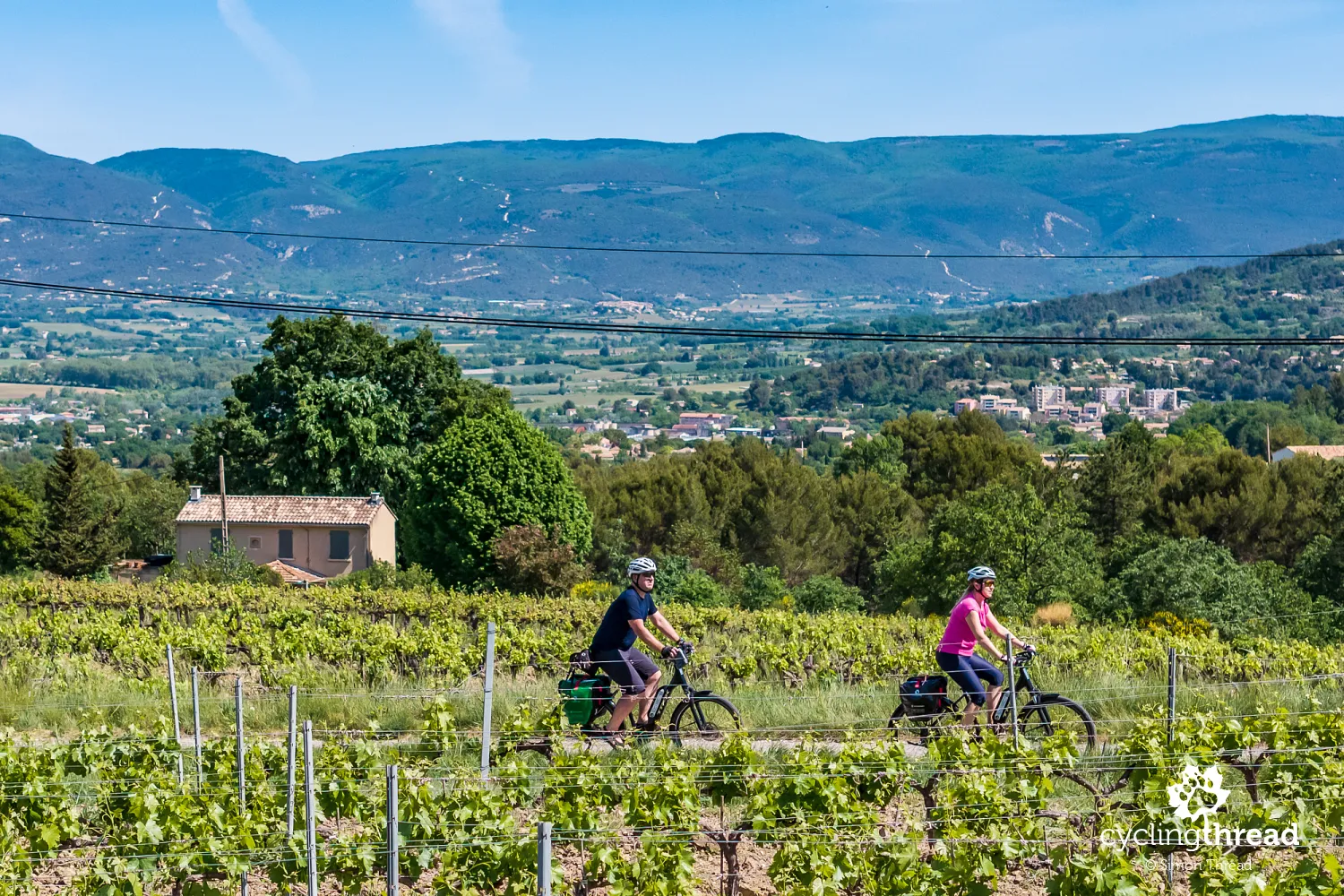
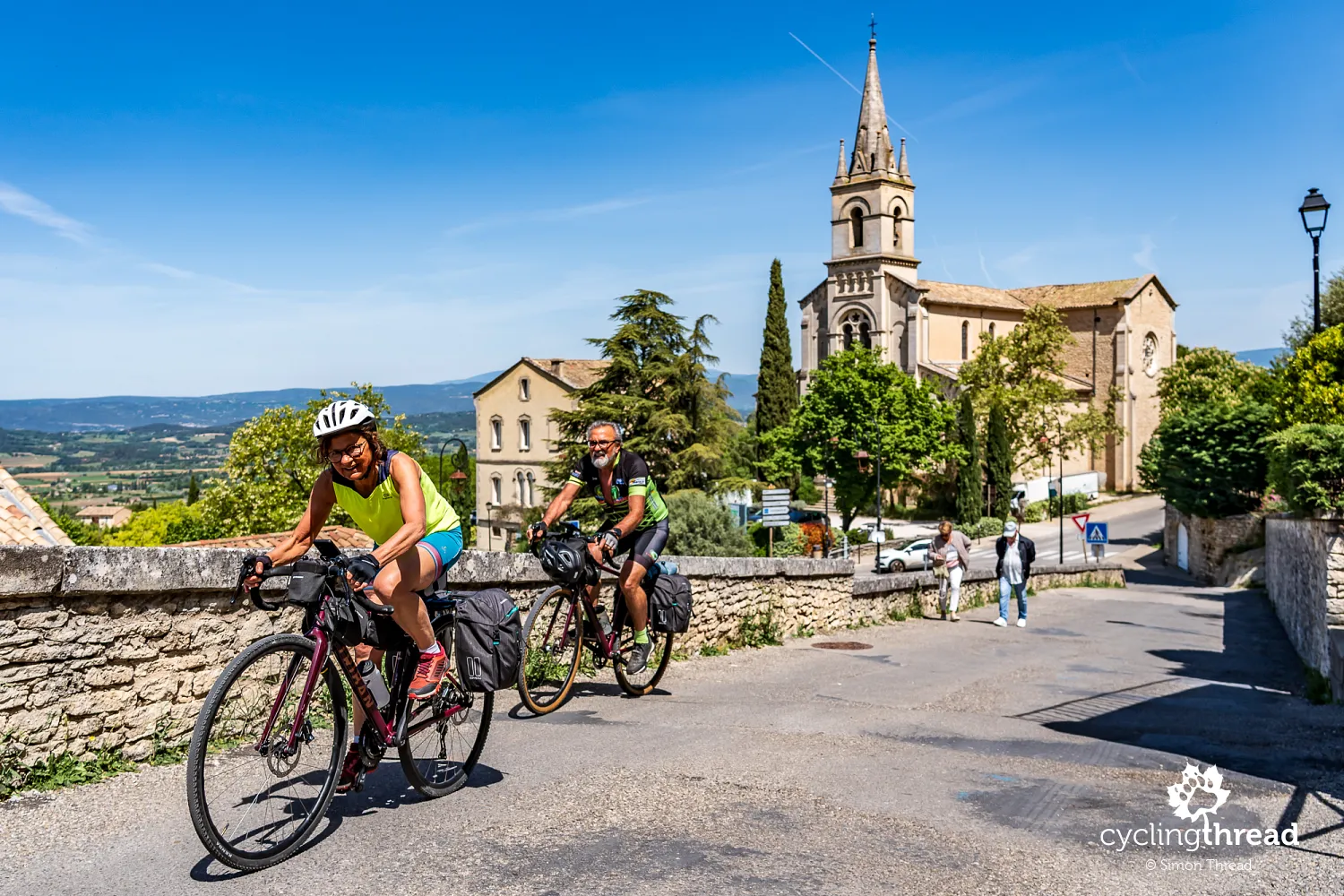
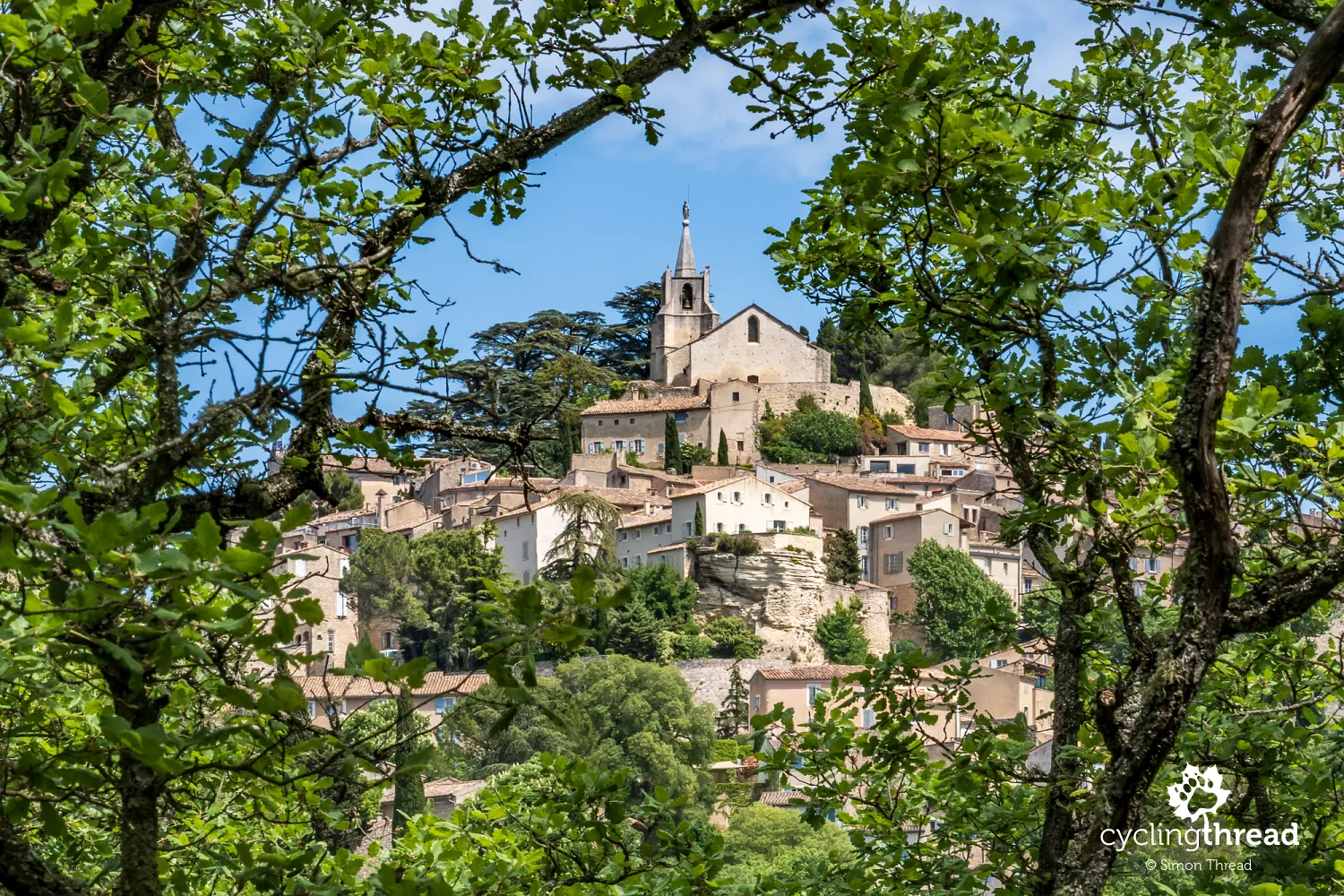
Following a scenic stretch of quiet local road, we finally reached Bonnieux, one of these most characteristic stone villages in the Luberon. Here, at two cafés located at the end of a short but steep climb near the lower church, we met no fewer than four other cycling couples. What immediately caught my attention was that out of all of us, only we were using electric assistance - everyone else was exploring the Luberon on traditional "analogue" bicycles. Sitting with a good coffee, we read more about Bonnieux, which today we would probably describe without hesitation as the most beautiful and most spectacularly located town in the entire Luberon. Because although Gordes offers that one famous postcard view from its easily accessible viewpoint, where visitors admire stone houses climbing the hillside, the old town itself felt to us slightly more modest. Bonnieux, meanwhile, impressed us in almost every possible way - with its layered streets traversing the slope, its everyday life unfolding across several levels and, finally, its wide panorama with Mont Ventoux rising in the background.
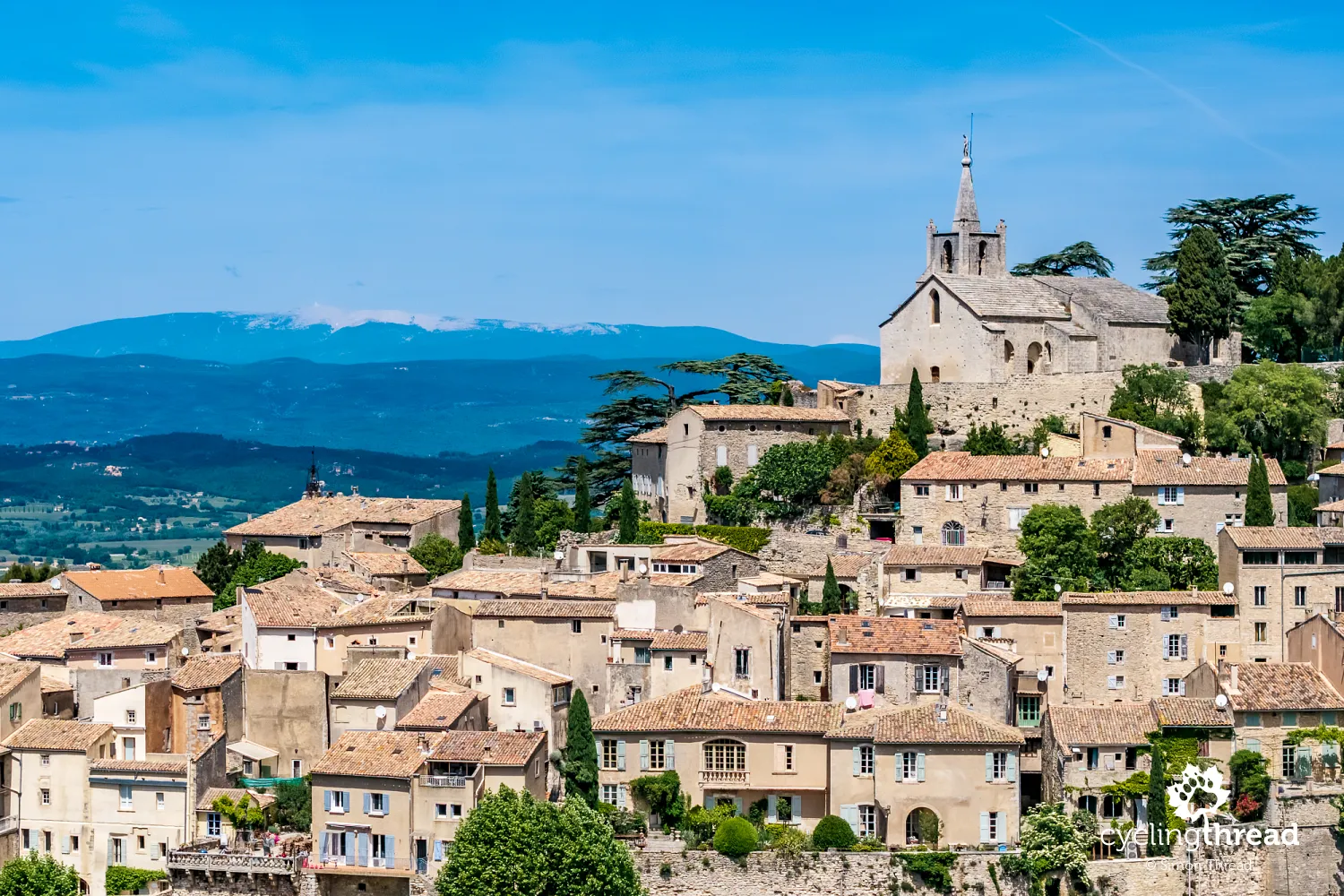
The history of Bonnieux dates back to Roman times, something clearly reflected by nearby Pont Julien - a remarkably well-preserved stone bridge from the 1st century BC that we visited a few hours later. The bridge was built along the ancient Via Domitia, one of the most important Roman roads crossing southern France from Italy towards the Iberian Peninsula. Bonnieux itself began developing high on the hillside already in the early Middle Ages, and its layout still perfectly illustrates the traditional structure of fortified Provençal settlements. The oldest part of the village clusters around the Vieille Église, a 12th-century church dominating the town from above, reached by steep stairways and narrow streets winding between stone houses. For several centuries, Bonnieux belonged to the Papal States and remained one of the papal enclaves in this part of Provence.
Today, Bonnieux is considered one of the most picturesque towns in the entire Luberon, although its surroundings also hide a less obvious story. Above the village stretches a cedar forest that appeared only in the 19th century, when cedar trees were brought here from the Algerian Atlas Mountains. The trees were planted mainly to reduce erosion of the limestone hills and help restore landscapes damaged by intensive deforestation. Over time, the cedars adapted perfectly to the dry Provençal climate and today form one of the most characteristic landscapes of the Luberon. The forest can easily be reached from Bonnieux by bicycle using quiet local roads running high above the surrounding valleys.
A visit to Rent Bike Luberon
In Bonnieux, we also visited our bike rental company, which makes this a good moment to mention how the bicycles from Rent Bike Luberon performed in practice. We rode Trek Allant+ 5 e-bikes - comfortable, stable and well suited to the varied terrain of the region. The 545 Wh batteries also performed very well. In the hilly landscapes of the Luberon, with regular climbs and using mainly Eco and Tour modes, it was possible to achieve around 80-90 kilometres of range with a rider weight of approximately 80 kilograms including luggage. With a higher total load - including panniers and full touring equipment - the realistic range in these modes was around 70 kilometres. That is why, during our longest day from Cucuron to Forcalquier, ending with a long climb, we had to recharge the battery for a while in Manosque. For a multi-day cycling trip with luggage, this setup worked really well.
The turbulent history of beautiful Lacoste
On the opposite hillside lies the slightly lesser-known Lacoste. The immediate association with the famous clothing brand turns out to be misleading, although the village itself certainly has no reason to feel overshadowed by the crocodile logo. The history of this small Provençal settlement is filled with so many extraordinary people and events that it is rather the brand that could envy the heritage of its older namesake. For centuries, Lacoste developed around the powerful château overlooking the Luberon valley, whose origins date back to the Middle Ages. Its most famous resident was Donatien Alphonse François de Sade - the infamous Marquis de Sade, an 18th-century aristocrat, writer and one of the most controversial figures in French history. It was from his surname that the later term "sadism" originated, referring to the sexual violence and domination present in his writings.
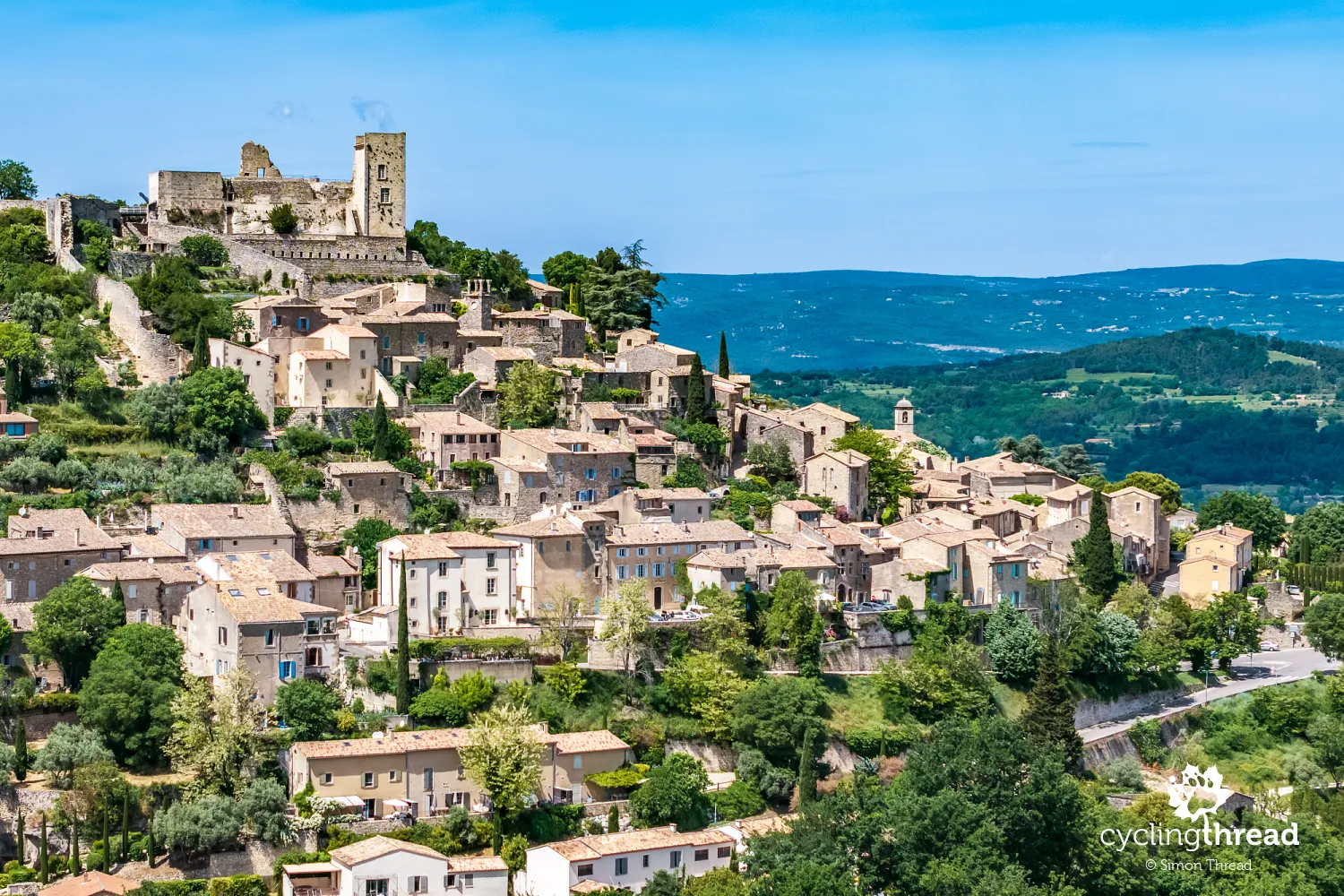
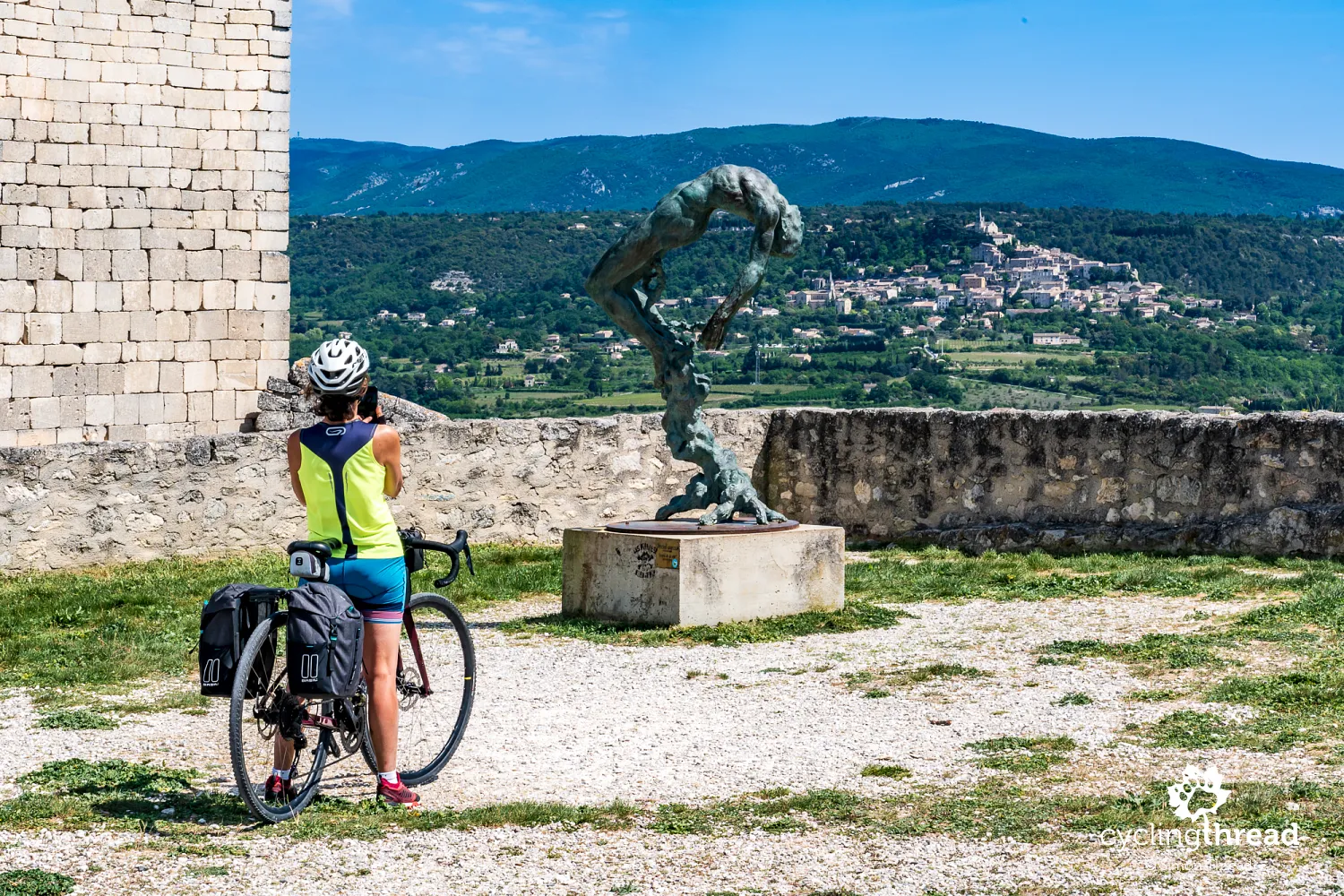
After the French Revolution, the château in Lacoste gradually fell into ruin, but at the end of the 20th century it gained a completely new life thanks to Pierre Cardin. Over many years, the famous designer purchased - despite protests from many local residents - successive parts of the fortress, along with around forty buildings in the village itself, hoping to transform Lacoste into a centre for art and cultural events. It was his initiative that led to the creation of theatre, music and arts festivals, which quickly became one of the defining features of modern-day Lacoste. Cardin died shortly after the first editions of some of the new festivals held within the restored spaces of the village. Today, the château still hosts major artistic events, while several large sculptures displayed on its grounds make the entire complex feel like an open-air modern art gallery suspended high above the Luberon valley with views towards neighbouring Bonnieux.
Ménerbes - another amazing village
The next stop along our route was Ménerbes, stretching across a long rocky ridge above the valley and considered for centuries one of the most picturesque villages in this part of Provence. Seen from a distance, it is said to resemble a stone ship floating above a sea of vineyards and cypress trees - at least according to Nostradamus, who himself came from Provence. The history of Ménerbes dates back to Roman times, although the village became most important during the Middle Ages as a fortified settlement protected by a citadel and defensive walls, fragments of which still survive today. In the 20th century, Ménerbes attracted numerous artists and cultural figures. Among those connected with the village were Dora Maar, Pablo Picasso and Nicolas de Staël, while British writer Peter Mayle made the village famous worldwide with his book A Year in Provence. One of the most interesting monuments nearby is Abbaye Saint-Hilaire, a former 13th-century Carmelite monastery partly carved into the rock and hidden among olive terraces and limestone hills of the Luberon.
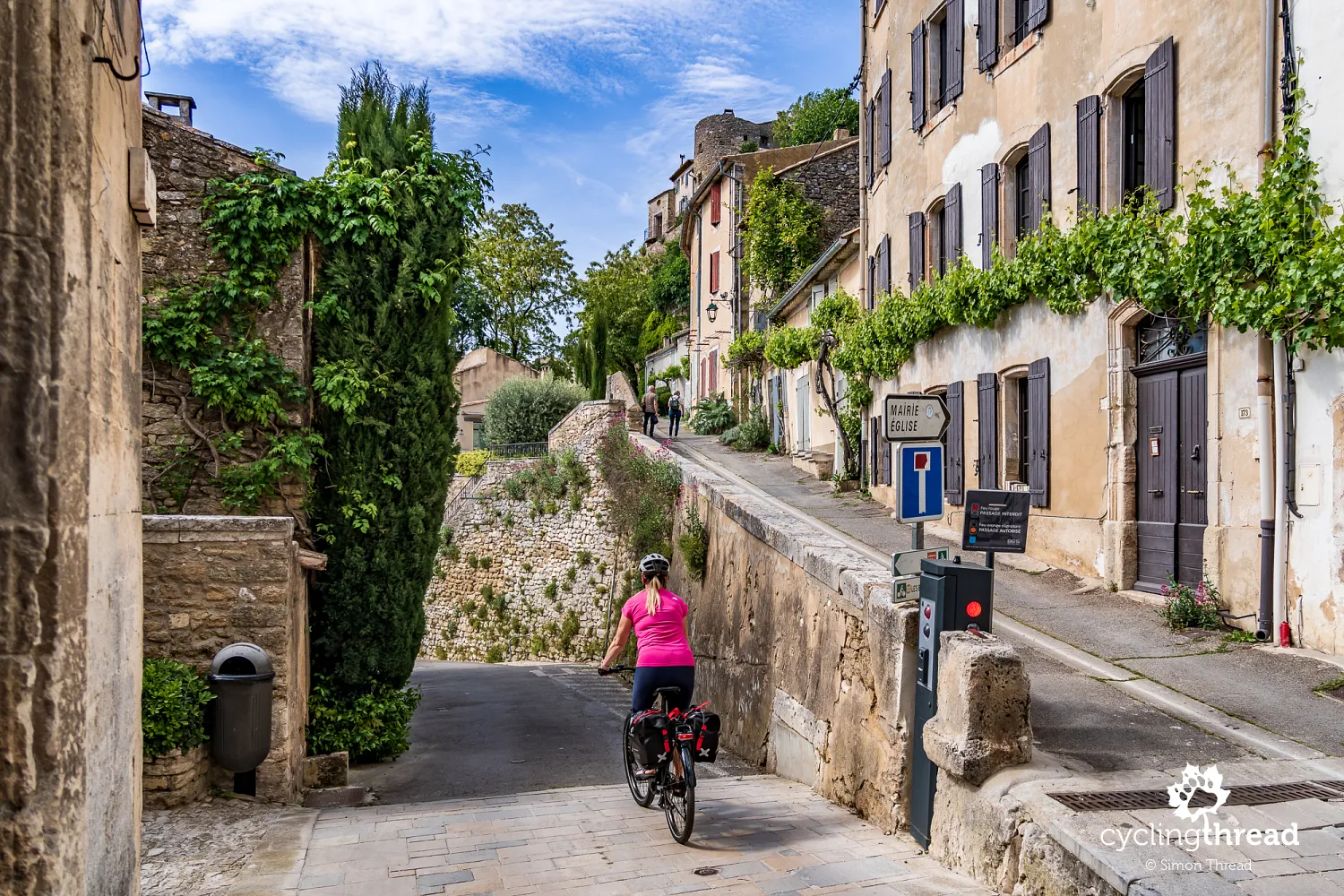
Exploring the ruins of Oppède-le-Vieux
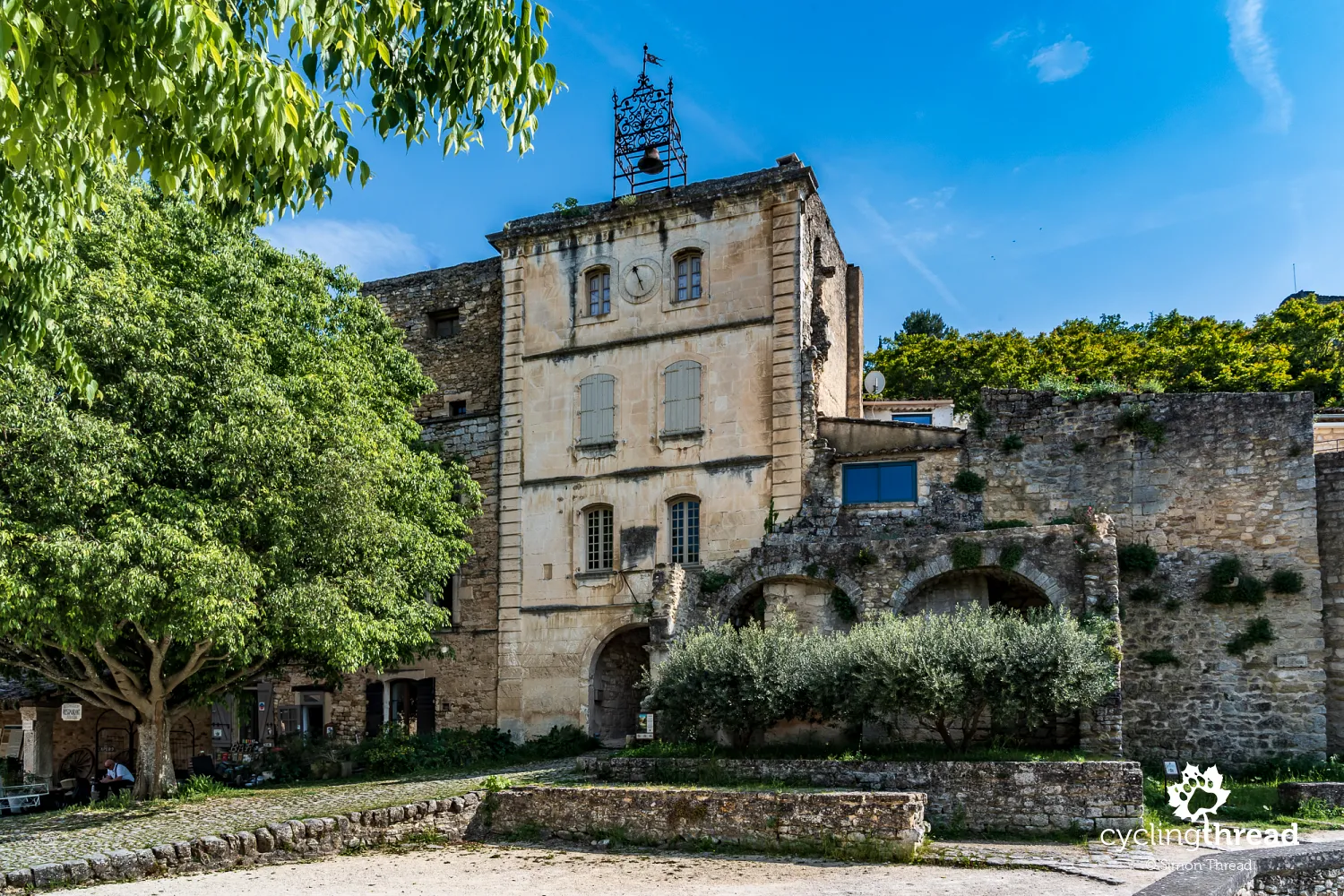
From Ménerbes, we quickly reached Oppède-le-Vieux, one of the most extraordinary places in the entire Luberon. At the centre of old Oppède lies the small Place de la Croix with its 18th-century bell tower and covered market hall, reminders of the period when life in the village gradually moved down from the rocky hilltop towards the fertile Calavon valley below. Here we left our bicycles behind, because exploring the historic part of the settlement requires a short walk through steep stone streets climbing towards the old village. After only a few minutes, we already felt as if we had entered a Provence from several centuries ago - without heavy tourism, souvenir shops or modern buildings overwhelming the historic layout of the settlement. Walking through narrow passages between stone houses, ruined buildings and high walls left a far stronger impression on us than many of Provence’s more famous viewpoints.
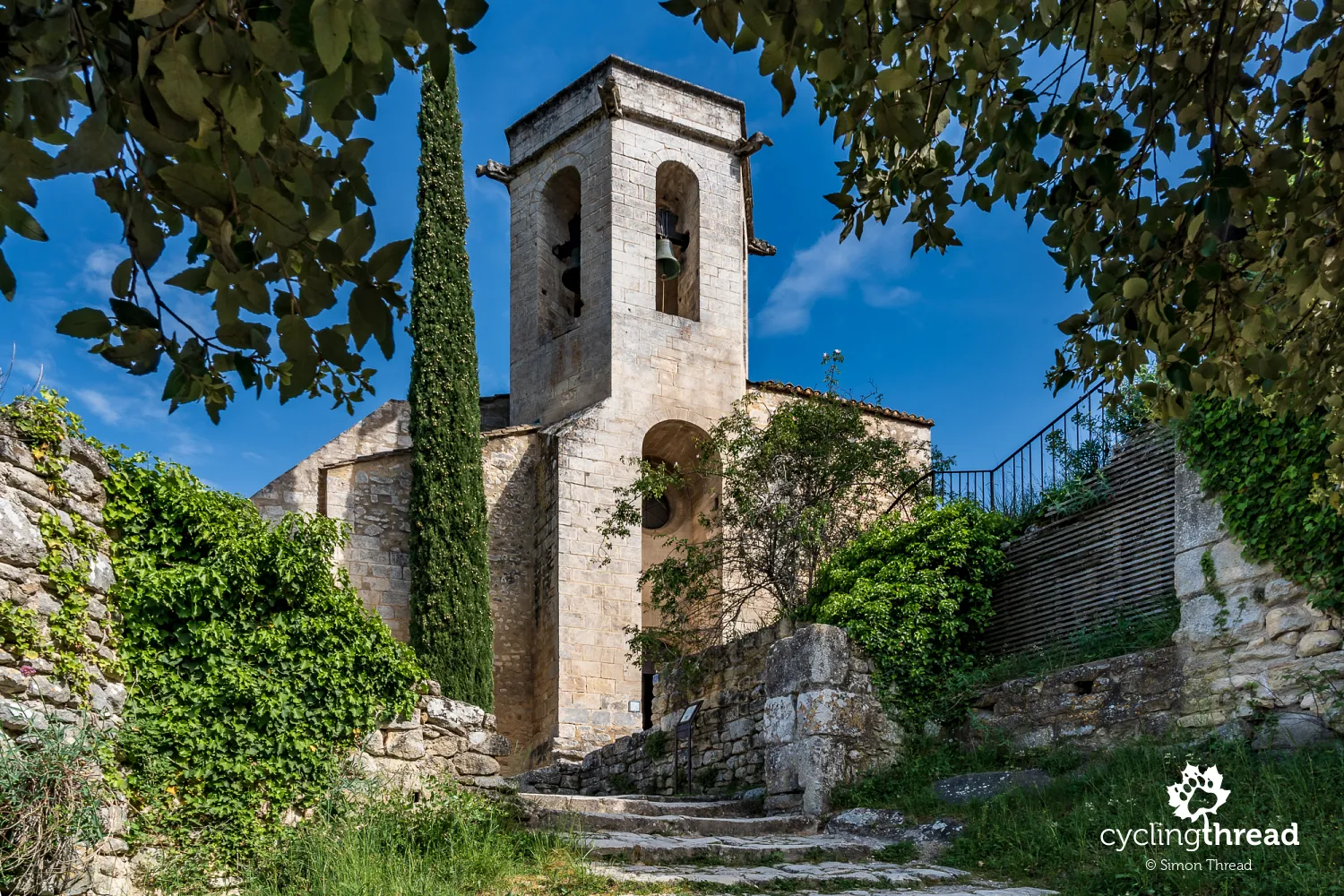
The most characteristic place in Oppède-le-Vieux is undoubtedly the collegiate church of Collégiale Notre-Dame d’Alidon, located high above the village and dating back to the 10th century. This Romanesque church was rebuilt many times over the centuries, and today intimate sunset concerts are organised here during the summer months. Even higher above the church stand the ruins of the medieval fortress known as Vieil Oppède, reminding visitors of the former strategic importance of this part of the Luberon. Below the historic buildings, on the left side of the road towards Robion, stretch the Sainte-Cécile terraces - once used for agriculture and now transformed into a peaceful Mediterranean garden filled with umbrella pines, oaks, thyme and rosemary. From the hillside, wide views open across the Calavon valley and the limestone hills of the Vaucluse region. Truly a beautiful and unique village within the Luberon.
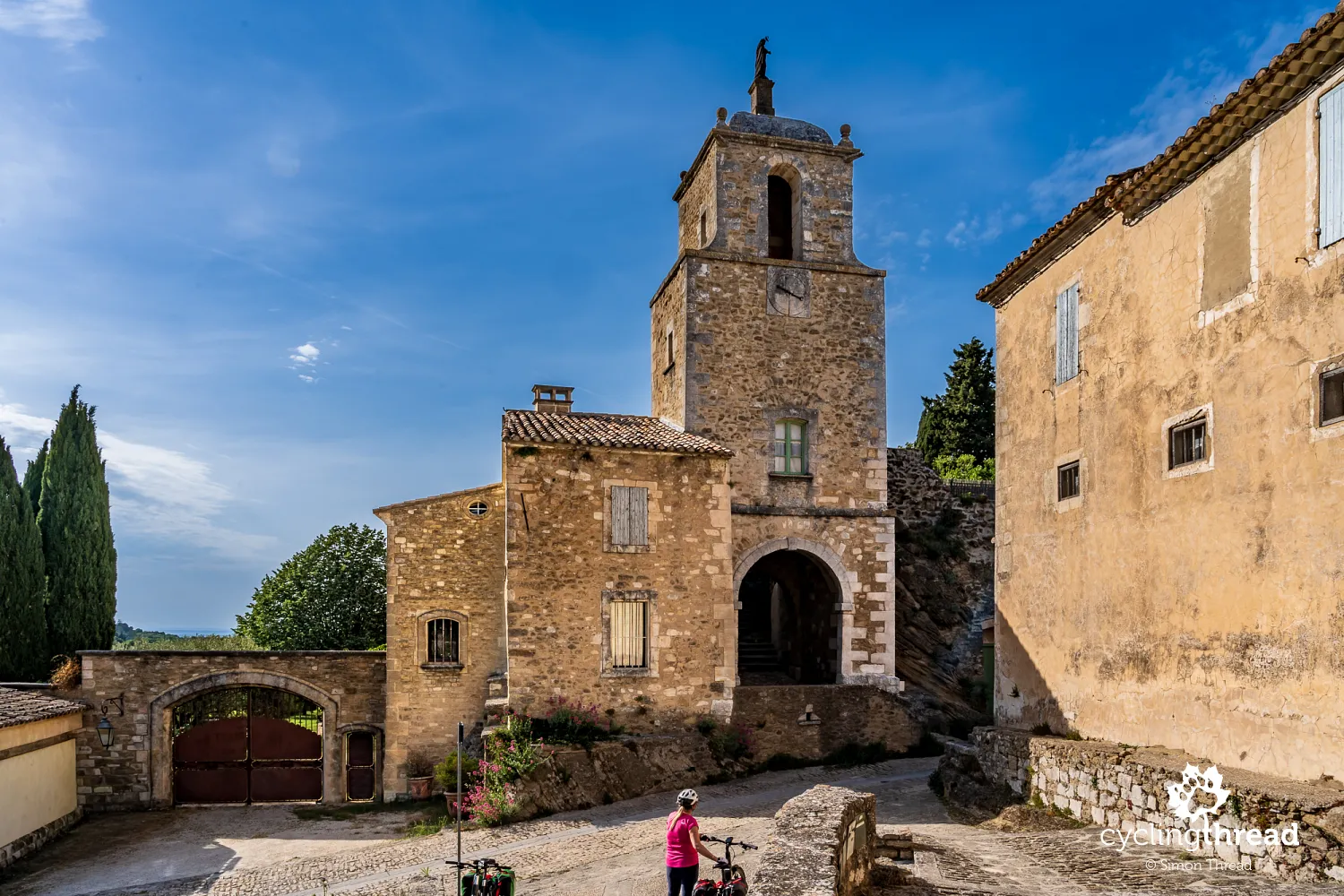
Another stop along our route was the small village of Maubec. Its oldest section climbs a small rocky hill above the newer buildings, preserving the calm and almost sleepy atmosphere of a traditional Provençal settlement. During a short walk through the stone streets of old Maubec, we passed pale houses with blue shutters, fragments of former fortifications and the characteristic bell tower that has become the symbol of the village. At the centre of the old quarter stands Église Saint-Maurice, an 18th-century church with an elegant Baroque façade facing a small stone-paved square. In the past, Maubec was a medieval fortified settlement belonging to the Counts of Toulouse, but after the destruction caused by religious wars and a later period of depopulation, the village only slowly came back to life during the 20th century.
The final village from the list of the most beautiful Luberon villages we visited that day was Robion, located directly beneath the limestone cliffs of the Petit Luberon massif. Fragments of the medieval castle walls, steep cobbled streets and the Romanesque Église Notre-Dame-de-la-Nativité, whose origins date back to the 12th century, have all survived to this day. One of the most characteristic places in Robion is the Théâtre de Verdure - a stone amphitheatre used during summer for concerts and cultural events, located directly beneath the towering cliffs of the Luberon. The village is also an important point on the cycling map of the region, because this is where the popular Véloroute du Calavon, following the former railway line through the Luberon, connects with the Around the Luberon cycle route. We noticed one more interesting detail here - a different road design for the "2 minus 1" roads, painted in green with green road signs. It is one of those traffic solutions we strongly appreciate and had already mentioned recently while writing about the Waterline Route in the Netherlands.
The Around the Luberon route - completed!
By joining the former railway Véloroute du Calavon once again, we had almost completed the full loop of the Around the Luberon cycle route. And without the slightest hesitation, we are adding it to our personal list of the best cycling routes in Europe. It was a truly beautiful cycling journey. What stayed in our memory most strongly was the cyclist-friendly route design along local roads with genuinely very little traffic - especially in the part of the Luberon located within the Vaucluse department. Thanks to this, for most of the trip it felt almost like riding on dedicated cycling infrastructure. In the Alpes-de-Haute-Provence department the experience was clearly less comfortable, although not enough to spoil our overall impression of the excellent Autour du Luberon à Vélo route.
Not the best alignment for EuroVelo 8
To finish the day, between Robion and Apt, we cycled the longest section of the Véloroute du Calavon. And while more stone Provençal villages kept appearing and disappearing on the distant hillsides, a certain thought came to my mind. Was routing EuroVelo 8 together with the Véloroute du Calavon really the best decision for the region? I watched touring cyclists with panniers passing by and wondered how many of them realised what extraordinary places they were missing. Because although the Véloroute du Calavon is fast and comfortable, it follows the floor of the valley, far from the most picturesque places in the region. Would it not have been better - both for cyclists and for the Luberon itself - if EuroVelo 8 had followed the Around the Luberon route beyond Apt through places such as Bonnieux, Lacoste and Oppède? Knowing typical cycling travel habits, most tourists simply cross the region by following the signs of the European long-distance route. And that means they miss the opportunity to discover some of the most beautiful places not only in Provence, but perhaps in all of Europe. A real pity.
Two museums - olive oil and lavender
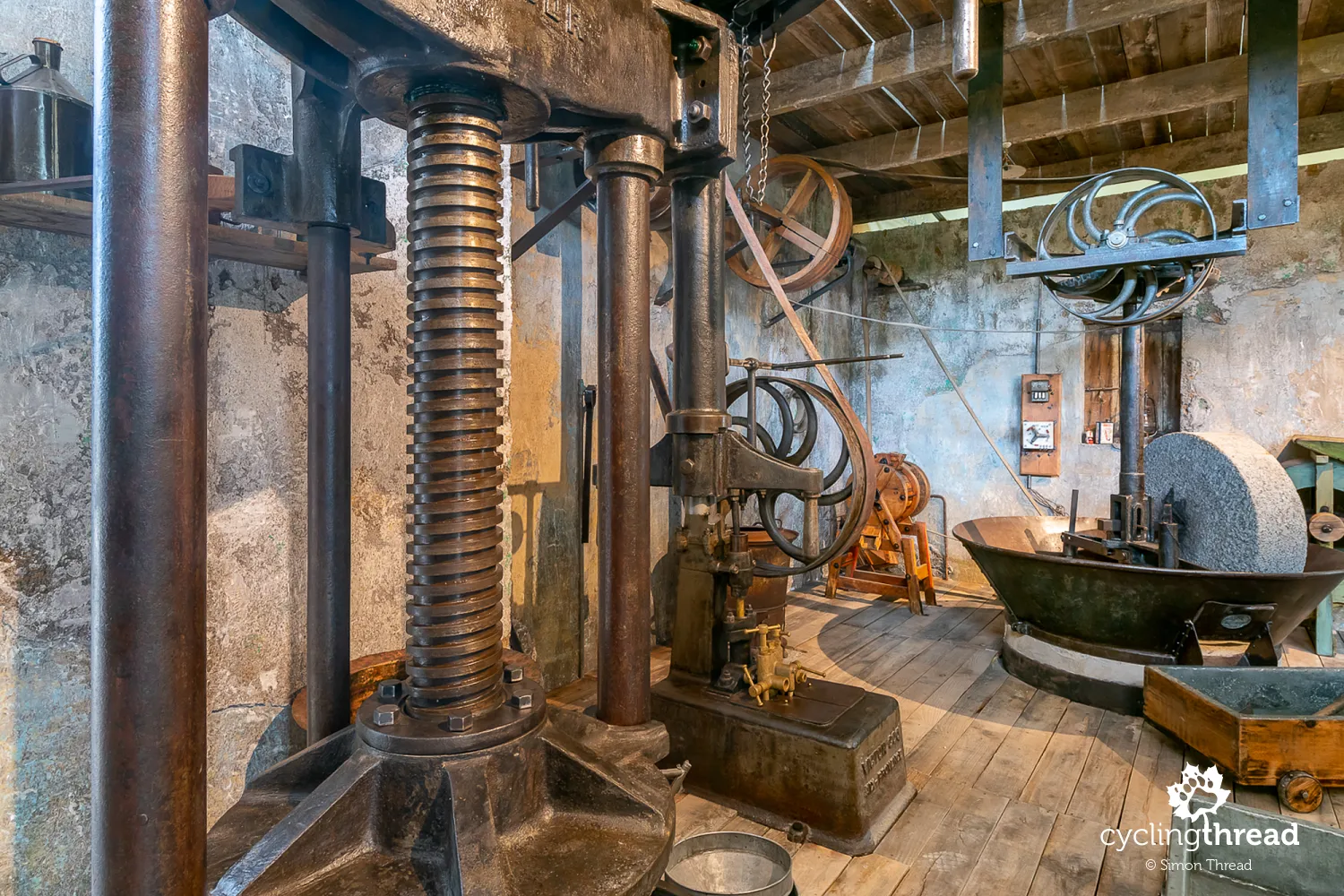
Very close to the Véloroute du Calavon there are also two popular museums dedicated to some of the most characteristic products of Provence. In Coustellet, visitors can explore Musée de l'Huile d'Olive, devoted to the history of olive cultivation and olive oil production across the Mediterranean region. The museum displays historic presses, tools and machinery used for centuries to produce olive oil, while also explaining the importance of olives in Provençal culture and cuisine. Just a few minutes away stands Musée de la Lavande Luberon, presenting the history of lavender in Provence - from traditional harvesting methods to modern essential oil production. The exhibition also explains the differences between lavender and lavandin, while showing how important these fragrant fields became for the local economy and the characteristic landscapes of the region.
A Roman bridge you can ride
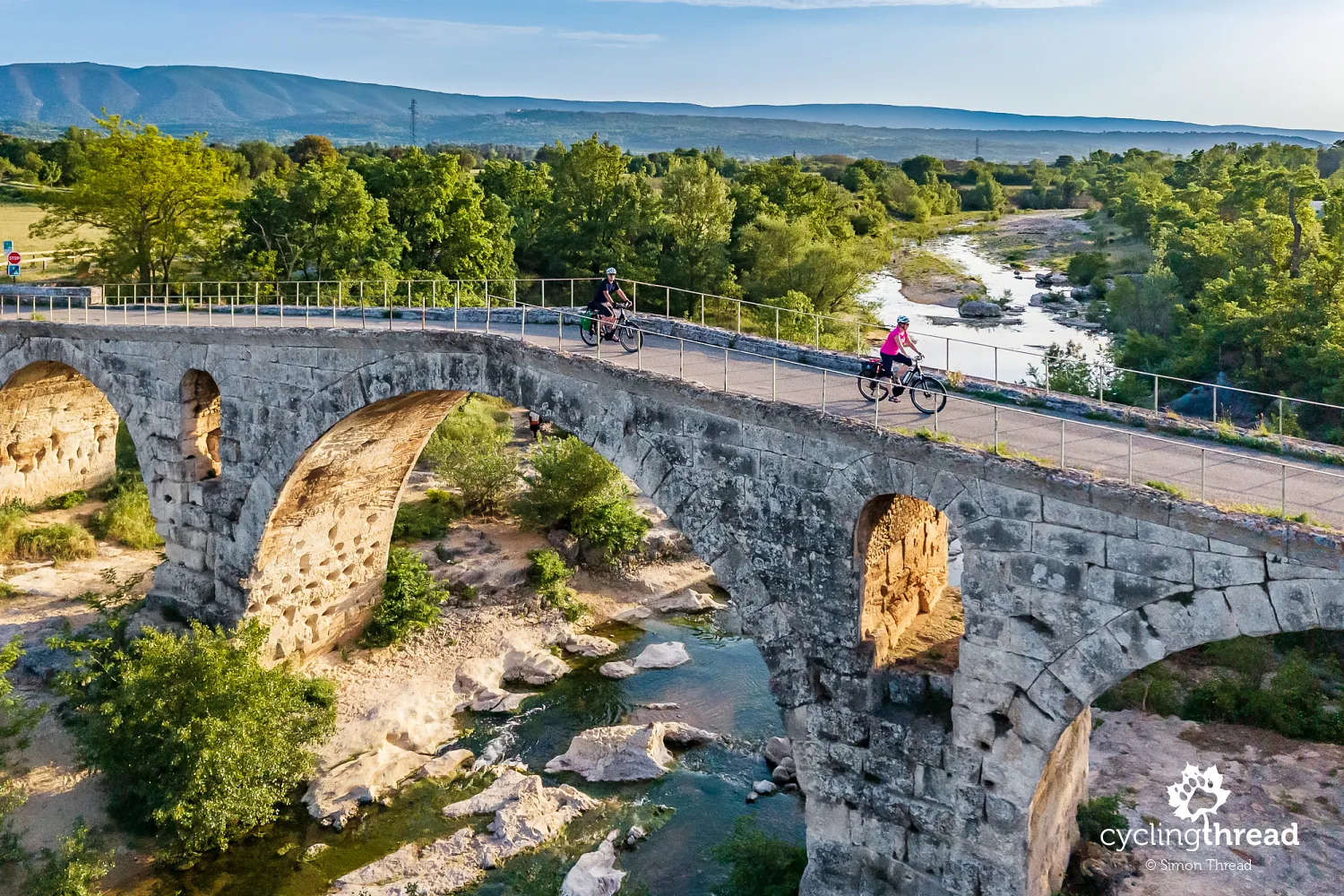
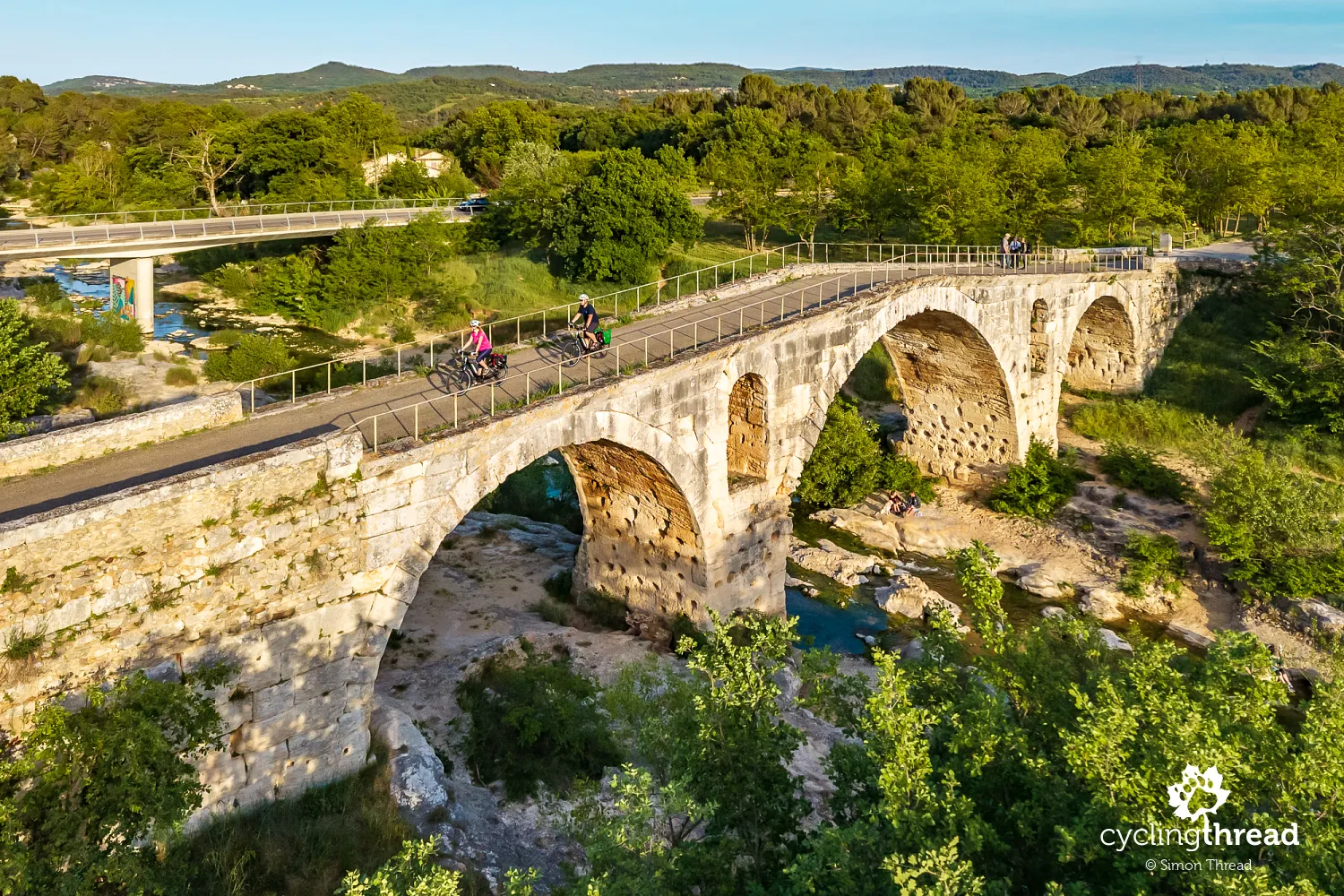
One truly extraordinary place - and one fully accessible to cyclists - is the ancient Pont Julien, located right in the heart of the Luberon directly along the Véloroute du Calavon. The bridge was built in 3 BC - which means it is… 2,029 years old. It formed part of the ancient Via Domitia, one of the most important roads of the Roman Empire connecting Italy with the Iberian Peninsula. The structure has three stone arches, measures around 80 metres in length and was constructed entirely without mortar - enormous limestone blocks were fitted together with remarkable precision. What is especially fascinating is that for almost two thousand years the bridge continued to carry normal road traffic, with cars only being banned here as recently as 2005. Today, the atmosphere is completely peaceful - cyclists rest beside the river, someone sits on the stones with a baguette and cheese, while just a few metres away the former railway embankment continues as a cycling route. It is certainly a strong candidate for our personal list of the most extraordinary cycling bridges we have ever seen.
The largest candied fruit factory in Europe
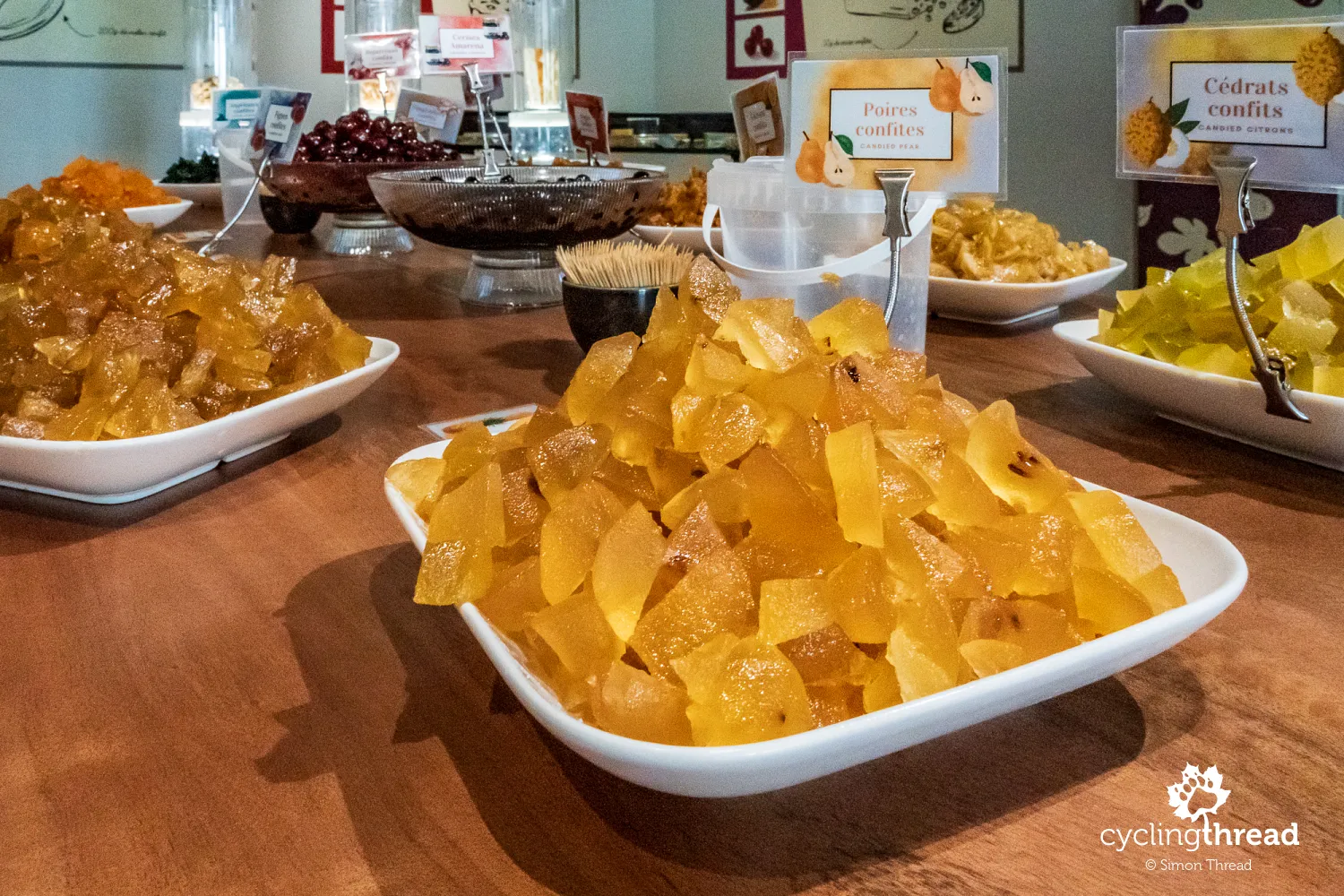
We began the next day with a visit to the House of Candied Fruits - a small museum and shop operating beside what is considered the largest candied fruit factory in Europe. Maison du Fruit Confit is located on the outskirts of Apt, not far from the hotel where we stayed. The small exhibition explains how candied fruits are produced in Provence - from cherries, apricots and figs to melon, pears and citrus peels. The process involves slowly replacing the water inside the fruit with sugar, allowing the fruit to keep its shape, colour and soft texture for many months. Since the 18th century, Apt has been regarded as the world capital of candied fruits, and local products today are supplied to French pastry shops, dessert makers and producers of traditional holiday cakes. Inside the museum, visitors can see historic tools, packaging and advertisements, although the most important part of the visit begins with the tasting session. Only then does it become clear why candied fruits in France are treated more like delicacies than ordinary cake ingredients.
The incredibly colourful landscapes of Provence
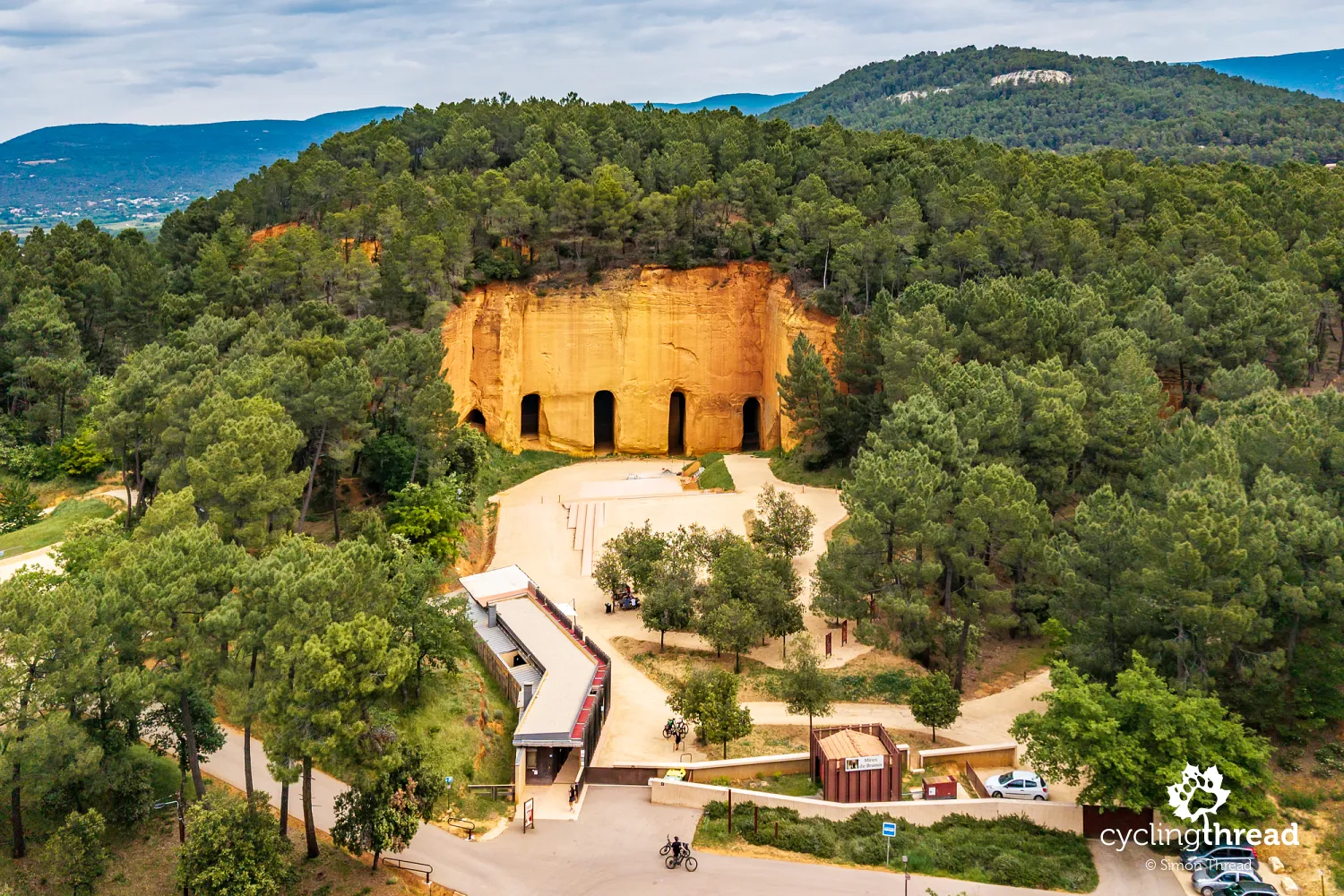
Leaving Apt behind, we entered a yellow, orange and red world of ochre landscapes. Ochre is a natural mineral pigment created by the high concentration of iron oxides in rocks and sands. For centuries, it was used in the production of paints, plasters and dyes. And the Luberon - especially the areas around Gargas and Roussillon - contains some of the largest and most famous ochre deposits in Europe. At times, the intense colours of the local rocks make it feel as if a fragment of the American desert had somehow been moved into the heart of Provence. One of the most fascinating places connected with the history of ochre mining is Mines de Bruoux. This enormous system of former underground galleries was carved by miners into soft ochre sandstone. Visiting the site means walking through gigantic tunnels that resemble a cathedral far more than a mine - some rise more than ten metres high. During the 19th and early 20th centuries, ochre mining was one of the region’s most important industries, and pigments from the Luberon were exported throughout Europe. Today, the site remains one of the most extraordinary examples of industrial heritage in the entire region.
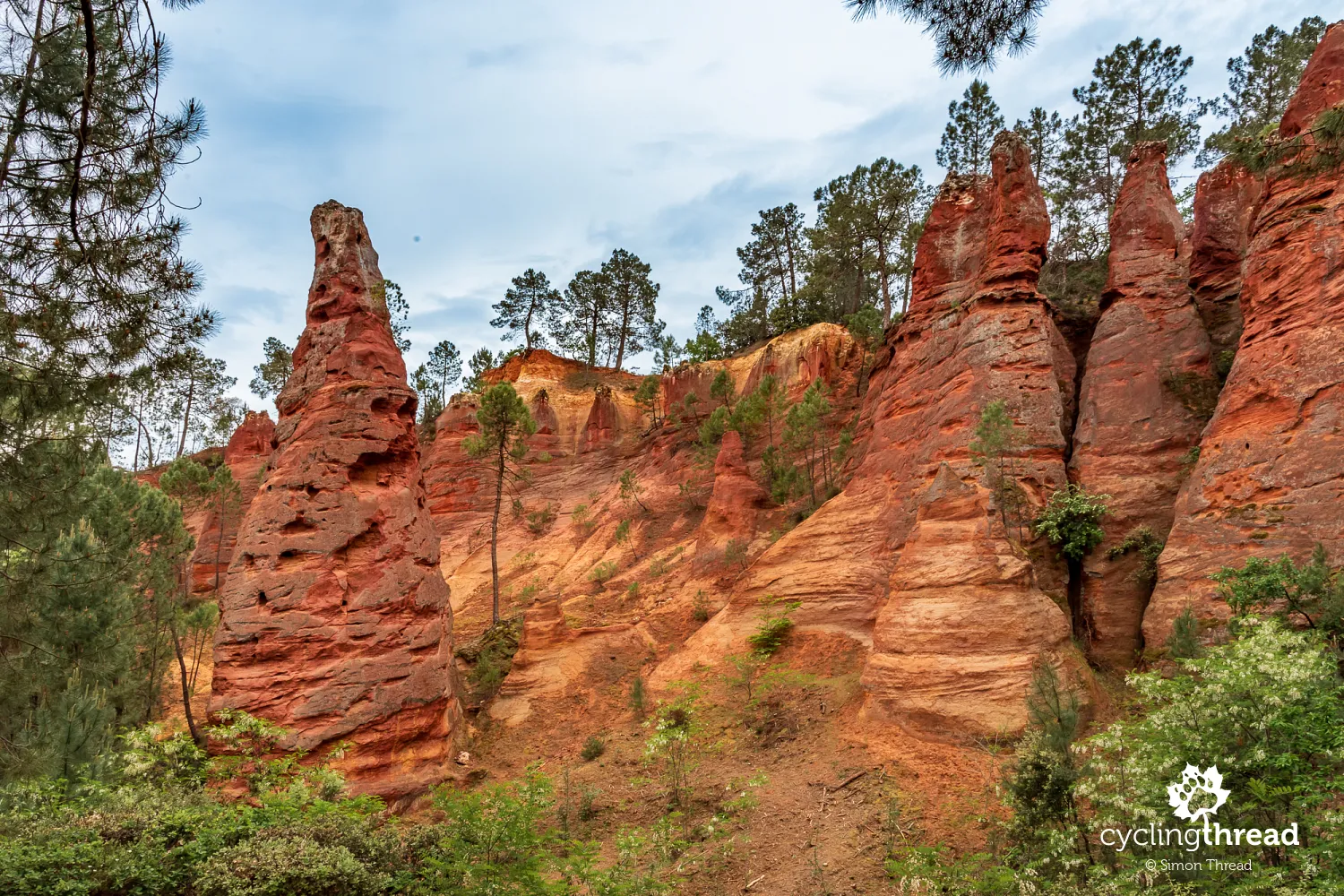
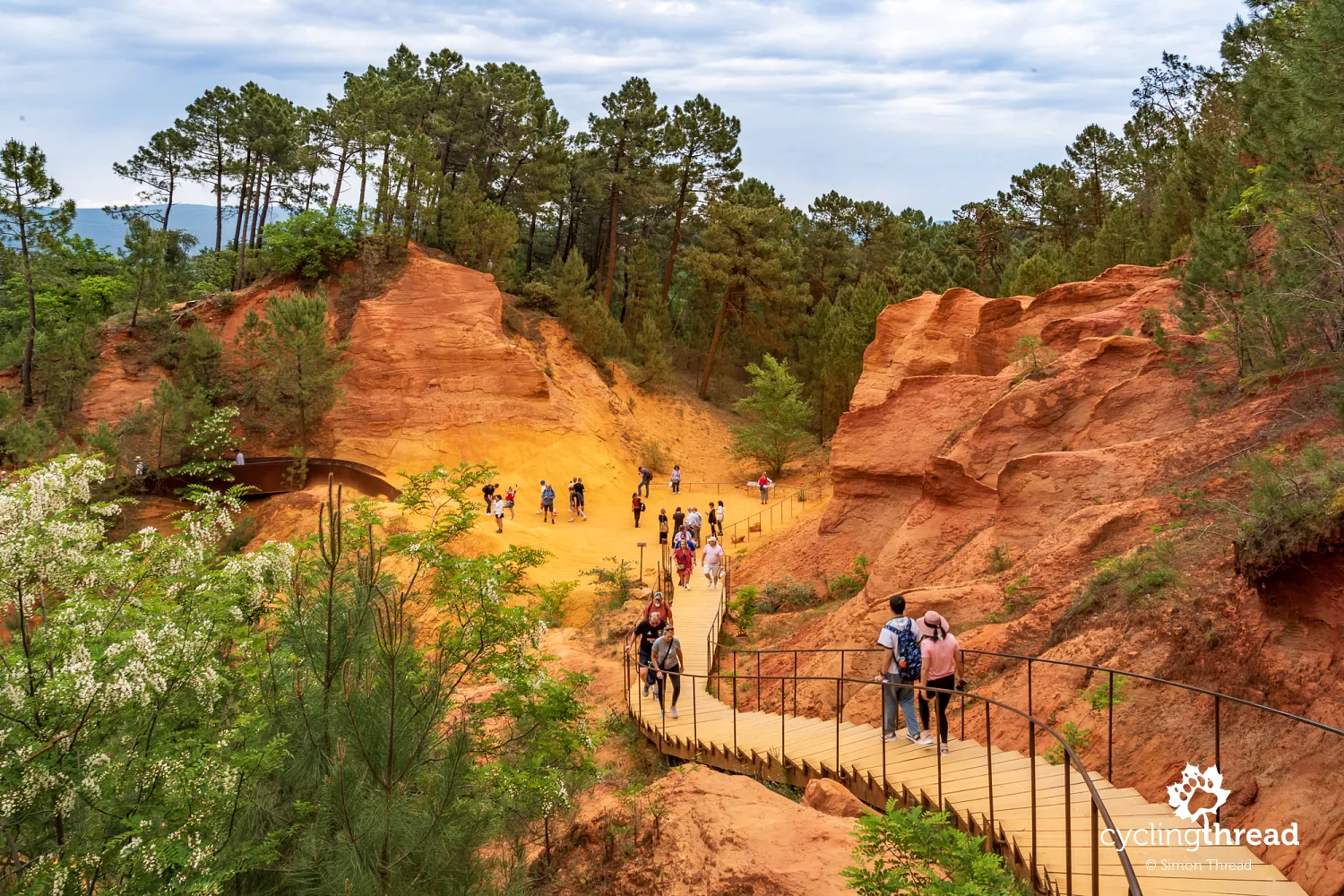
A few kilometres further stands the famous Sentier des Ocres, the ochre trail in Roussillon. This short walking route leads through former open-pit mines and spectacular sand formations glowing in shades of yellow, red and orange. In sunlight, the colours look almost unreal, especially when contrasted with the green pine trees and deep blue Provençal sky. Wooden boardwalks and stairways allow visitors to safely explore the steep walls of the former quarries. Only a few decades ago, some of these areas were still actively mined, with local factories exporting pigments to dye works and industrial producers around the world. Today, the former industry has transformed into one of Provence’s most impressive natural attractions, while also revealing how strongly the landscapes of the Luberon were shaped by human activity.
After walking the ochre trail, the natural next step is to explore the village itself. Most houses in Roussillon have façades painted in shades of ochre - from pale yellow to deep red - because for centuries the local pigment was also used to finish buildings. A network of narrow streets winds between stone houses, small squares and terraces overlooking the colourful hills surrounding the village. At the highest point stands Église Saint-Michel, whose origins date back to the 11th century, while beside it survives the characteristic Belfry, the old clock tower that has become one of the symbols of Roussillon. An interesting addition to any walk through the village is also the Ôkhra - Ecomusée de l’Ocre, located inside a former ochre factory and showing how the local pigment was mined and processed for decades - first making Roussillon famous across France, and later throughout Europe.
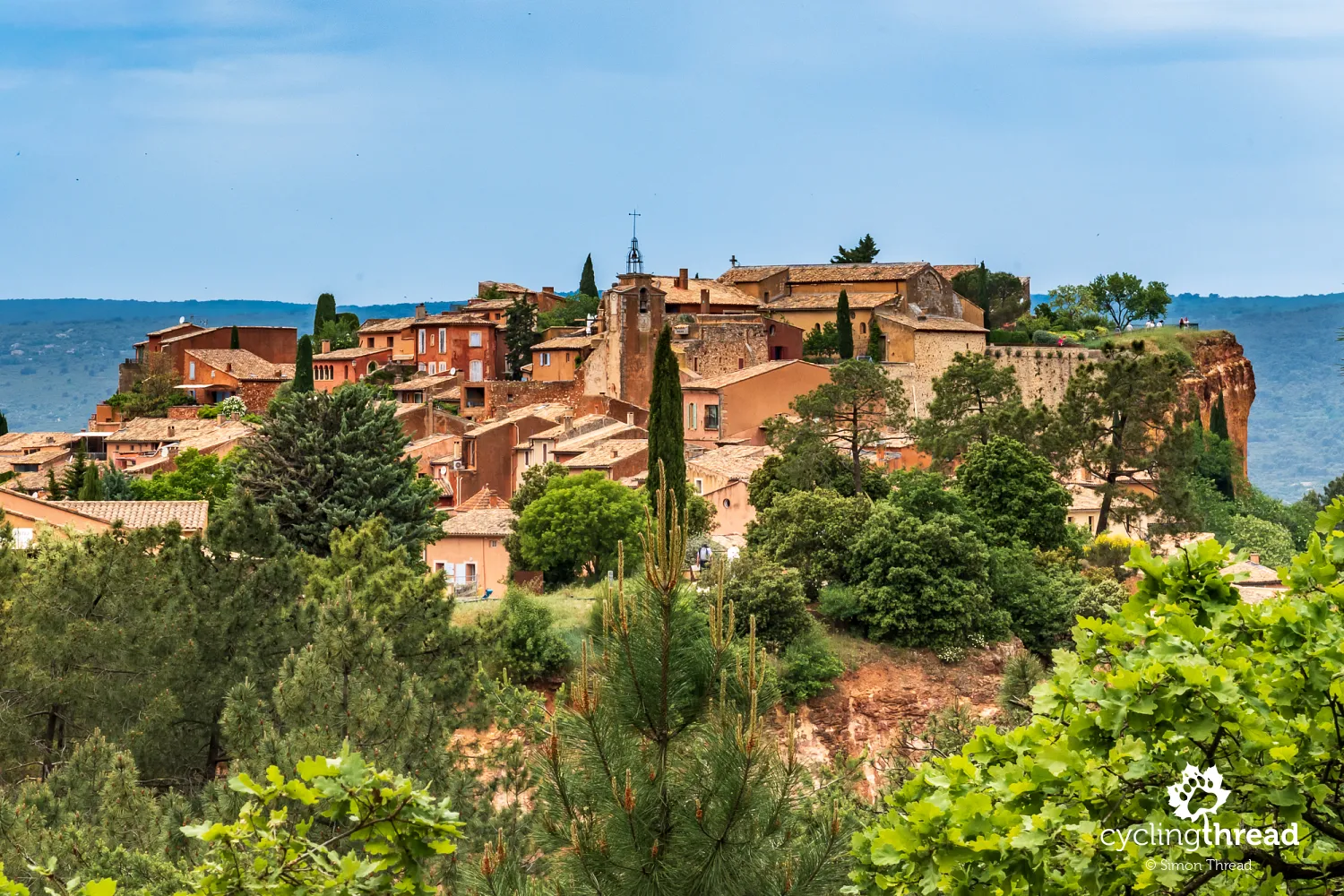
Roussillon is one of the most characteristic villages in the Luberon, one of the most visited places in Provence and regularly listed among the most beautiful villages in all of France. It is therefore no surprise that the village attracts huge numbers of visitors, often crowded with hundreds of people at the same time. Its true Provençal atmosphere is much easier to experience early in the morning or later in the evening, once the day visitors have left the area. Fortunately, this level of tourism is not typical for the Luberon as a whole - while visiting 17 of the region’s most beautiful villages, only here in Roussillon and later in Gordes did we actually encounter large crowds. Everywhere else - still at the beginning of May - life followed its calm Provençal rhythm.
Gordes - a must-see attraction in Provence
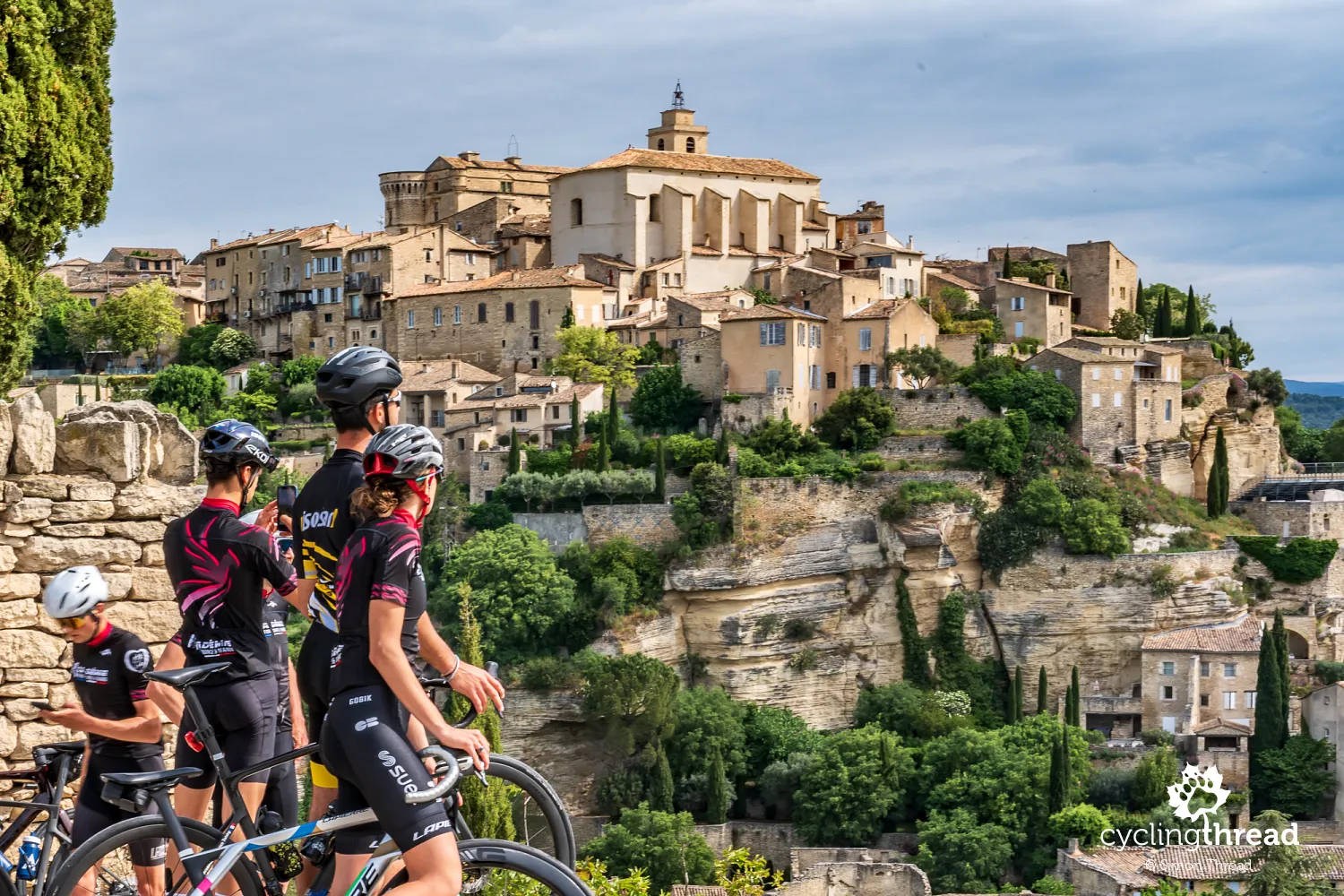
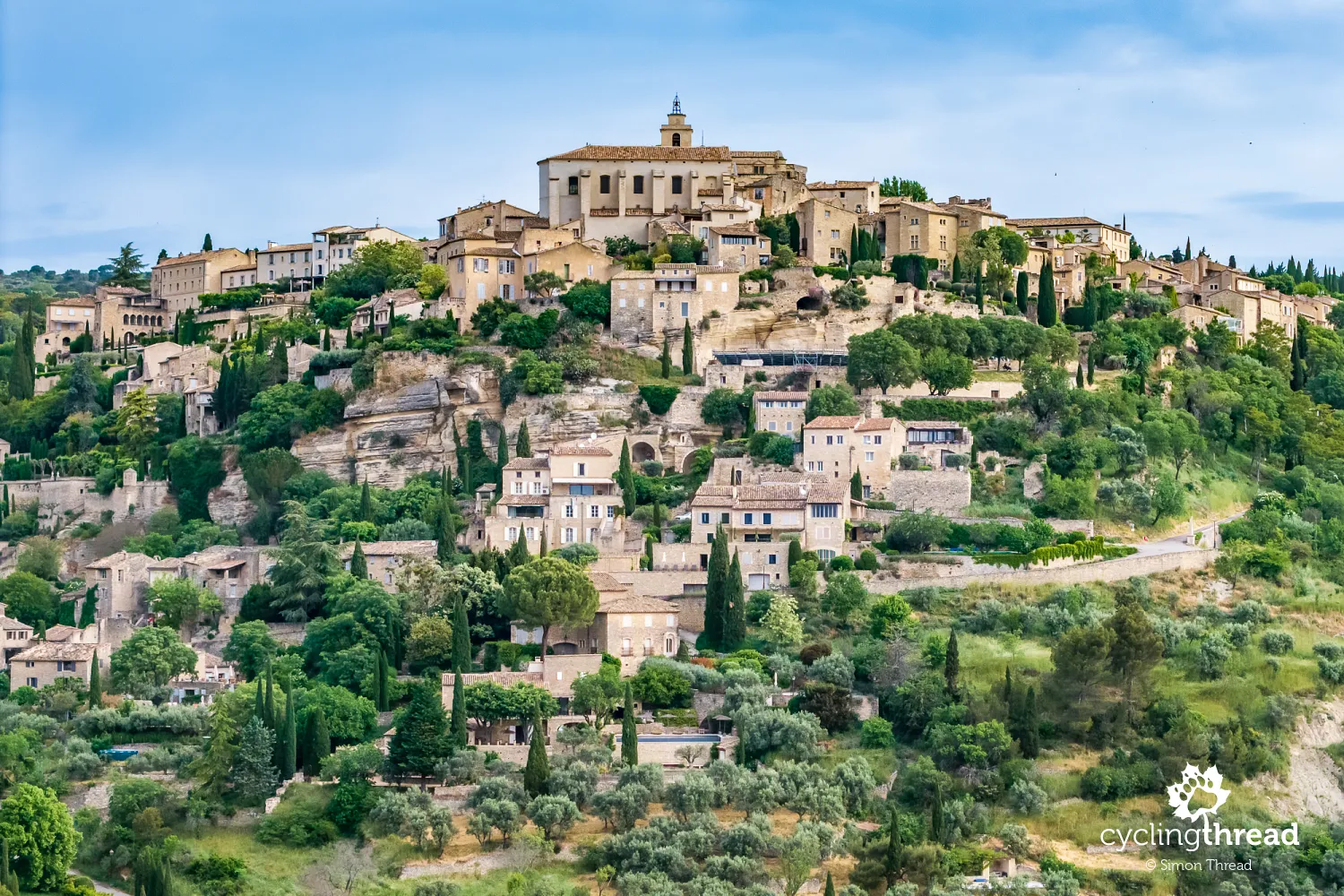
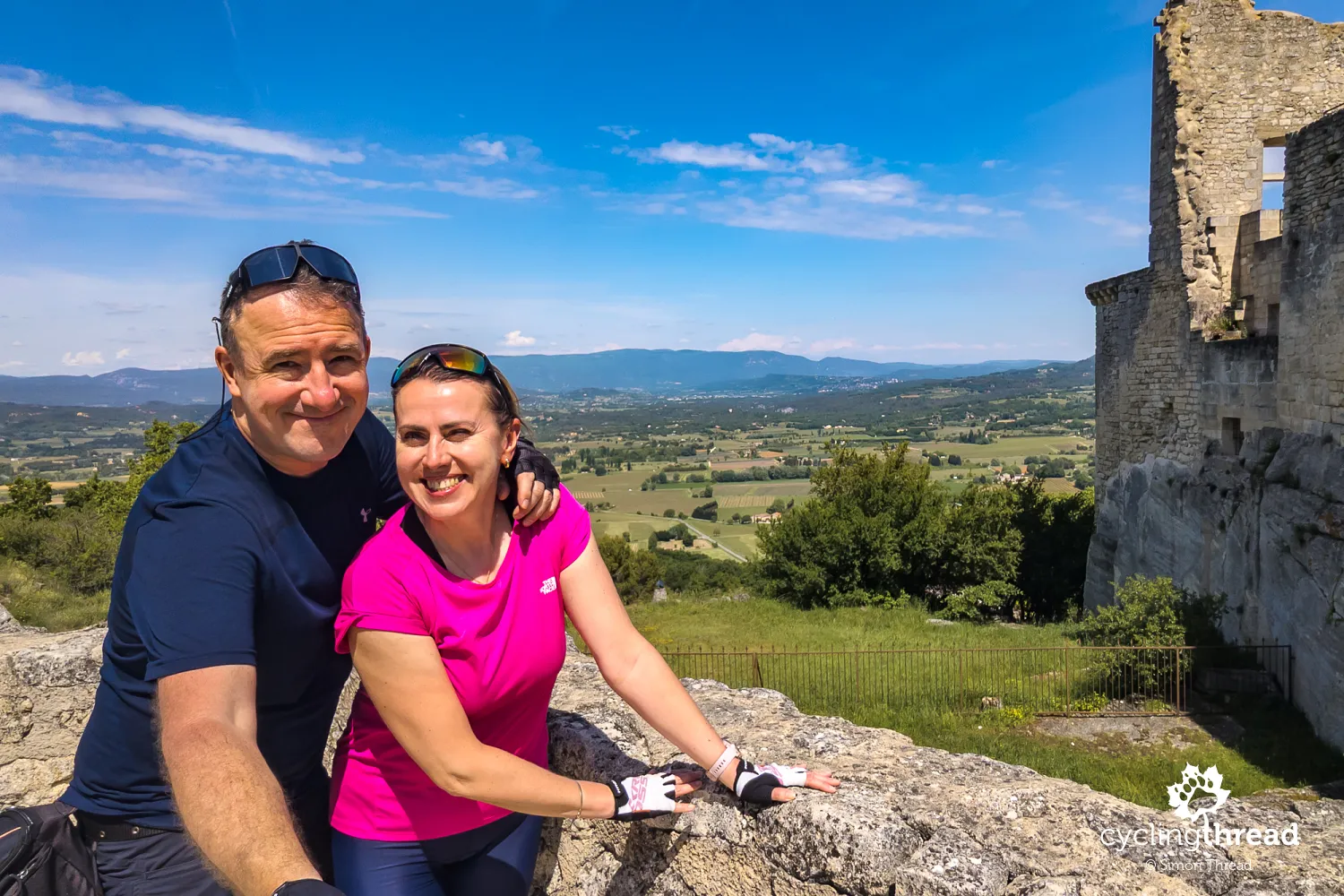
The famous pair of villages - Roussillon and Gordes - are separated by only around ten kilometres, roughly half an hour by bicycle. But Gordes reveals its most spectacular side only when viewed from the west. The viewpoint located on the opposite side of the valley is probably the single most essential stop during a cycling trip around the Luberon. And even if millions of tourists from around the world have stood there before you, it is still absolutely worth becoming one more. From this spot, you can perfectly see how the stone houses of Gordes climb terrace-like up the steep hillside, almost growing directly out of the pale limestone cliffs. What makes the panorama even more extraordinary are the dramatic rocky escarpments beneath the village, emphasising its remarkable position high above the green valley below. Dominating the skyline are the massive Renaissance château and Église Saint-Firmin, while slender cypress trees, stone pines and olive terraces complete the characteristic landscape of this part of Provence. And there is still one thing that even the best photographs fail to capture - the surprising feeling of closeness to this immense and spectacular panorama.
The historic centre of Gordes itself is relatively small and can easily be explored during a short walk. Narrow streets lead between pale stone houses, small squares and terraces overlooking the valley below. Beneath the Renaissance château and Église Saint-Firmin, there is also a network of former cellars, cisterns and partially rock-carved chambers that for centuries were used by residents to store food and water. These hidden underground spaces helped the village function on its steep limestone hillside in the hot climate of Provence. And although Gordes is today one of the most famous places in the entire region, many quieter corners of the old town still make it easy to imagine the atmosphere of this remarkable Provençal settlement from centuries ago.
The unique Village des Bories
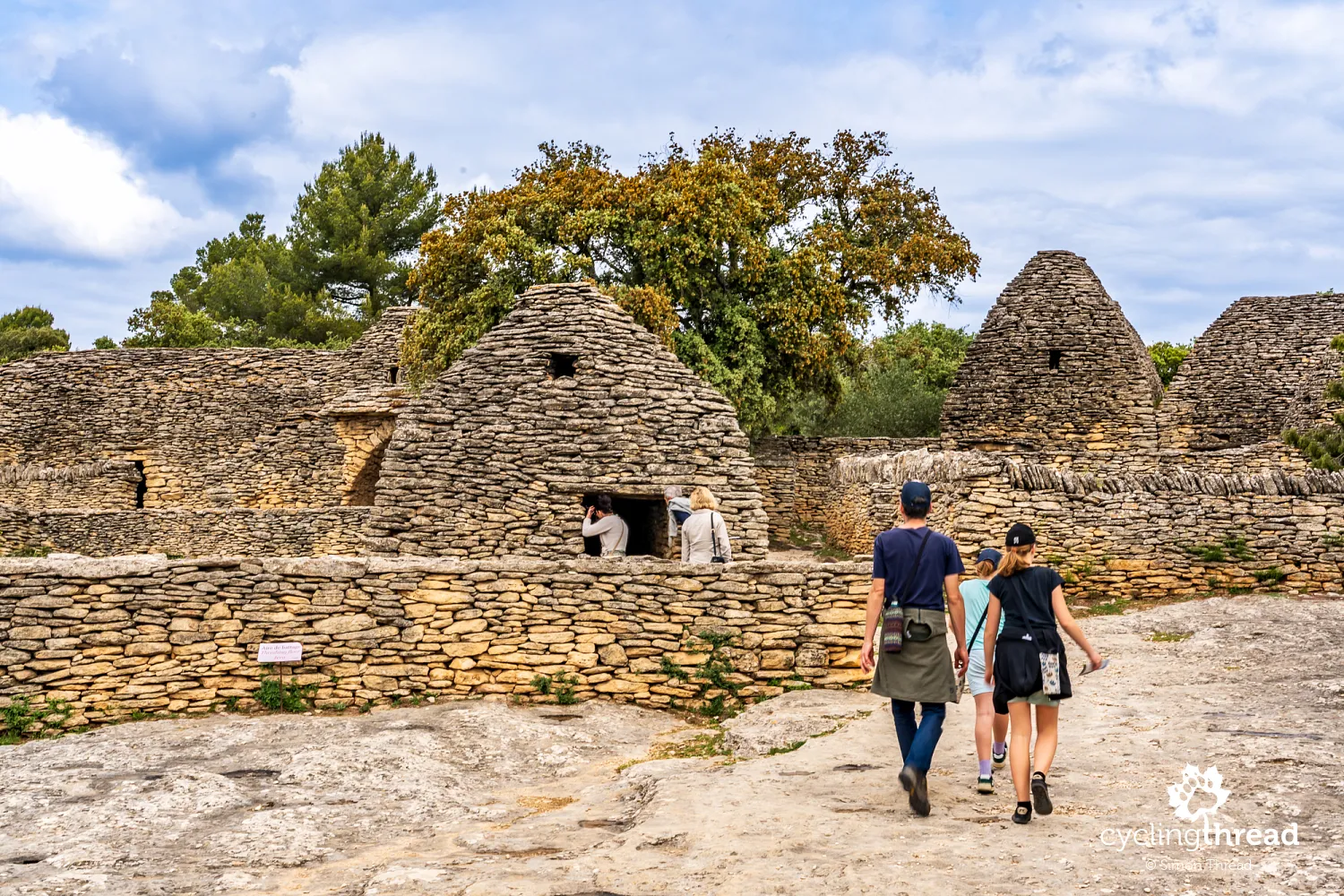
A few kilometres from Gordes lies one of the most characteristic attractions of this part of Provence - Village des Bories, a small stone settlement built almost entirely from local limestone without the use of mortar. The site consists of characteristic stone huts with thick walls and roofs constructed from flat stones using traditional dry-stone techniques typical of historic rural architecture in Provence. Most of the buildings date from the 18th and 19th centuries and served local farmers as shelters, storage spaces and agricultural buildings while working in the surrounding fields. Walking between these small structures makes it easy to imagine how simple and physically demanding life in this rocky part of the Luberon still was only a few decades ago. Today, the Village des Bories is considered one of the best-preserved examples of traditional Provençal architecture.
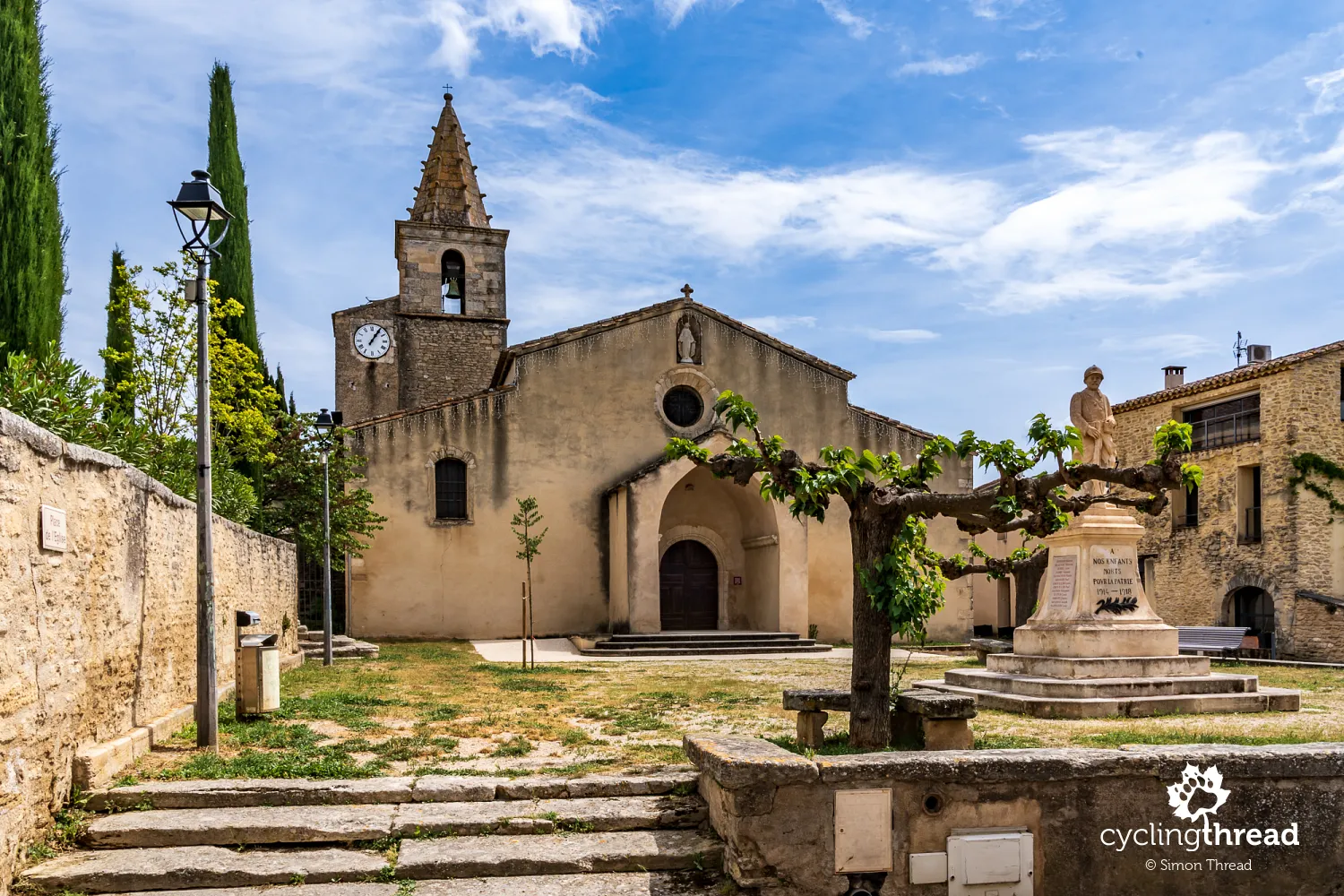
After leaving Gordes, the route leads towards the quieter village of Cabrières-d'Avignon - one of those Provençal places that do not try to compete with the region’s most famous icons and, thanks to that, have preserved a more authentic and everyday atmosphere. Stone houses built from pale limestone cluster around a small centre with a church and shaded squares, while narrow streets pass between the high walls of former private properties. For centuries, the village was closely connected with olive growing, vineyards and lavender cultivation, and its location at the foot of the Vaucluse hills means it is still surrounded by peaceful landscapes of olive groves, Mediterranean forests and small agricultural fields. Compared with nearby Gordes or Roussillon, life here moves at a noticeably slower pace.
The plague wall near Cabrières-d'Avignon
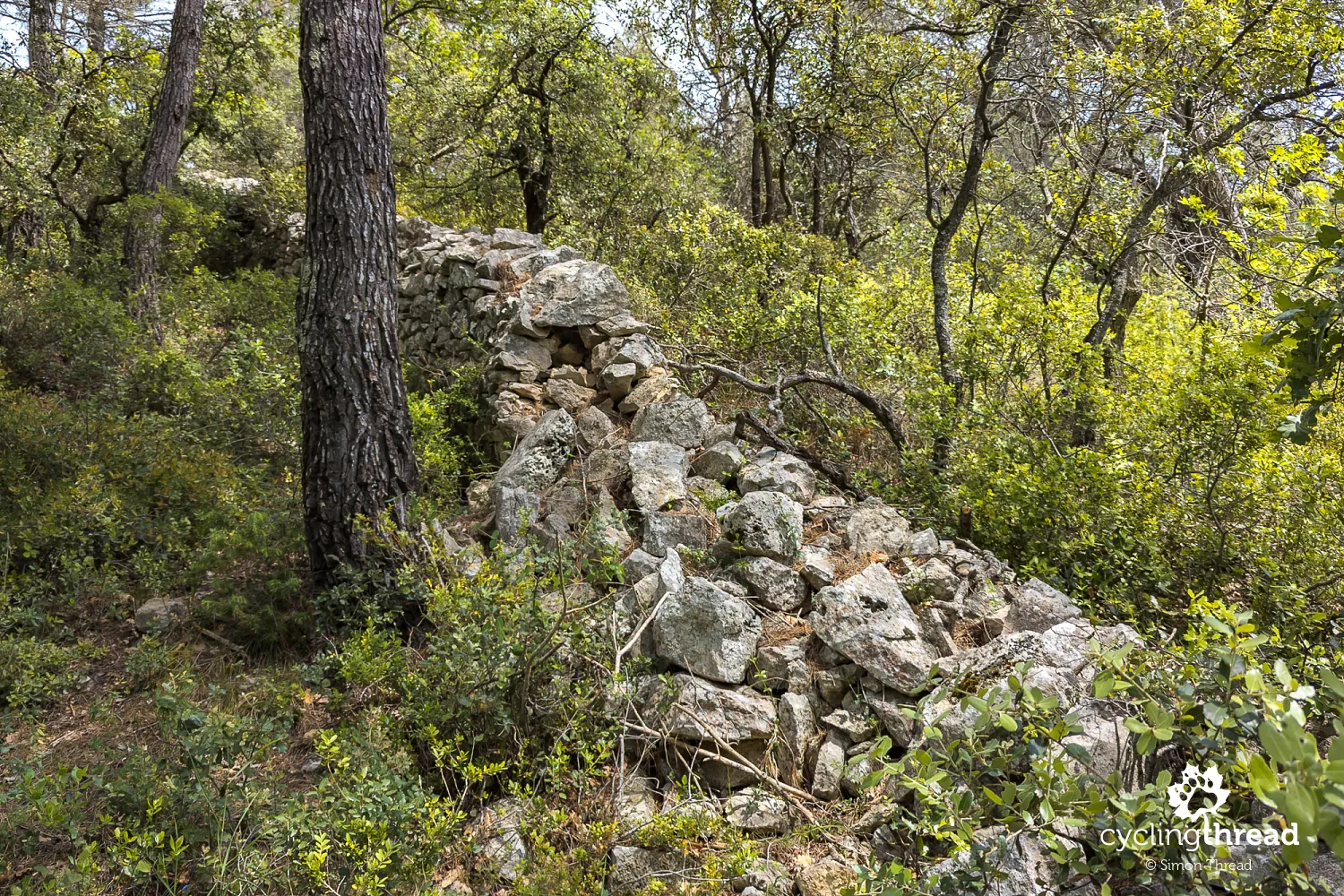
One of the most characteristic sites near Cabrières-d'Avignon is the Mur de la Peste - a stone wall built in the 18th century during a plague epidemic. The structure was intended to limit the spread of disease from the papal territories around Avignon into the rest of Provence. The wall once stretched for many kilometres through the hills and forests of the Vaucluse massif, and fragments of it still survive today, visible during walking and cycling trips in the surrounding area. Although the structure itself may seem rather modest nowadays, it remains a reminder of times when borders between regions were closed not for administrative control, but out of fear of epidemics.
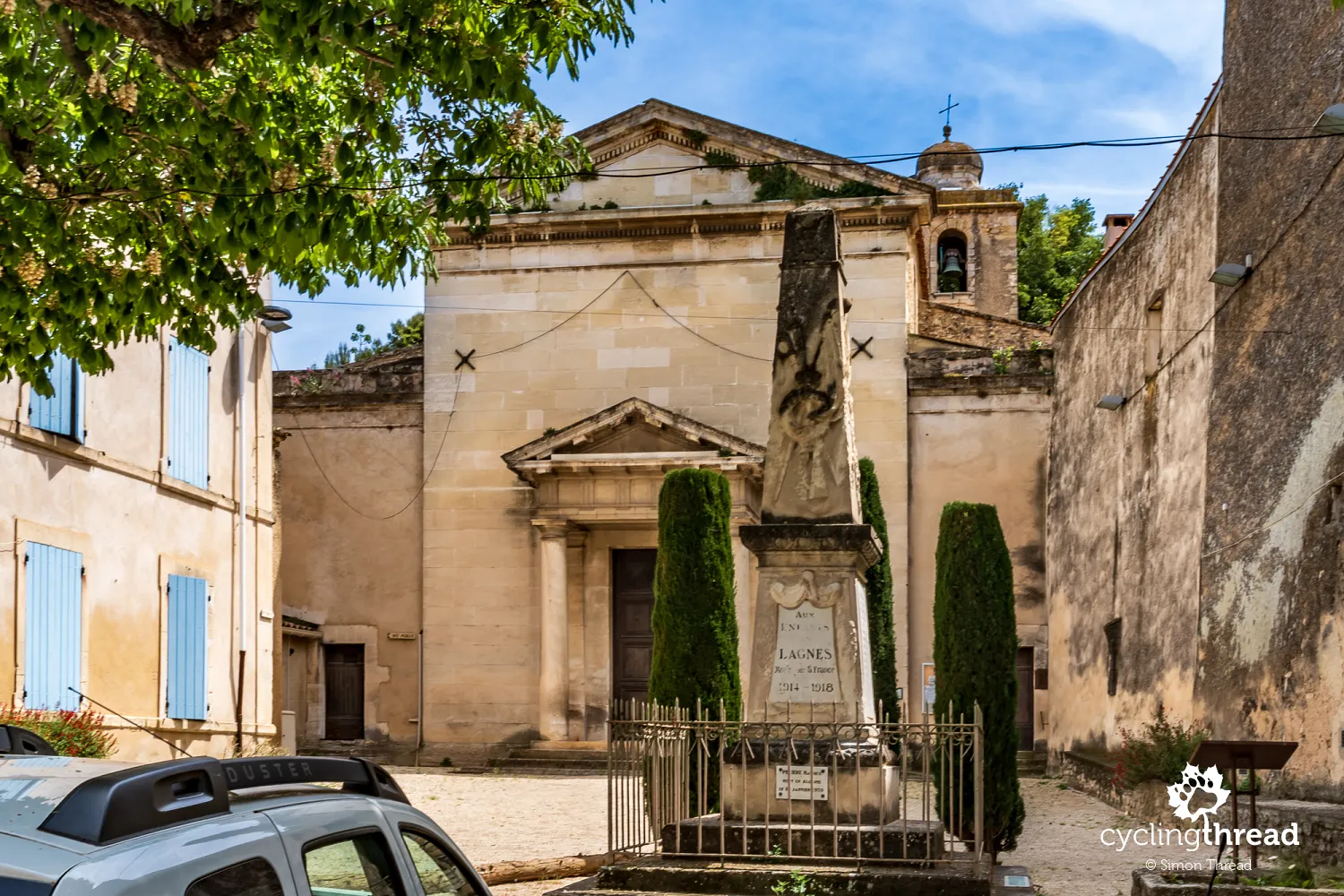
The final Provençal village on our route from the list of the most beautiful places in the Luberon was Lagnes. Standing beneath the stone tower of the former château, we were reading about the history of this small settlement, which for centuries controlled an important route running through the Calavon valley. Today, it is difficult to imagine that these peaceful streets and small squares once formed part of a fortified village exposed to religious conflicts and invasions. Above the village rise the ruins of the medieval castle, reminding visitors of the former strategic importance of this section of the valley. Quiet streets lined with stone houses, small squares and old fountains run through the centre, while the entire village has preserved a much more local than touristy atmosphere.
One of the best cycling regions in France
These few days spent cycling through the Luberon showed us that this is truly one of the most attractive cycling regions in France. The routes pass through remarkably diverse landscapes - from peaceful valleys and vineyards to limestone hills and the stone villages built upon them. Compared with our journey along the Loire Valley cycle route, where riverside landscapes and long flat sections shape much of the experience, cycling in the Luberon feels more intimate, hillier and much more connected with small local roads between historic villages. Each place has its own history, architecture and local identity, which means the kilometres between them never become monotonous. Equally important, cycling in the Luberon remains comfortable and safe. Although there are relatively few traditional cycle paths, most routes follow quiet local asphalt roads with minimal car traffic, allowing cyclists to focus on the atmosphere of Provence.
Want to learn more about Luberon?
As before every trip, we looked for information about the region we were about to visit. It quickly became clear that the best source of information was the official tourism website, which helped us organise our stay. At www.destinationluberon.com you'll find detailed information about all the beautiful villages along the Around the Luberon cycling route, as well as many other attractions across the region. The website also provides very practical information on local events, suggested activities, accommodation options, regional food and products. It is a great resource for planning both your cycling itinerary and your entire stay in the Luberon. In addition to French, the website is also available in English and German.
Another valuable source of support is the work of Vélo Loisir Provence, an association that has been developing and promoting cycling tourism in the Luberon and Verdon areas for more than 20 years, working with a network of nearly 200 certified cycling-friendly partners and businesses. Its efforts have helped create an extensive network of routes, services and resources that make exploring the region by bike much easier. Free paper maps of the region's cycling routes can be found in many accommodation providers, tourist information offices and attractions. It is also worth visiting the association's website, where you'll find an interactive map, a route planner and detailed descriptions of cycling routes - including, of course, the Around the Luberon by Bicycle route.
Another huge advantage of the Luberon is its location. Only a few dozen kilometres away lies Marseille - the largest city in southern France and a completely different world compared with the quiet villages of Provence. It is an excellent idea to extend a cycling holiday by a day or two on the Mediterranean coast, especially since train connections between the regions are fast and convenient. This is exactly how we finished our own journey through the Luberon - exchanging silent roads between lavender fields and vineyards for harbour promenades, rocky coves and the Mediterranean atmosphere of Marseille. More about that - soon! :-)
Back to topHave a safe ride! 💚
Simon Thread
(Szymon Nitka)
I'm a passionate cycling traveler and the voice behind Cycling Thread. I explore Europe on two wheels, documenting the most scenic routes, inspiring places and cyclist-friendly practices. My writing blends personal experience with practical insights and a deep love of travel. I'm also a contributor to National Geographic Traveler magazine.