The Castle Route in Denmark: historic manors and palaces on Funen
For many years, Funen has been one of the most cycle-friendly regions not only in Denmark but in all of Scandinavia. Its character is best seen on the Castle Route (Herregårdsruten), a 660-kilometre route that takes cyclists through peaceful countryside, historic towns, and dozens of manor houses, palaces and castles scattered among fields, forests and orchards. But the Castle Route is more than just a themed cycling route. It is a journey through Denmark's cultural landscape, where grand country estates, small villages and the sea have existed side by side for centuries. In June, we spent several days cycling around Funen and the neighbouring island of Ærø to discover why this part of southern Scandinavia is so popular with cycle tourists.
Join us on our new 🟢 Komoot account!
Cycling Partners



Route on the map
GPX file (GPS track): cyclingthread.com-funen-2026.gpx
Castle Route in Denmark - table of contents
- Cycling Funen: Denmark's third-largest island
- The Castle Route (Herregårdsruten) in Denmark
- Castles vs. manor houses on the Castle Route
- Road conditions on Funen's cycle network
- Bike Friends services on Funen
- Cycle-friendly accommodation on Funen
- Excellent cycling route signage
- Planning your Castle Route itinerary
- Starting point: Middelfart and the Little Belt
- Bridgewalking experience above the Little Belt
- Cycling Without Age across Denmark
- One of Denmark's best-signposted cycling routes
- Funen's new cycle node network
- Historic Danish manor houses
- Cycling on quiet Danish country roads
- Two fascinating museums at Krengerup
- Where to eat on Funen Island
- Historic Brahesborg Manor before Assens
- Exploring historic Assens and its museums
- One of Denmark's largest country estates
- A hotel focused on quality and comfort
- An undiscovered historic manor house
- A forest of spectacular ermine moth webs
- The most distinctive church on Funen
- Denmark's living rural heritage landscape
- Cycling to the famous Queen's View
- The oldest continuously inhabited manor house
- Riding through the scenic Funen Alps
- Exploring the historic city of Faaborg
- The traditional colours of Danish houses
- Island-hopping across the South Funen Archipelago
- Cycling beside the Danish sea
- Marstal and its Maritime Museum
- Taking bicycles on local Danish ferries
- Crossing the iconic Langeland Bridge
- The impressive Valdemars Slot
- The mainland Castle Route option
- Traditional Danish half-timbered farmhouses
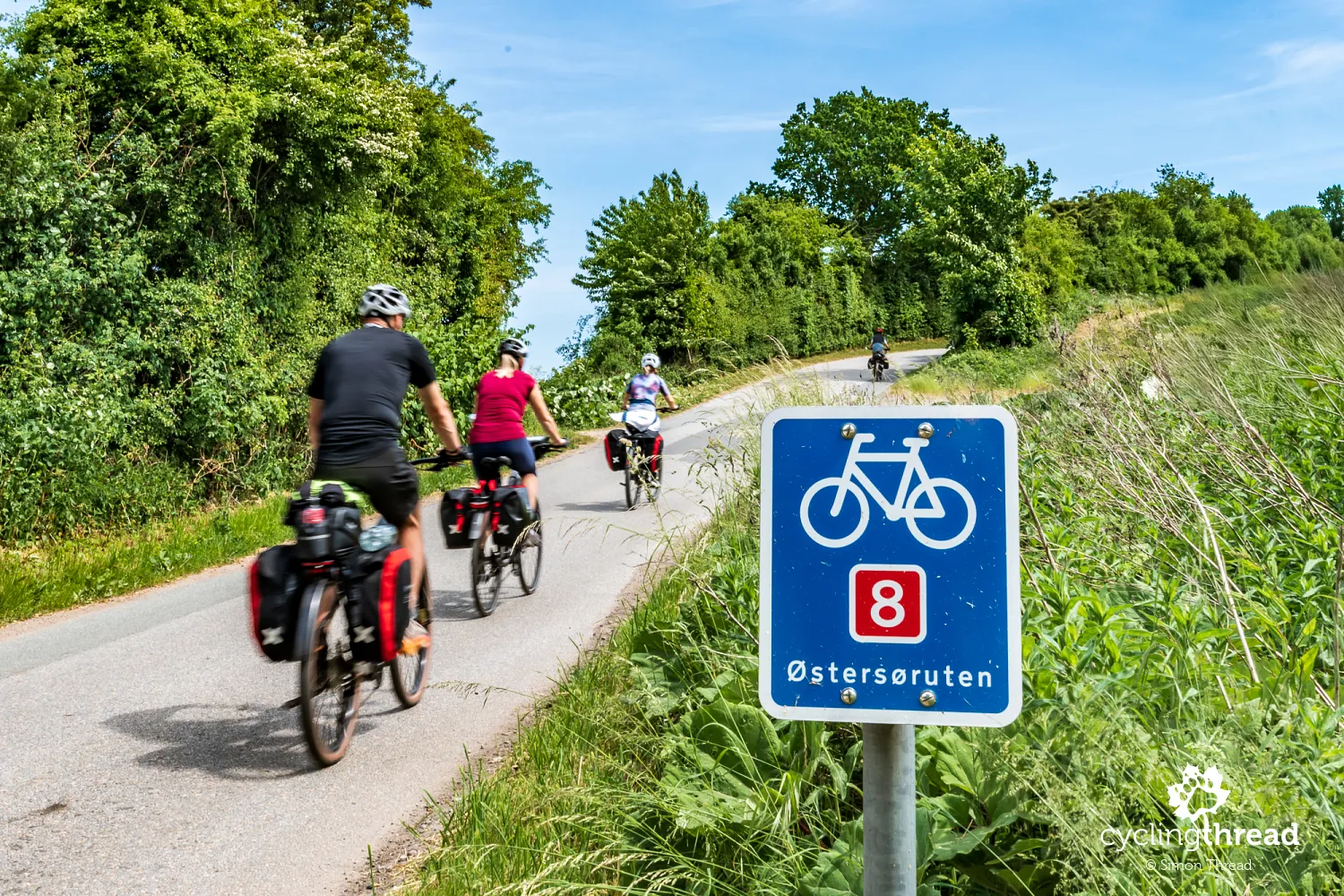
- Denmark's National Cycle Route 8
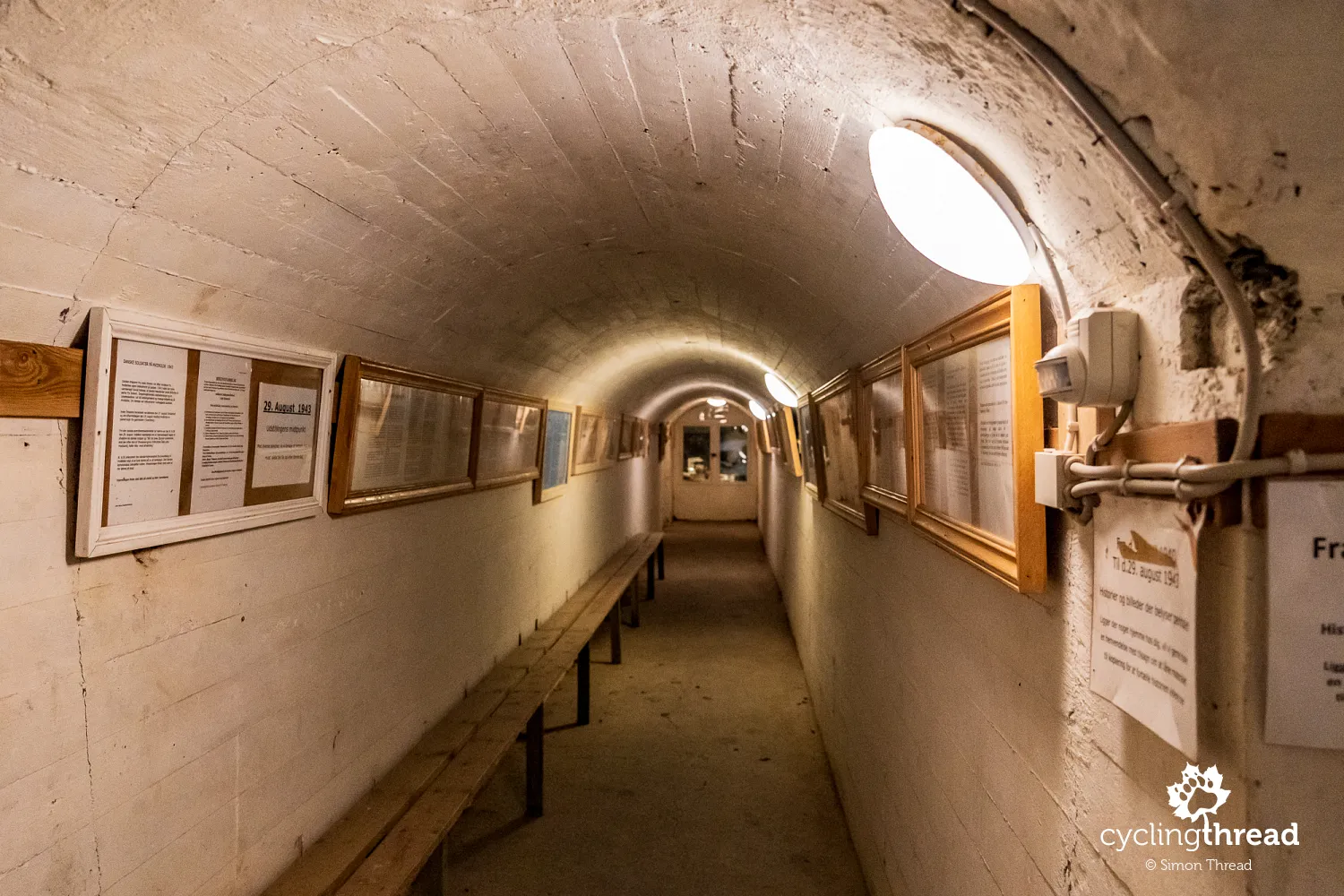
- A German wartime bunker on Funen
- The best sights in historic Svendborg
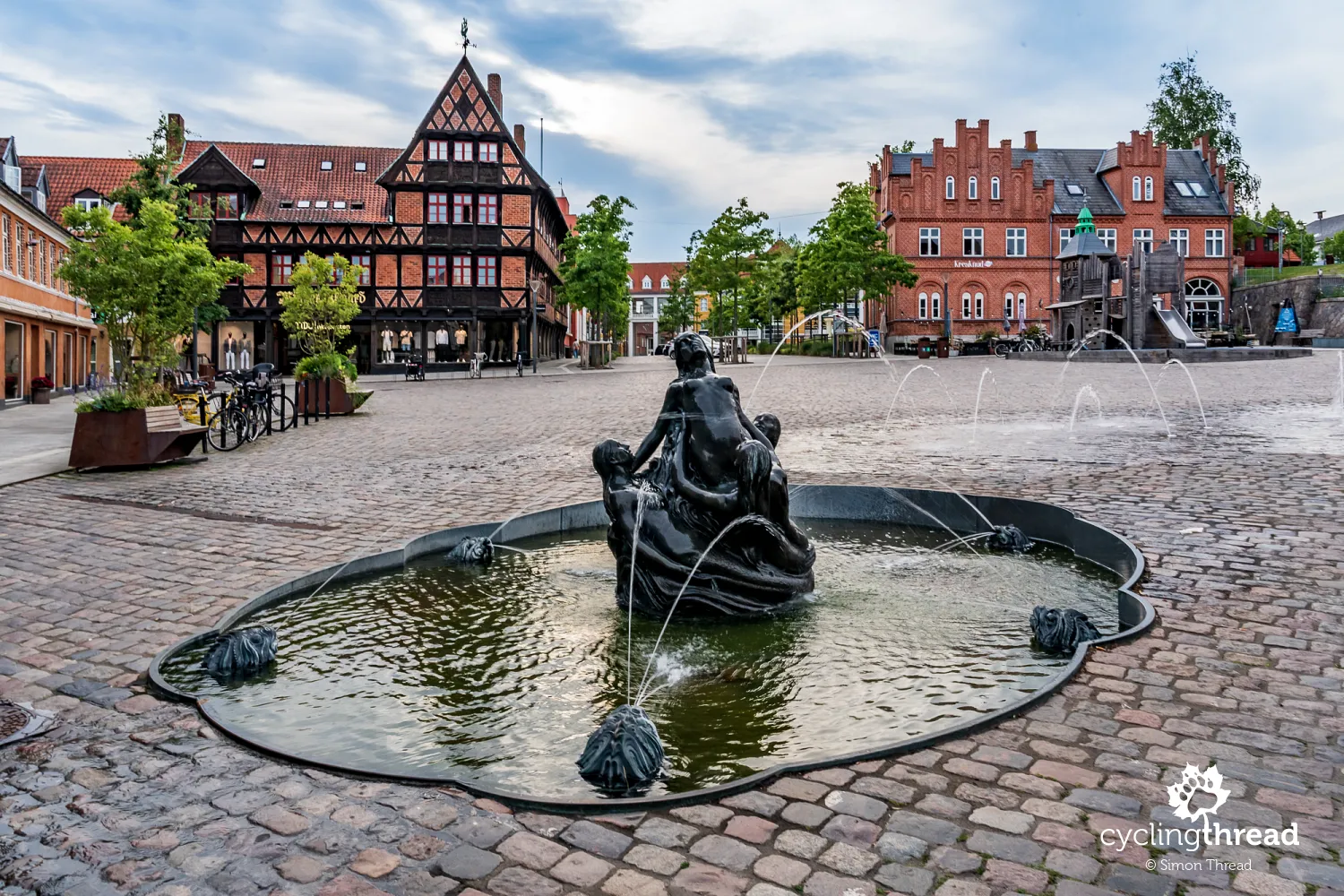
- Cyclist-friendly hotels on Funen
- Cycling along a former railway
- The famous Broholm Castle
- The largest Iron Age settlement in Scandinavia
- Glorup Gods historic estate
- When Nyborg became Denmark's capital
- Returning by Danish InterCity train
- One of Denmark's best cycling holidays
Cycling Funen: Denmark's third-largest island
Although Denmark is a small country, it has a remarkably varied coastline. Much of the country is made up of the Jutland Peninsula, while its capital, Copenhagen, is located on the island of Zealand. Between them lies Funen, Denmark's third-largest island, in the heart of the country. It is an important transport hub, with the main road and rail links between eastern and western Denmark crossing the island. Other major Danish islands include Lolland, Falster, Møn, the more distant Bornholm, and many smaller islands scattered between the North Sea and the Baltic Sea. This island geography gives Denmark a wide variety of landscapes, and cycling here often means riding with the sea close by, sometimes even taking a ferry to the next island.
The Castle Route (Herregårdsruten) in Denmark
Denmark is home to around 700 historic manor houses, palaces and castles, reflecting the country's long history and agricultural heritage. Their greatest concentration is on Funen. Thanks to its fertile soil and mild climate, the island became one of Denmark's most important farming regions, helping to create wealthy country estates and impressive residences. This is where the 660-kilometre Castle Route (Herregårdsruten) was created. It loops around the island through coastal scenery, forests and historic towns. In the south, additional branches lead to the neighbouring islands of Ærø and Langeland, allowing cyclists to explore part of the South Funen Archipelago.
Castles vs. manor houses on the Castle Route
The route's name is worth explaining. The Danish word herregård does not mean a castle in the medieval sense. Instead, it refers to a historic country estate - most often a manor house, palace or large estate once owned by the nobility. For this reason, the literal English name Castle Route can be slightly misleading, as it suggests a route linking only castles. In reality, most of the historic buildings along the route are elegant manor houses and palaces surrounded by parks and farmland, reflecting the Danish landscape far better than the fortified castles more commonly found elsewhere in Europe. This does not make the route any less appealing. On the contrary, understanding the meaning behind its name helps visitors appreciate its true character and avoids disappointment caused by expecting something different.
Road conditions on Funen's cycle network
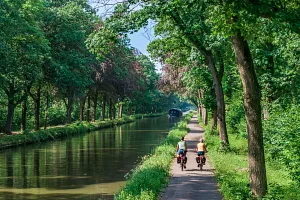
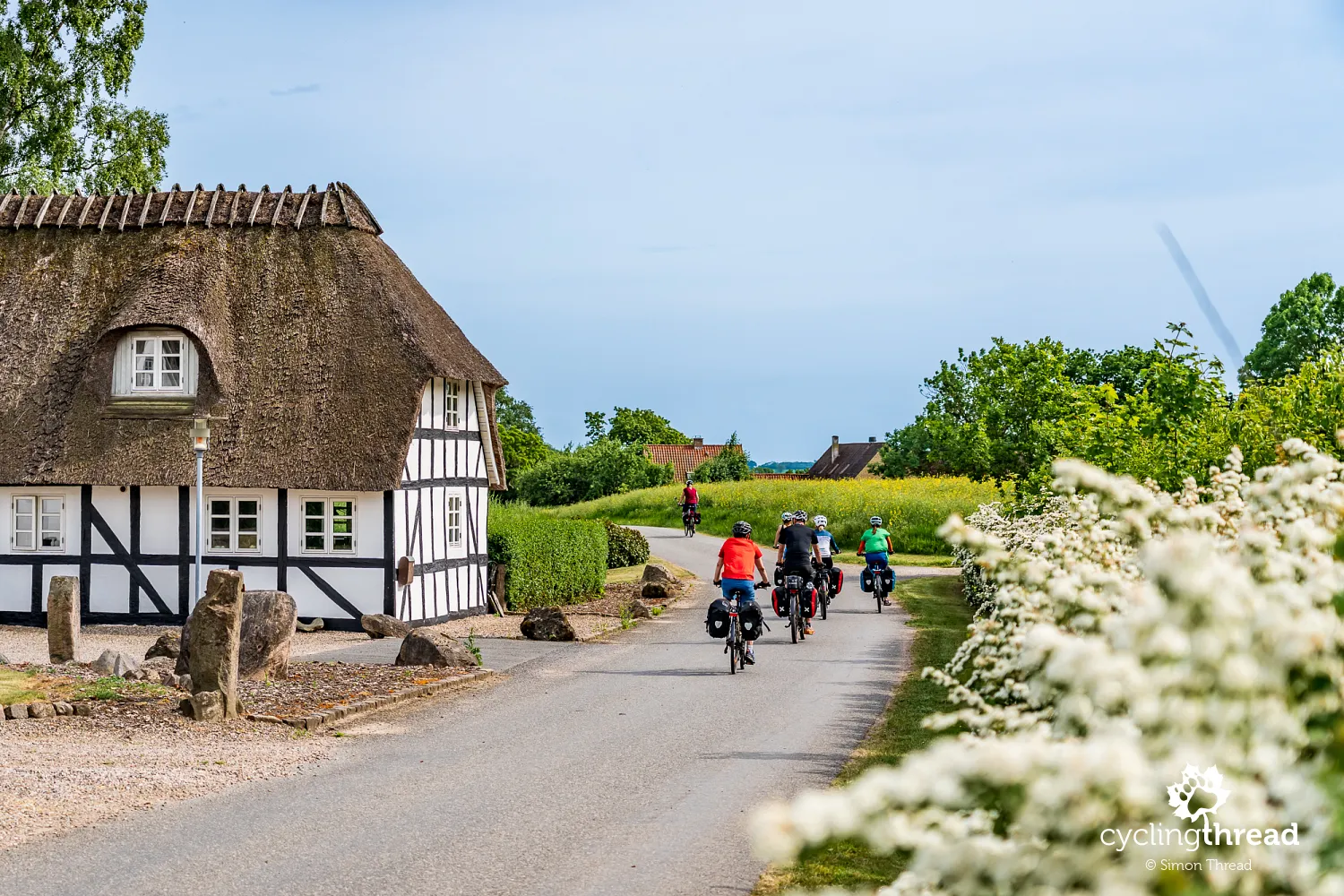
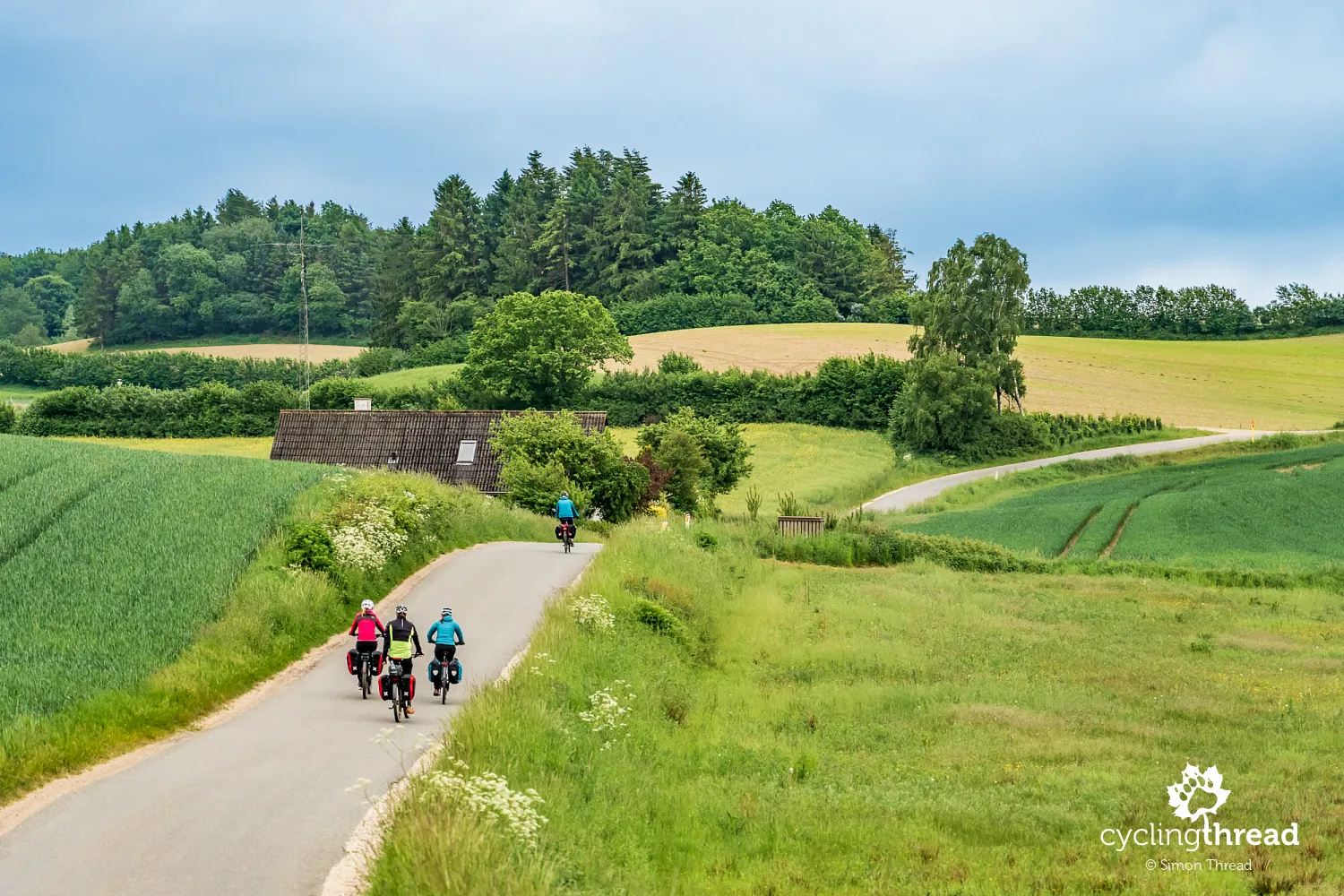
The Castle Route offers much more than a chance to discover Funen's historic estates. It also provides a good introduction to Danish cycling culture. Unlike many cycle routes in neighbouring Germany, dedicated cycle paths are surprisingly rare here. This is not because cycling infrastructure has been neglected, but because there is little need for it. Most of Funen's road network consists of quiet local asphalt roads used mainly by residents of nearby villages, farms and historic estates. Through traffic has largely been diverted onto the island's few higher-category roads, leaving the vast majority of local roads with very little traffic. As a result, cycling is both safe and enjoyable, while Danish drivers are accustomed to sharing the road with cyclists. All of this makes Funen an exceptionally cycle-friendly destination.
Bike Friends services on Funen
Funen is also home to the Bike Friends programme, a network of local shops, cafés, attractions, service points and other businesses that offer free help to cyclists. There are hundreds of Bike Friends locations across the island. Every one of them provides at least three basic services: a bicycle pump, drinking water and access to a toilet. Many also offer basic repair tools, charging points for e-bikes, or simply a place to take a break before continuing the ride. Although these facilities are simple, they solve many of the practical problems that arise during multi-day cycling trips. It is a good example of the Danish approach to cycle tourism, where supporting cyclists throughout the journey is considered just as important as the route itself.
Cycle-friendly accommodation on Funen
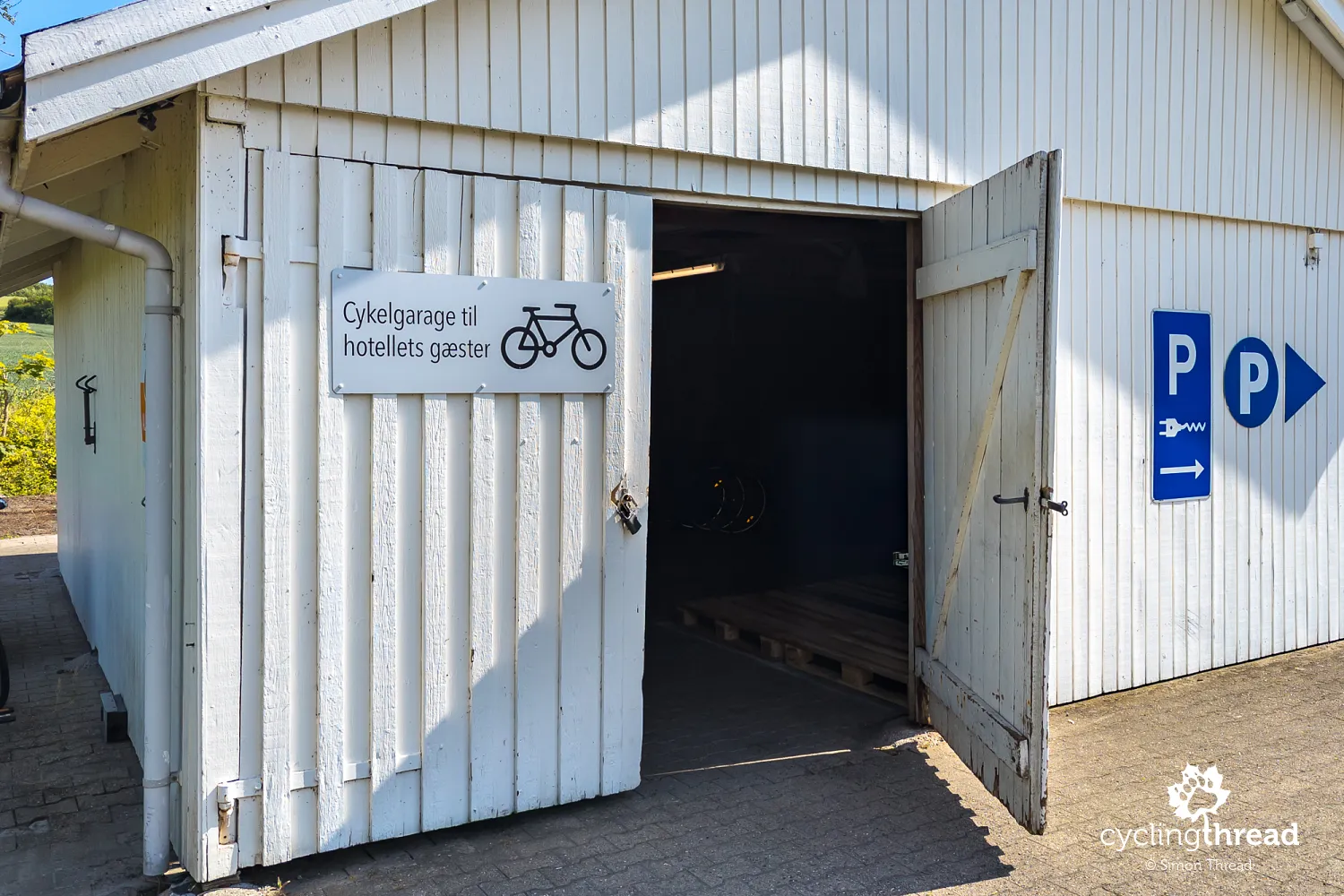
The route is complemented by a network of certified cyclist-friendly accommodation. Hotels, guesthouses and campsites participating in the programme accept one-night stays and provide secure locked bicycle storage, facilities for drying clothes, basic repair equipment, and often also bicycle washing stations and charging points for electric bikes. Thanks to these consistent standards, cyclists know exactly what facilities they can expect at every certified property on Funen. A list of certified accommodation is available on the region's official website, making it much easier to plan a multi-day cycling trip.
Excellent cycling route signage
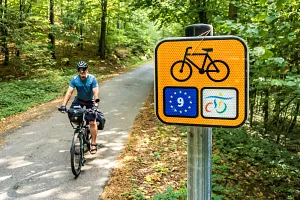
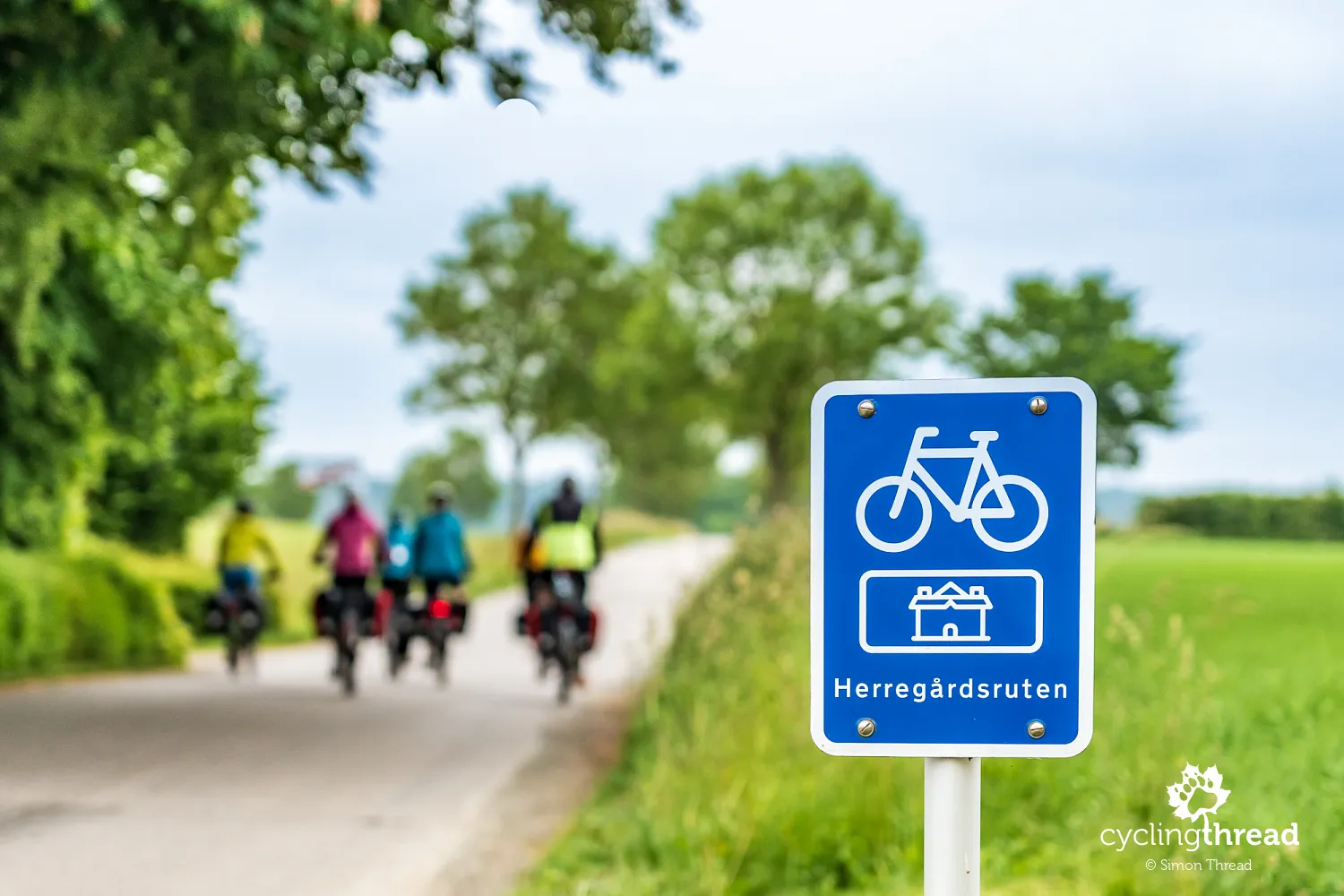
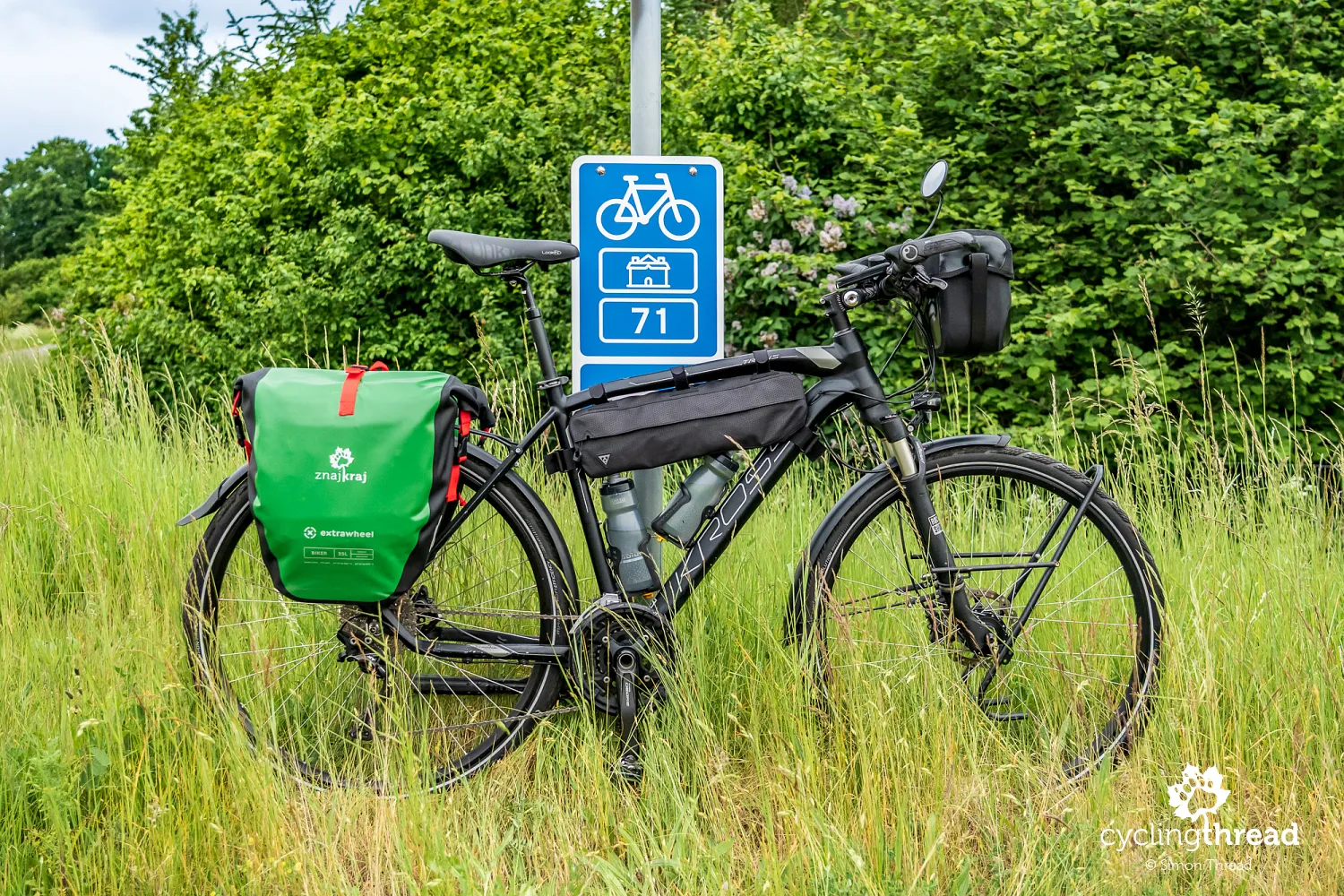
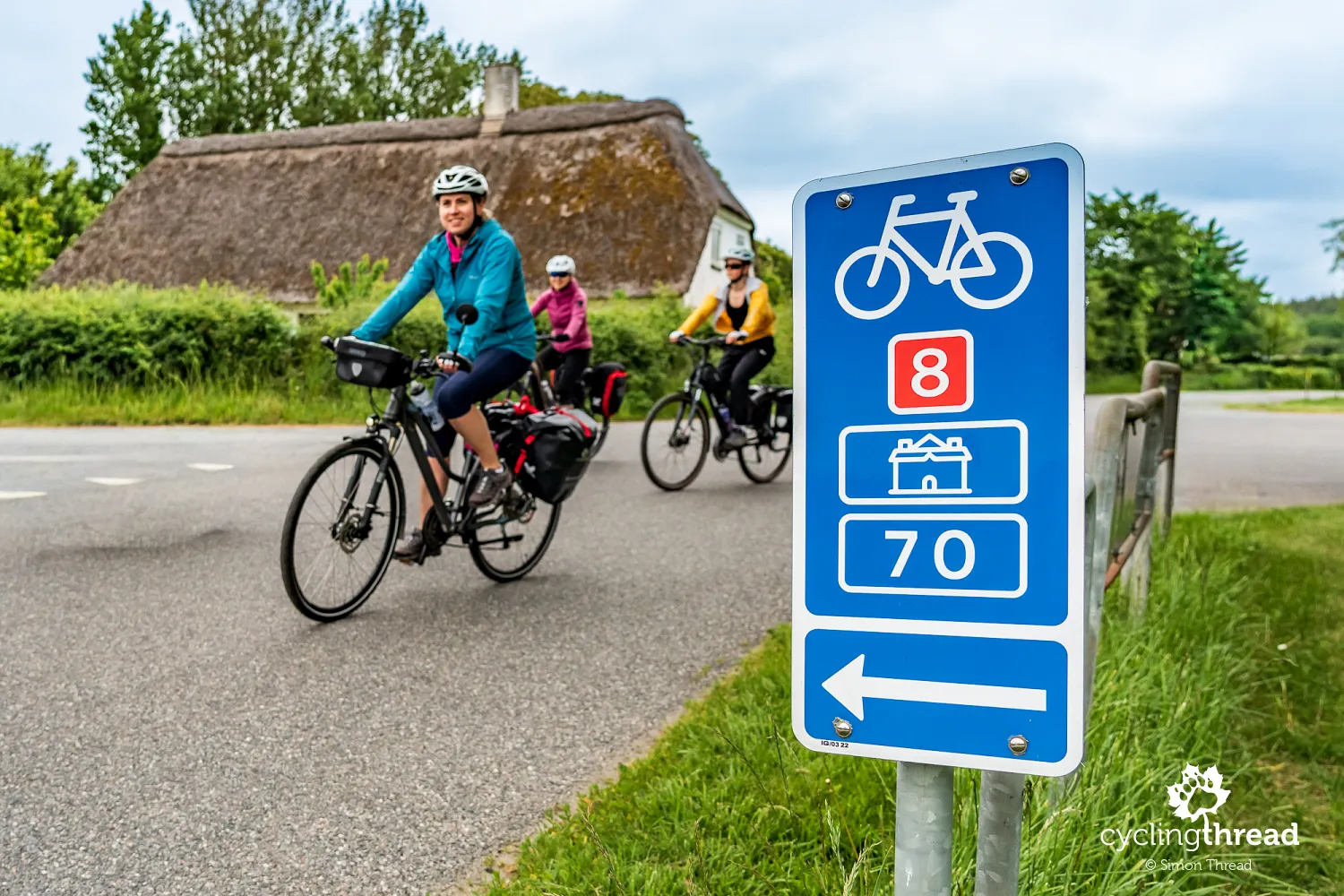
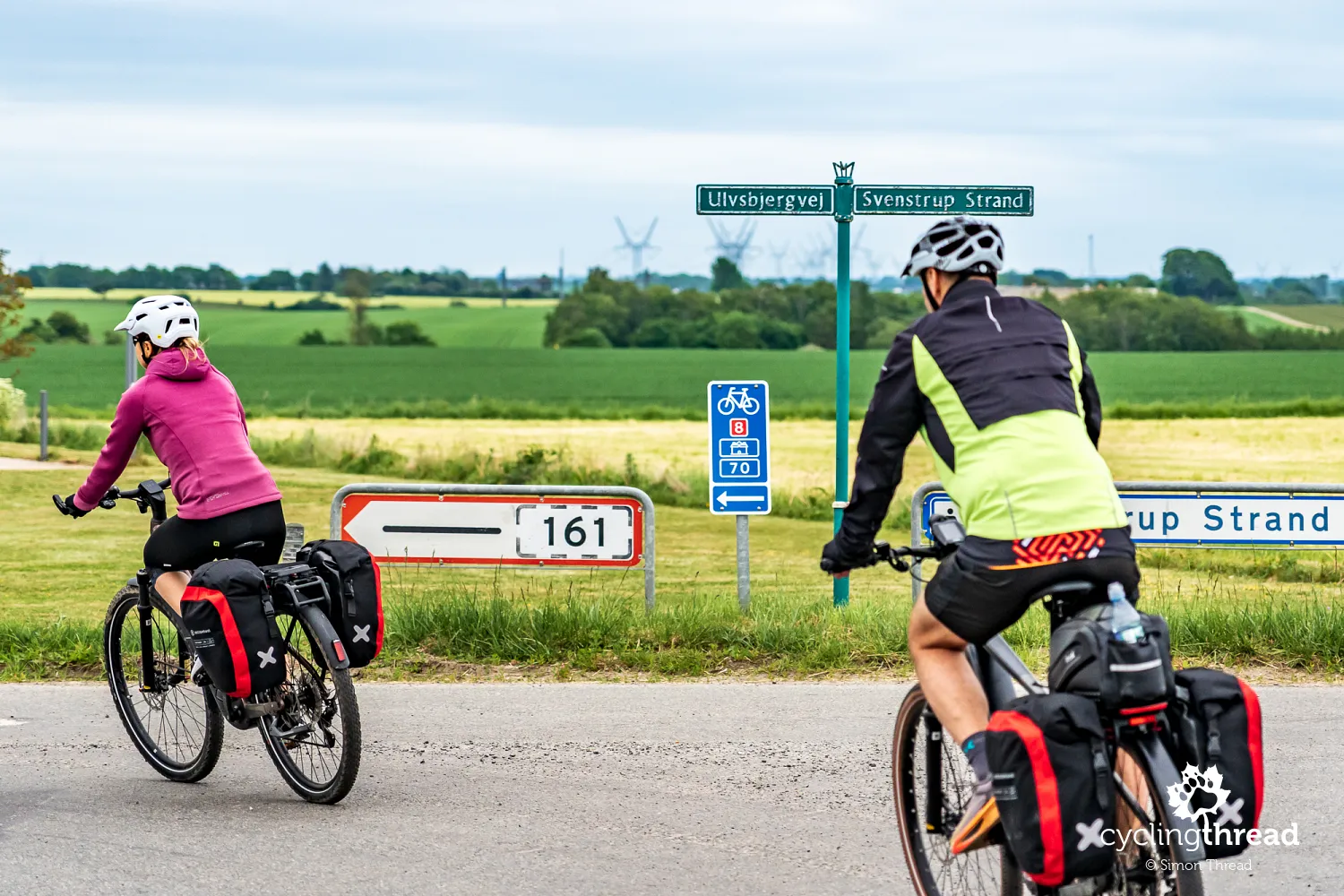
Getting around Funen's cycling routes is also easy thanks to the excellent waymarking. The Castle Route is marked with blue signs featuring a manor house symbol and the Danish name Herregårdsruten. On many sections, these are accompanied by a white number 8 on a red background, showing that the route shares its course with the Danish Baltic Sea Cycle Route. Direction signs at junctions clearly indicate the way ahead, making it difficult to lose the route even without GPS navigation. One interesting detail is that Denmark is one of the few countries where cycling signs are installed at cyclists' eye level rather than high on poles, making them much easier to spot while riding.
Planning your Castle Route itinerary
We started our journey across Funen in Middelfart, on the island's western coast. From there, we followed the southern section of the Castle Route, adding the branch through the islands of the South Funen Archipelago before finishing in Nyborg on the eastern side of the island. Including the island section, our route was around 270 kilometres long. The mainland alternative is slightly shorter at about 250 kilometres. Both versions are ideal for a relaxed four-day trip, with plenty of time to visit historic residences, charming towns and other attractions along the way. From Nyborg, we returned to Middelfart, where we had left our car, on a direct InterCity train.
Starting point: Middelfart and the Little Belt
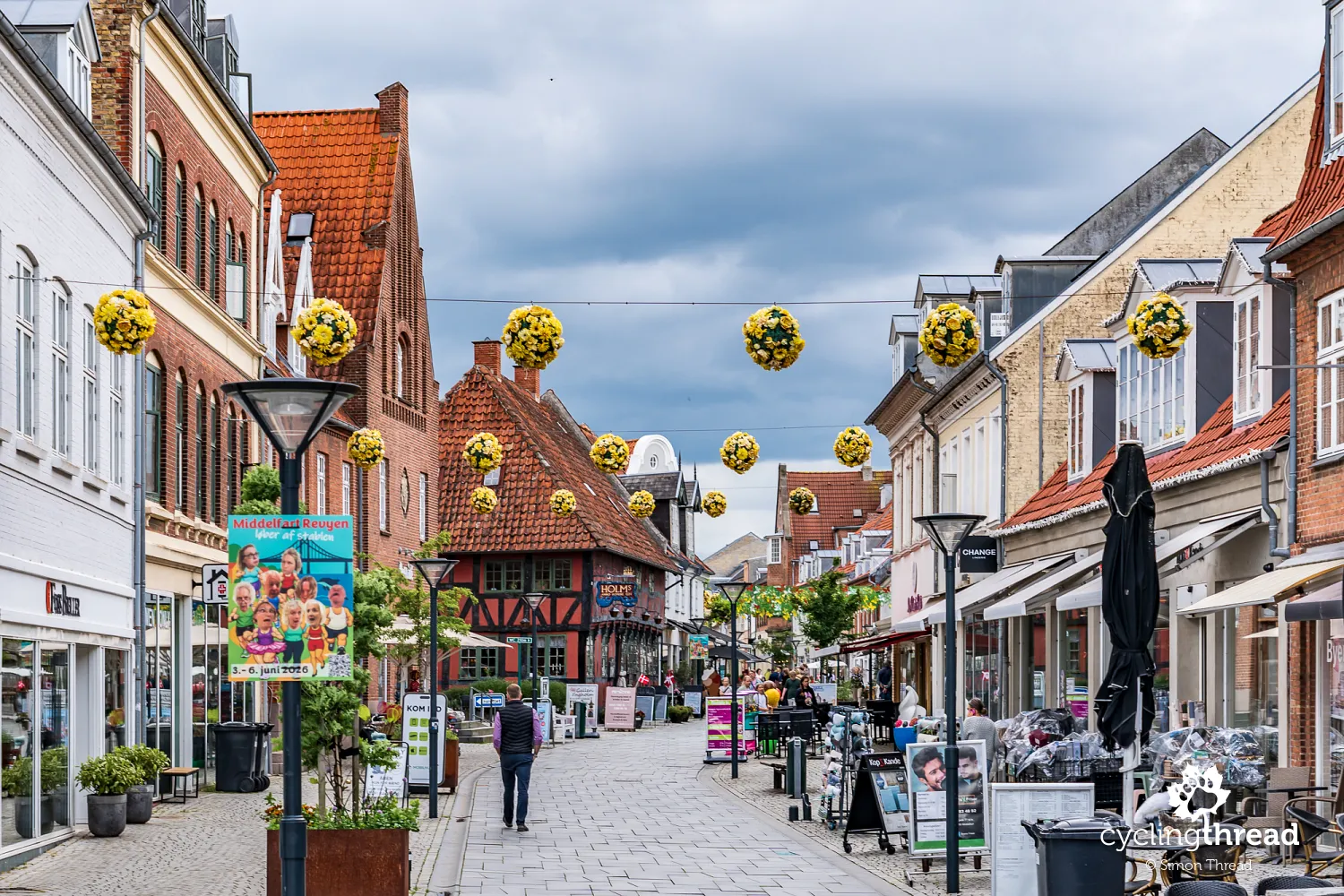
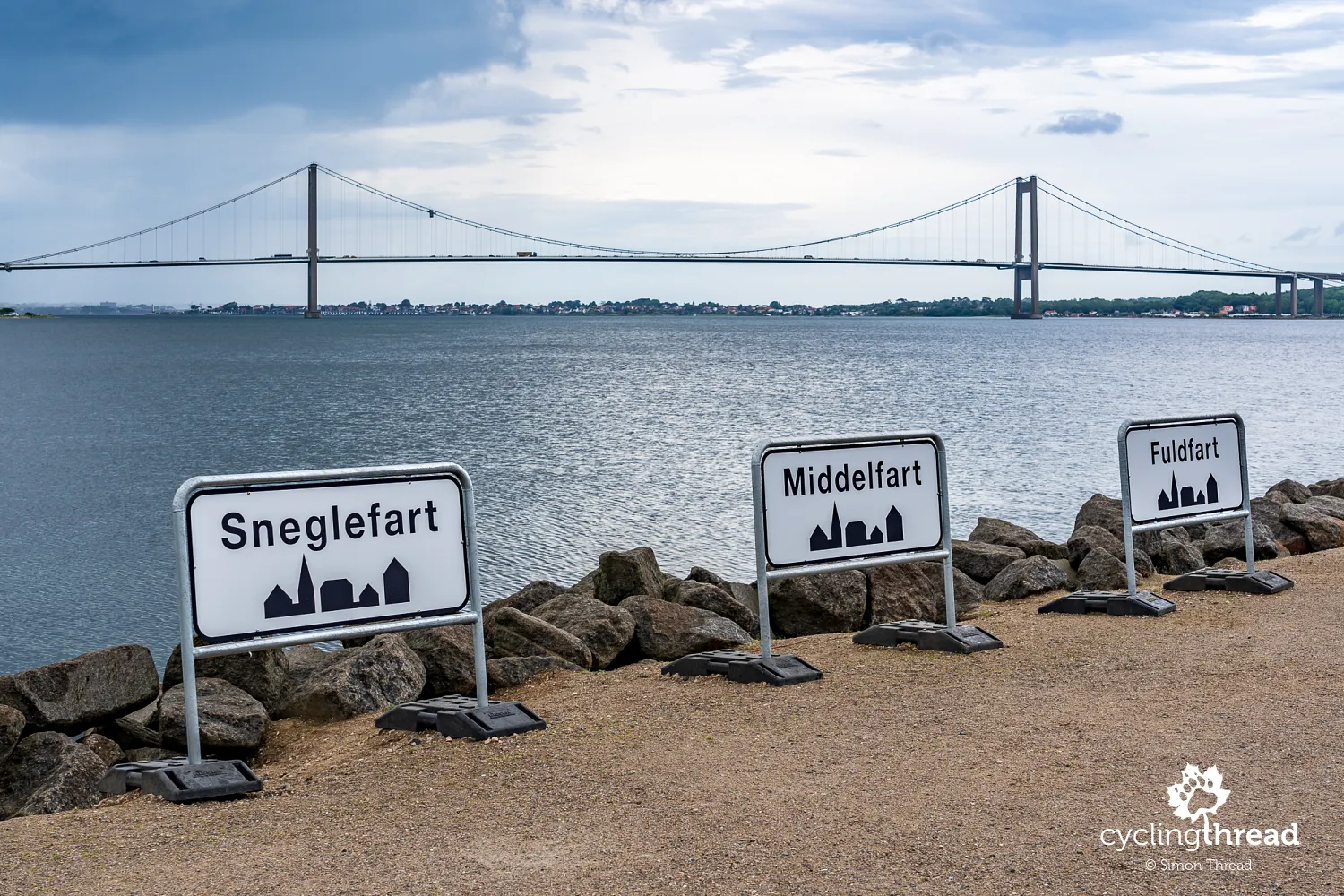
Middelfart is an excellent place to start a multi-day cycling trip around Funen. The town has grown for centuries thanks to its location on the Little Belt, the strait separating Funen from the Jutland Peninsula and one of Denmark's most important transport routes. Since 1935, the two shores have been connected by the Little Belt Bridge, followed by a parallel motorway bridge in 1970, making Middelfart one of western Denmark's main transport hubs. Today, it combines the atmosphere of a small seaside town with well-developed tourist facilities. It offers a good choice of accommodation, a convenient location as the main gateway to Funen from the west, and several attractions worth visiting before setting off on the Castle Route.
Bridgewalking experience above the Little Belt
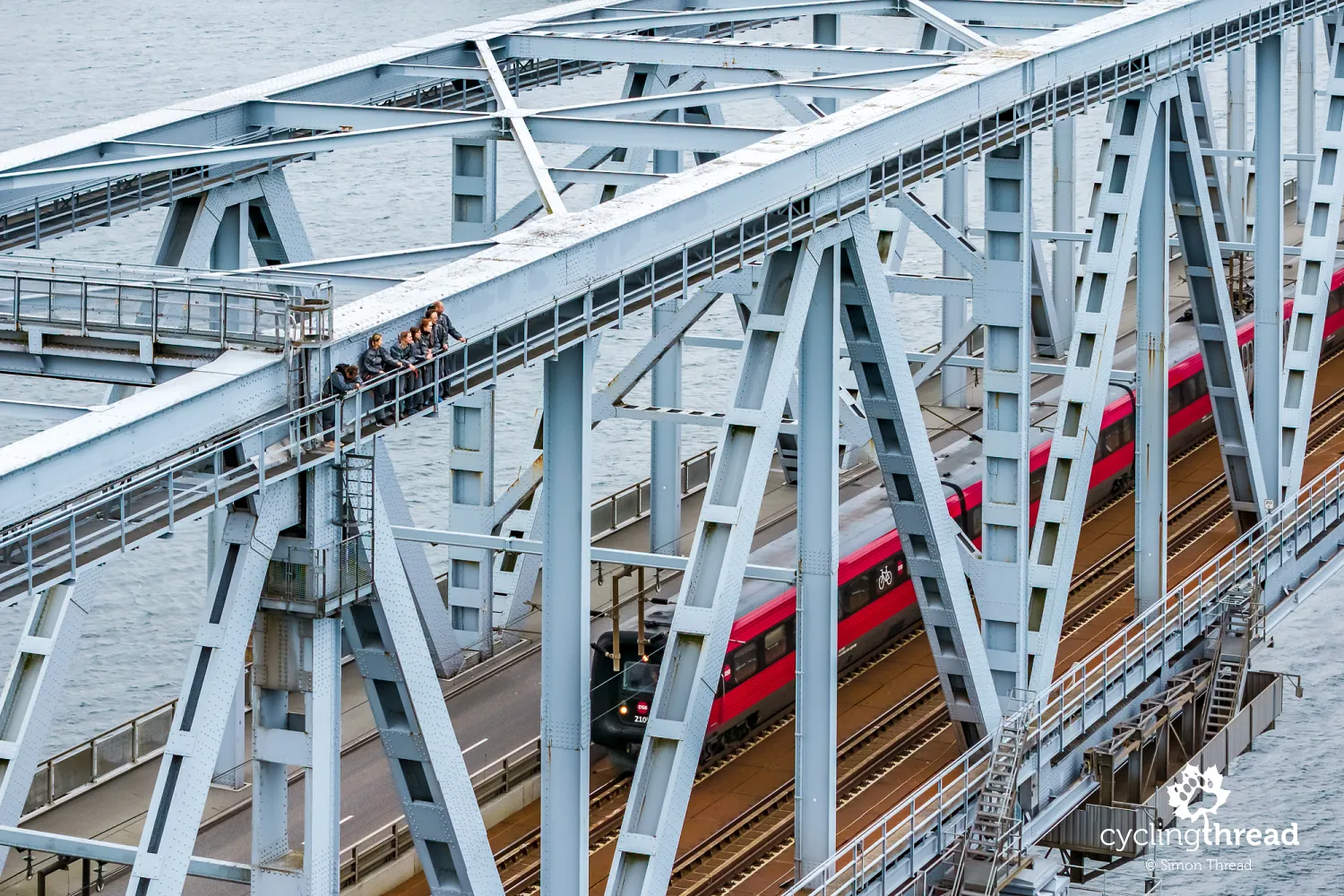
One of Middelfart's best-known attractions is Bridgewalking, a guided walk across the old Little Belt Bridge, which was also how we began our visit to Funen. Wearing safety suits and harnesses, and leaving behind personal items such as mobile phones, visitors follow a specially designed walkway high above the water. It is a unique way to experience the Little Belt and the surrounding landscape from a completely different perspective. Below the bridge, ships pass through the strait, while harbour porpoises and other marine mammals can sometimes be spotted in the water. Around the bend, you can also see the newer Little Belt Bridge, which carries the motorway connecting Funen with Jutland. The walk lasts about an hour and offers a good introduction to the strategic importance of this narrow waterway, one of Denmark's key transport corridors for centuries.
Middelfart also has several other attractions worth seeing before starting your cycling trip. They include the CLAY Museum of Ceramic Art Denmark, home to one of the country's finest collections of Danish ceramic art, and the Danish Psychiatric Museum, which explores the history of mental health care and psychiatric hospitals in Denmark. It is also worth taking a walk through the town centre, with its harbour, historic streets and buildings that reflect Middelfart's long role as an important trading and transport centre. The area's most impressive historic landmark, however, is Hindsgavl Castle, beautifully set on the shores of the Little Belt.
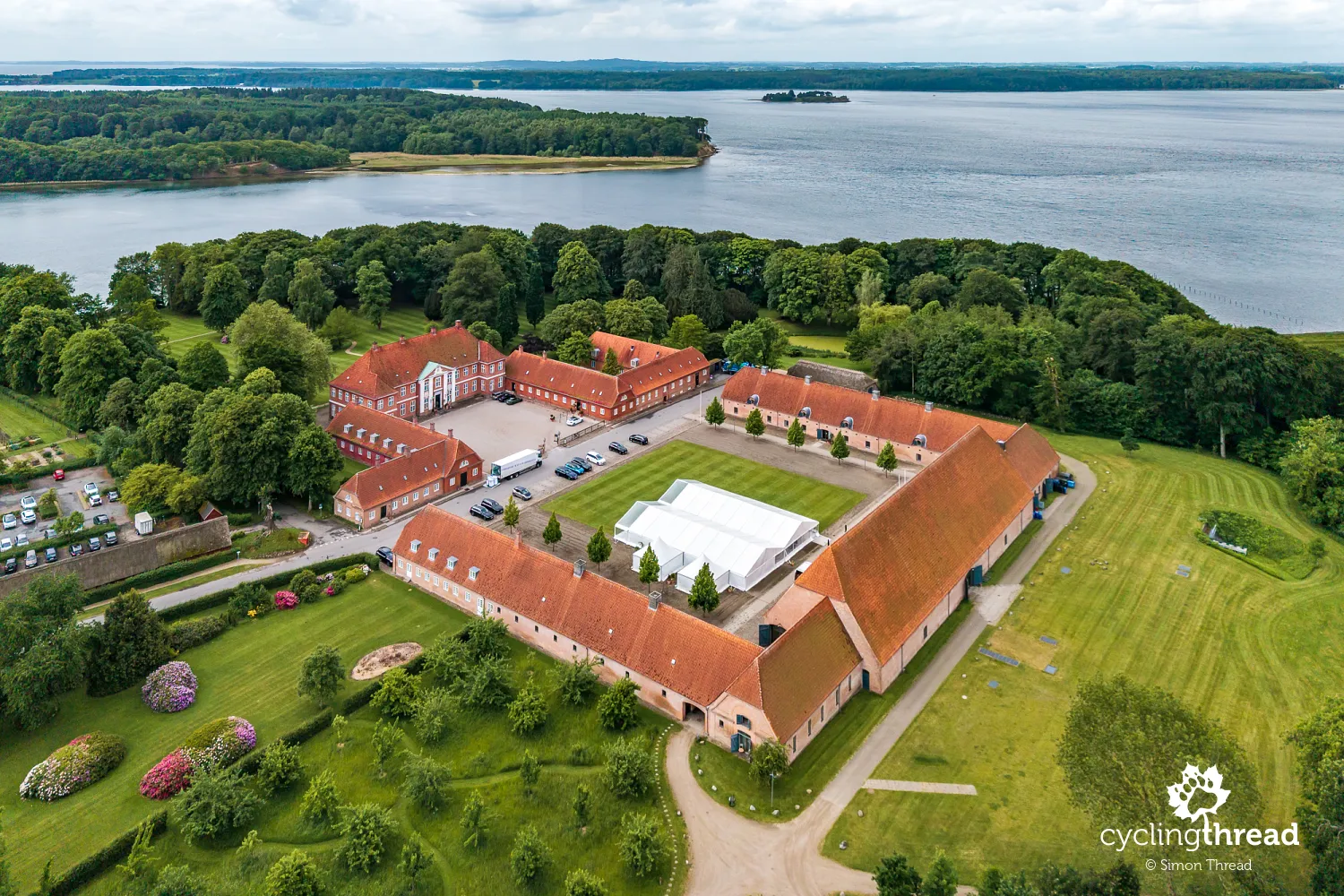
Hindsgavl Castle stands on the site of a medieval royal fortress that once guarded one of the most important crossings between Funen and Jutland. The fortress was heavily damaged during the wars with Sweden in the 17th century, and after a severe storm in 1694 it was never rebuilt. The present Neoclassical mansion was completed in 1784 by Chamberlain Christian Holger Adeler, who transformed the former royal stronghold into an elegant country residence. Today it serves as a hotel and conference centre, but visitors are free to explore the surrounding park and former estate. The paths leading towards the Little Belt are particularly enjoyable, offering fine views of the strait and the bridges linking Funen with Jutland. Another highlight is the herd of fallow deer, often seen even before reaching the mansion along the tree-lined avenue from Middelfart.
Cycling Without Age across Denmark
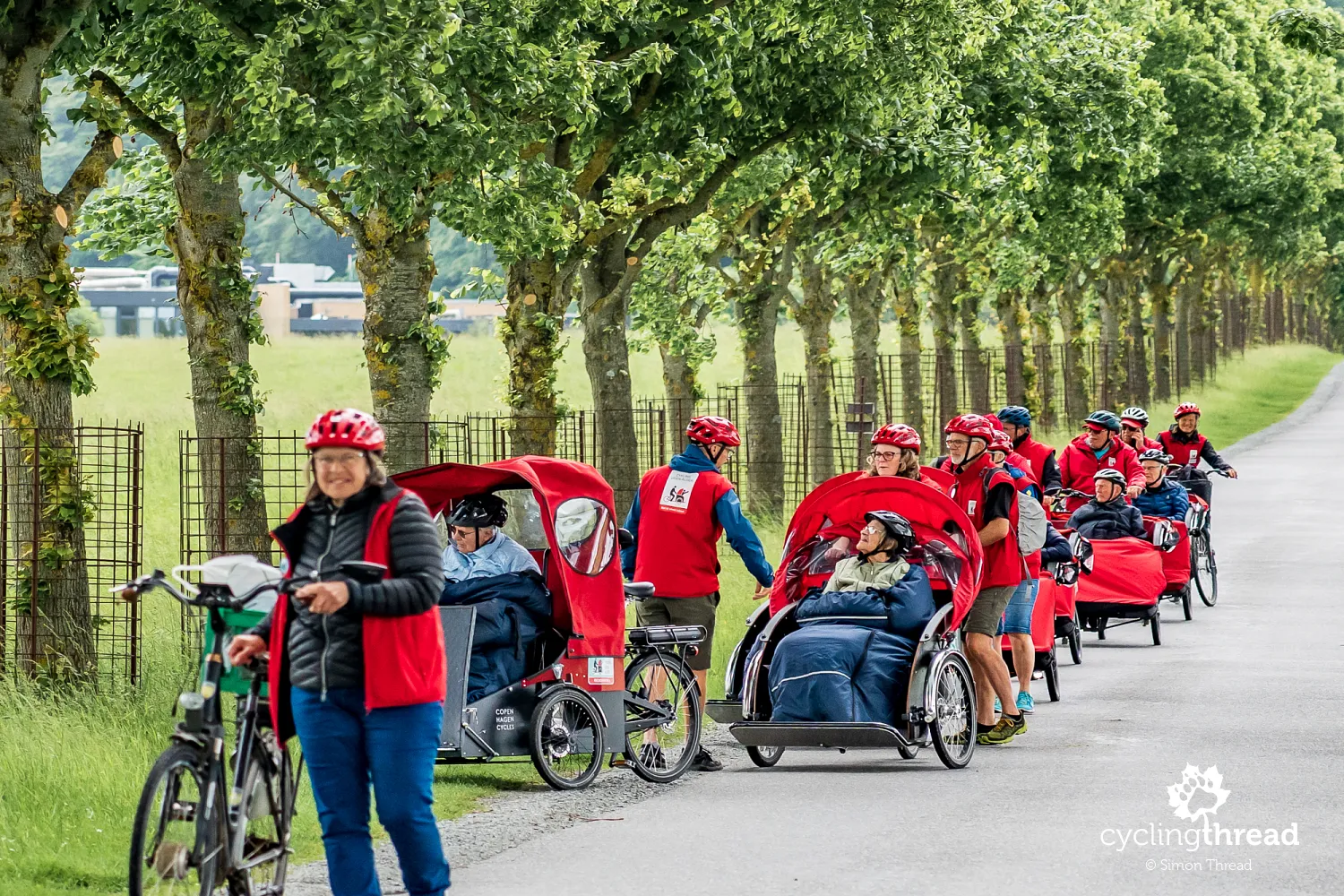
It was on this avenue that we came across an unusual cycling group with the words Cykling uden Alder ("Cycling Without Age") on their vehicles. This Danish social initiative enables older people and those with limited mobility to enjoy bike rides in specially designed cycle rickshaws. The bikes are ridden by volunteers, allowing passengers to revisit familiar places, spend time outdoors and stay connected with their local community. The idea started in Denmark and has since spread to many countries across Europe and beyond. Watching several of these rickshaws moving quietly along the avenue was not only an interesting sight, but also a clear example of the importance Danish society places on helping older people remain active and engaged in everyday life.
One of Denmark's best-signposted cycling routes
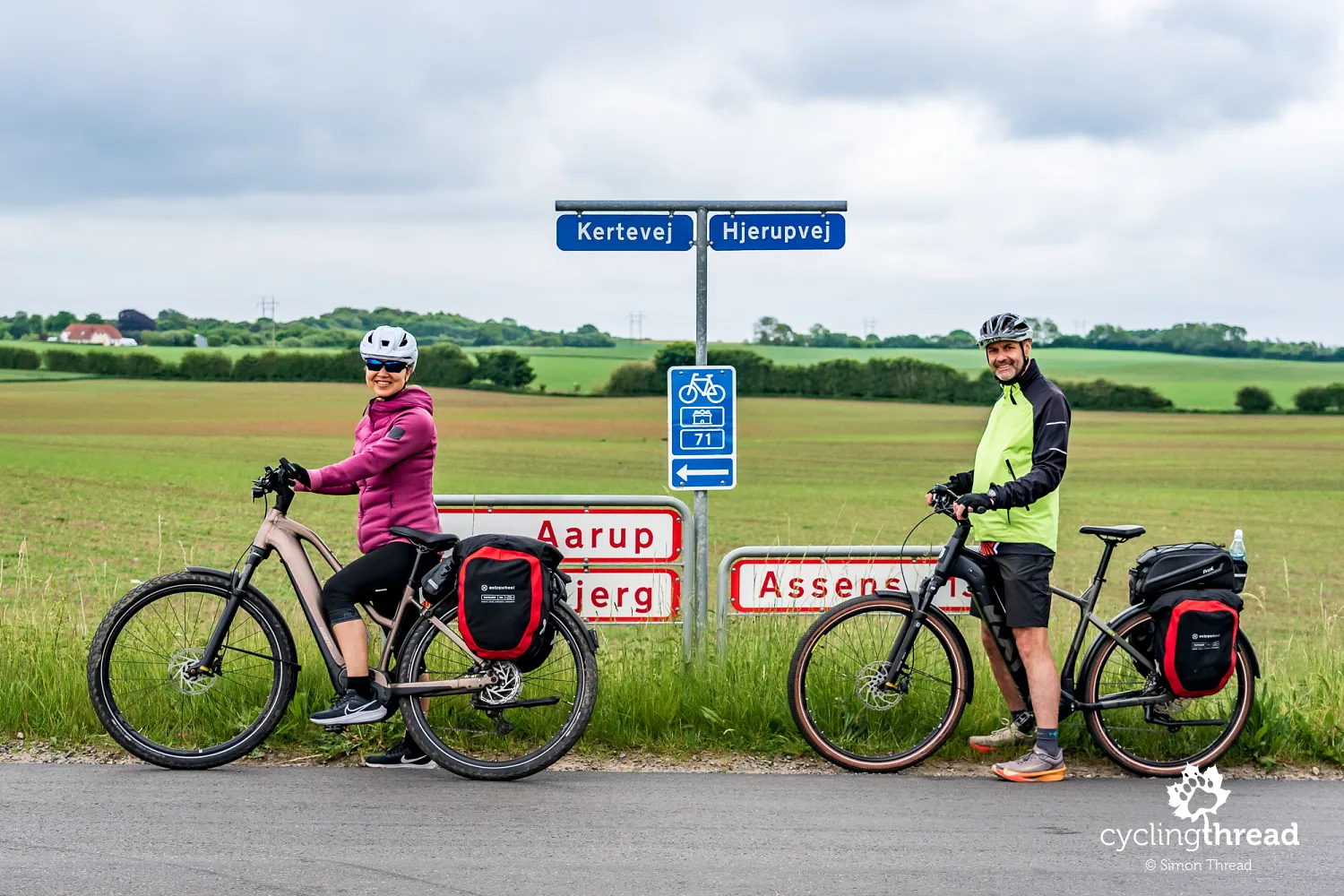
Leaving Middelfart, we followed the blue signs of the Castle Route. It quickly became clear that this was one of the best signposted cycling routes we had ridden in recent years. It would be easy to complete the entire route without GPS or any digital navigation. Direction signs appeared at almost every junction and wherever a change of direction was needed, so there was rarely any need to stop and check the map. As the unofficial guide of our group, I soon trusted the signage completely and felt comfortable letting everyone ride at their own pace, even without navigation. The only surprise was the lack of distance signs. Unlike many other cycling routes, there are no boards showing the remaining distance to the next town or attraction. Perhaps they are still planned for the future.
Funen's new cycle node network
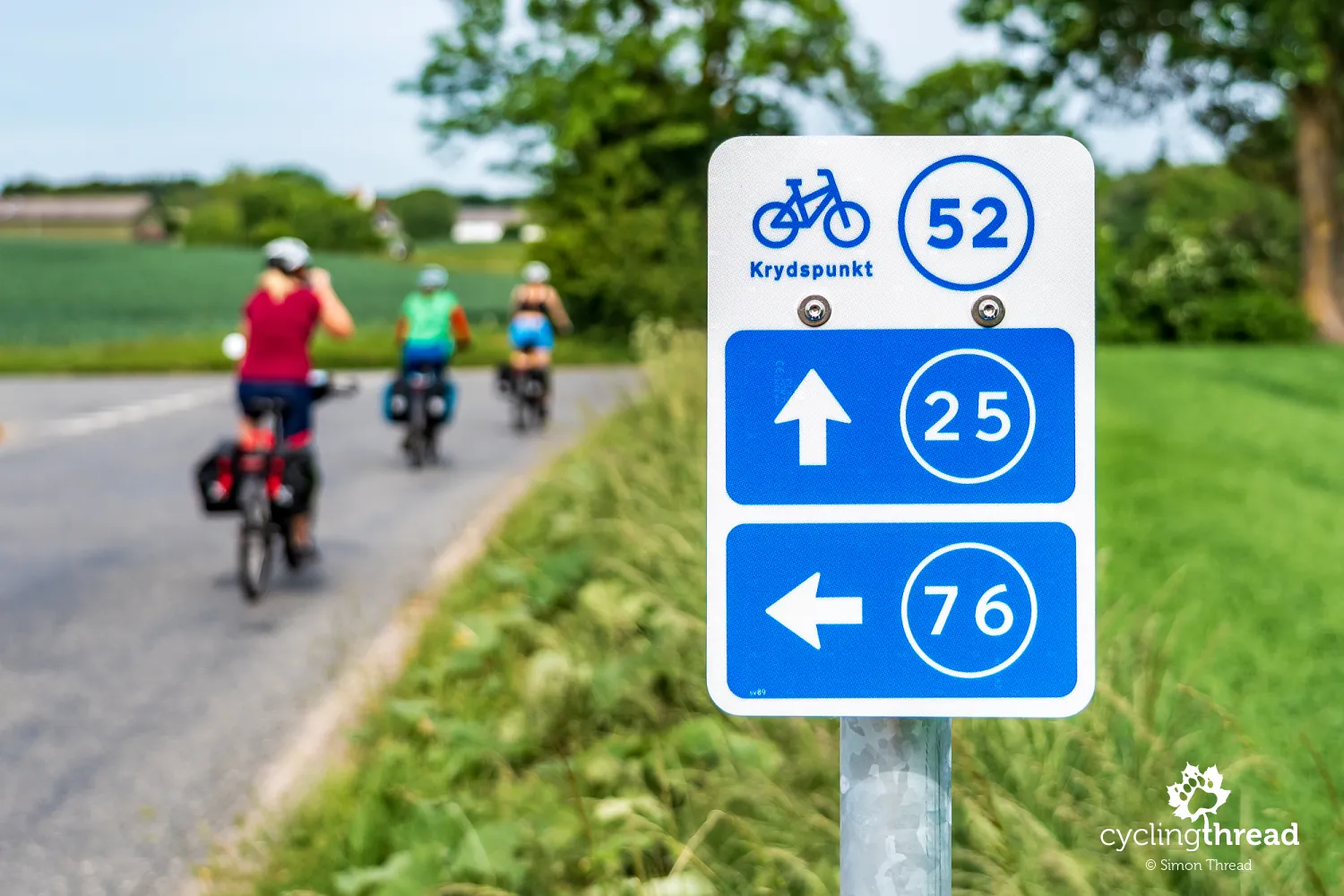
A useful addition for cyclists on Funen is the new cycle junction network, a system already well known from other European countries, especially the Netherlands, where such numbered points are commonly known as cycle nodes. At each junction, signs point towards the next numbered nodes, so cyclists can simply follow a sequence of numbers and easily create their own route or modify it along the way. The system is particularly convenient for spontaneous detours to small villages, manor houses or other places away from the Castle Route. We found the new signs clear, easy to spot and simple to understand, even without constantly checking the map or navigation. For touring cyclists, it is another small detail that makes exploring Funen pleasantly straightforward.
Historic Danish manor houses
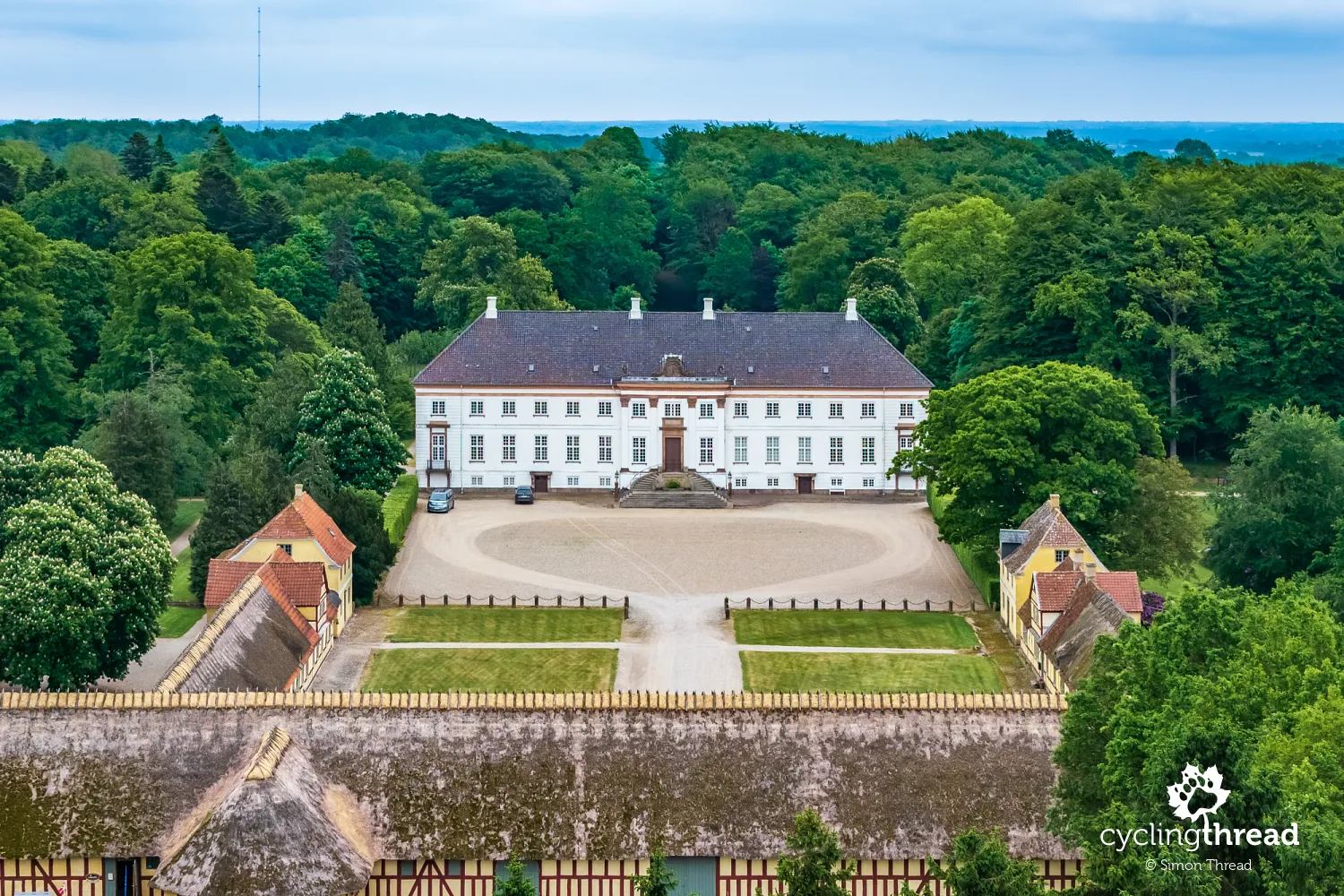
Before long, the first Danish herregårde began to appear along the route. These historic country estates are the defining feature of the Castle Route and can be found all along its length. Some are large estates with an impressive manor house or palace surrounded by farm buildings. Others are much smaller and more intimate, often consisting of a single three- or four-winged building enclosing a courtyard. Many are approached by long tree-lined avenues, while parks, ponds and former farm buildings complete the setting. Despite their differences in size, architecture and age, they all seem to blend naturally into the peaceful landscape of Funen.
Cycling on quiet Danish country roads
We soon discovered that Denmark is not as flat as many people think. Funen has no long or steep climbs, but the route is constantly going up and down, adding much more elevation than you might expect before the trip - often more than 500 metres a day. The climbs are short and generally gentle, so they are not particularly demanding, even for less experienced cyclists. However, there are enough of them to make your legs feel the effort by the end of the day. The reward comes at the top, where many hills offer wide views across fields, forests and, in places, the coastline.
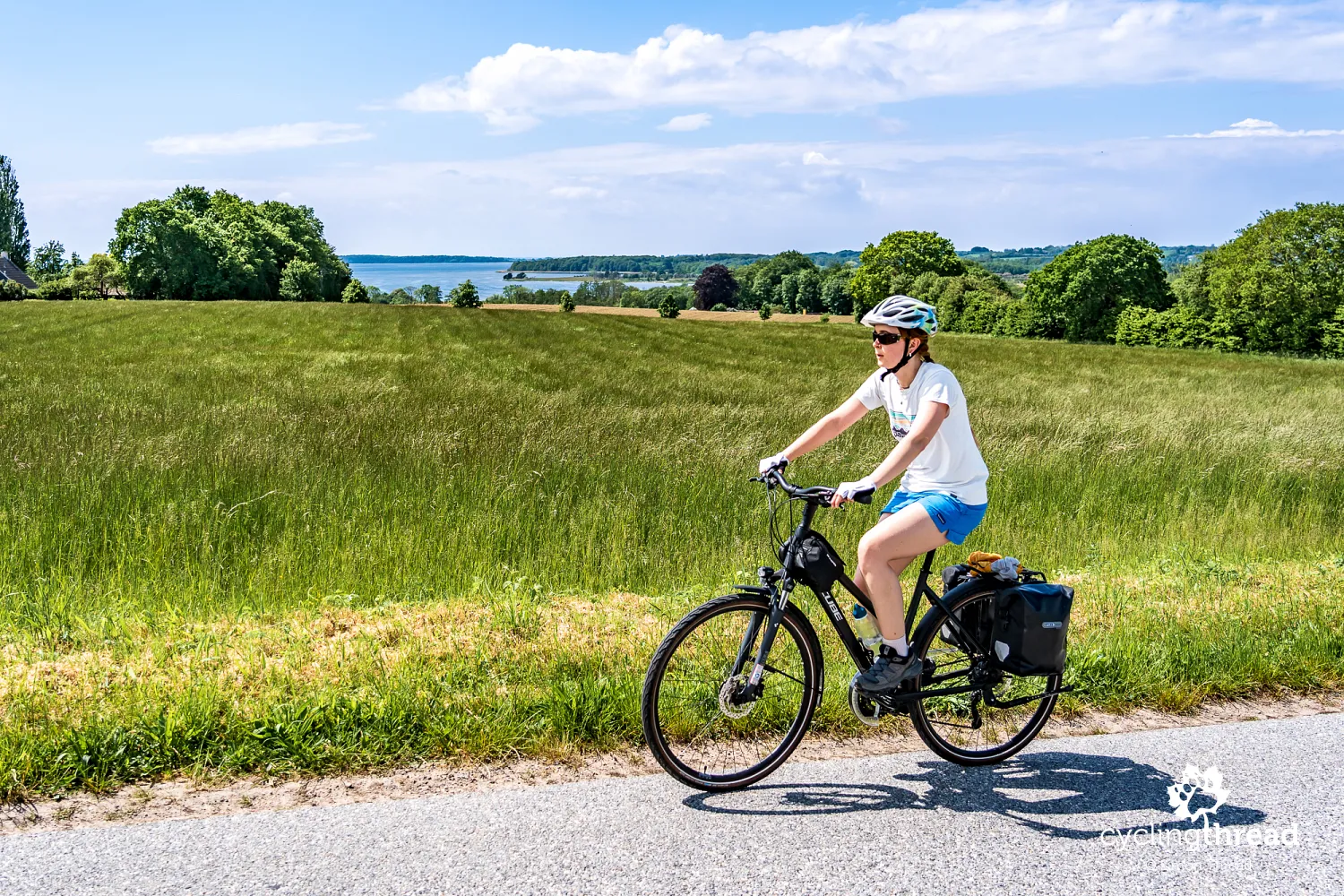
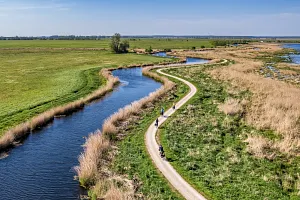
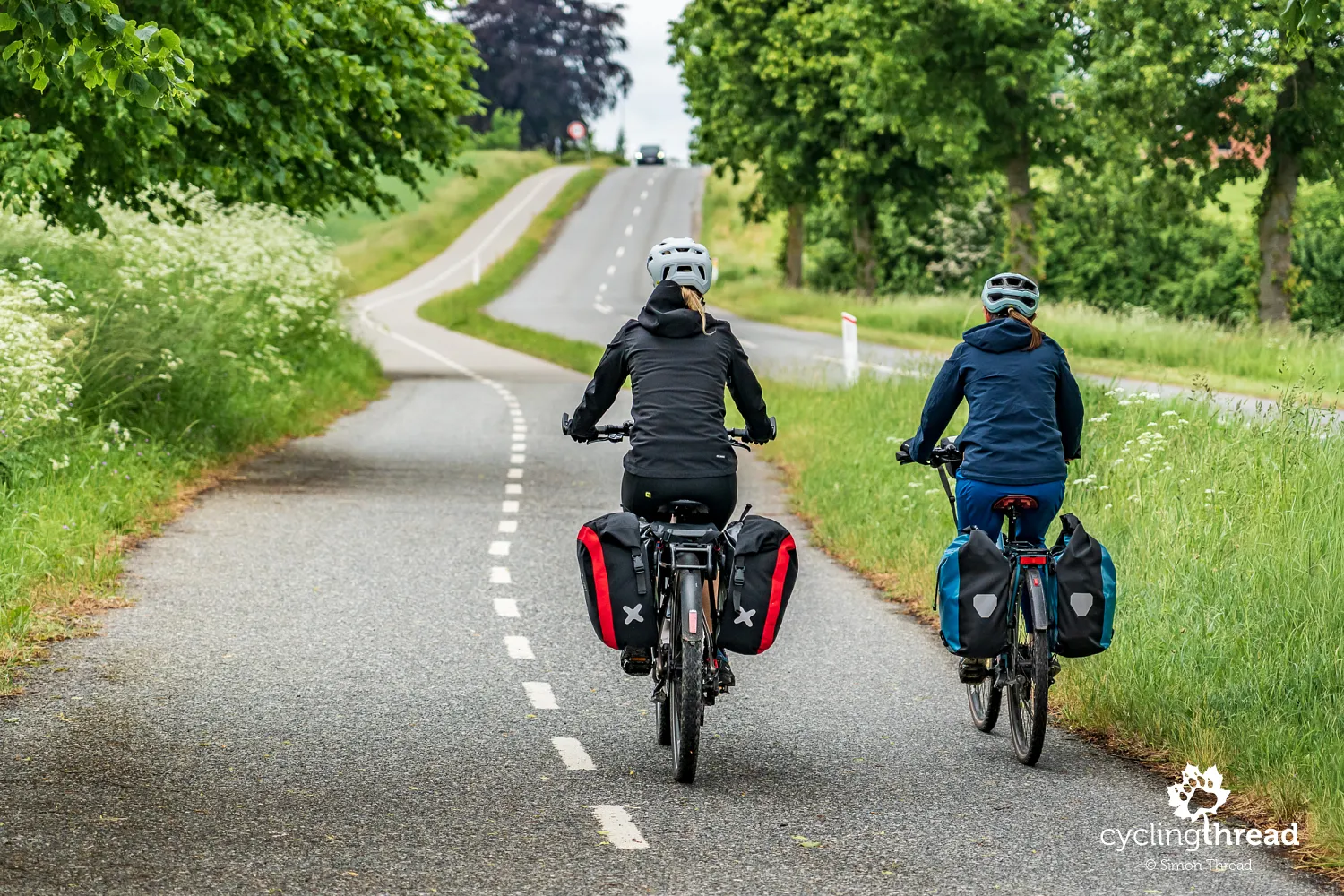
With every kilometre, we got a better feel for cycling on Funen. Most of the Castle Route follows ordinary public roads with surprisingly little traffic. It was common to ride for several dozen minutes without seeing a single car, enjoying the road almost entirely to ourselves. Even when cars did appear, drivers were patient, left plenty of space when overtaking and clearly respected cyclists. This makes riding both relaxed and enjoyable. Although I am generally a strong supporter of dedicated cycle paths and good cycling infrastructure, I honestly do not remember a single moment on the Castle Route when we missed them.
Two fascinating museums at Krengerup
The highlight of our first day was Krengerup. Although it is often called a castle, it is in fact a classic Danish herregård - a historic country estate. The estate dates back to the 14th century, while the present manor house was built in the first half of the 17th century and later remodelled several times. It remains privately owned and is surrounded by former farm buildings, a landscaped park and extensive green spaces. Visitors are welcome to walk around the courtyard and park, while the interiors are open only on guided tours and on selected dates.
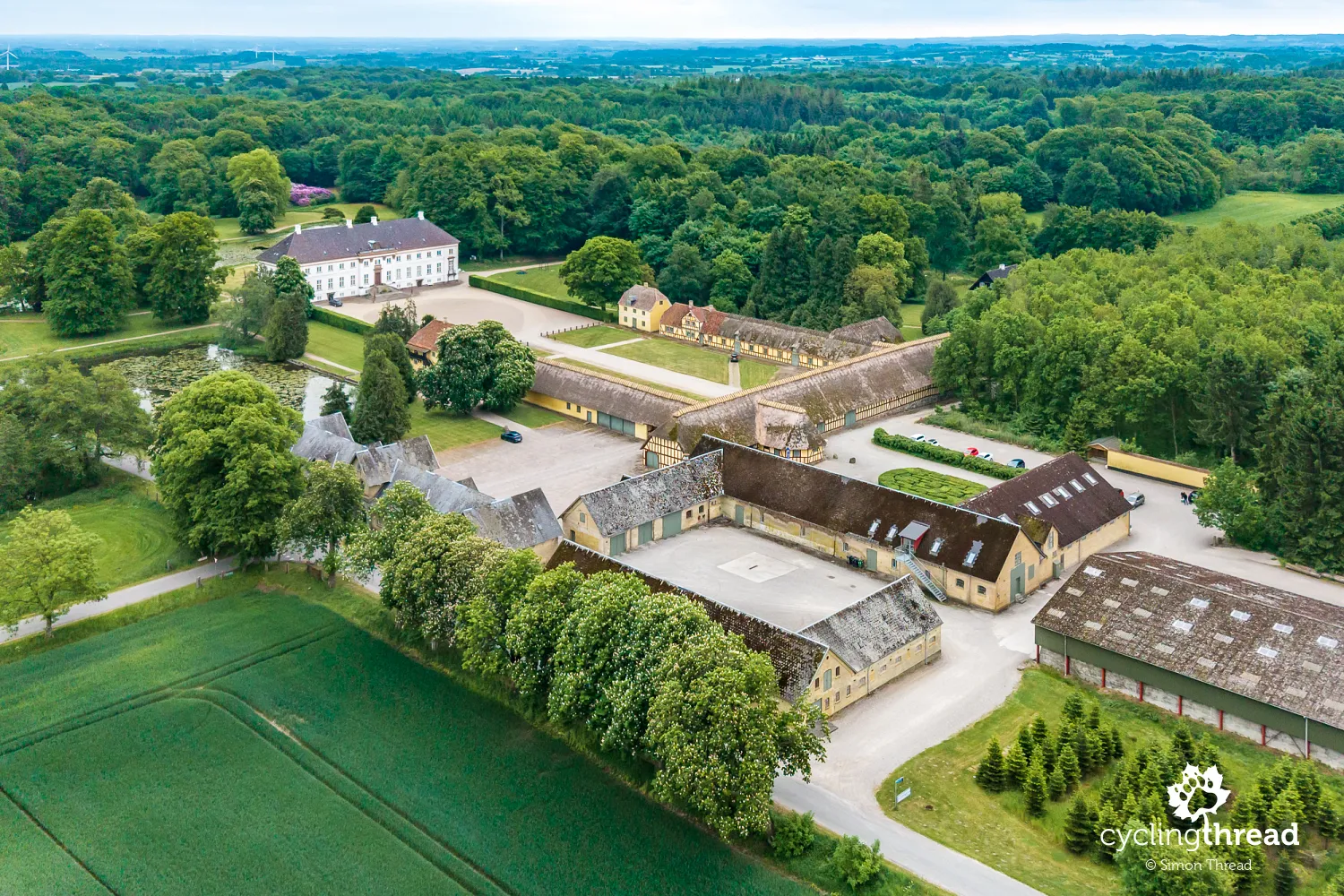
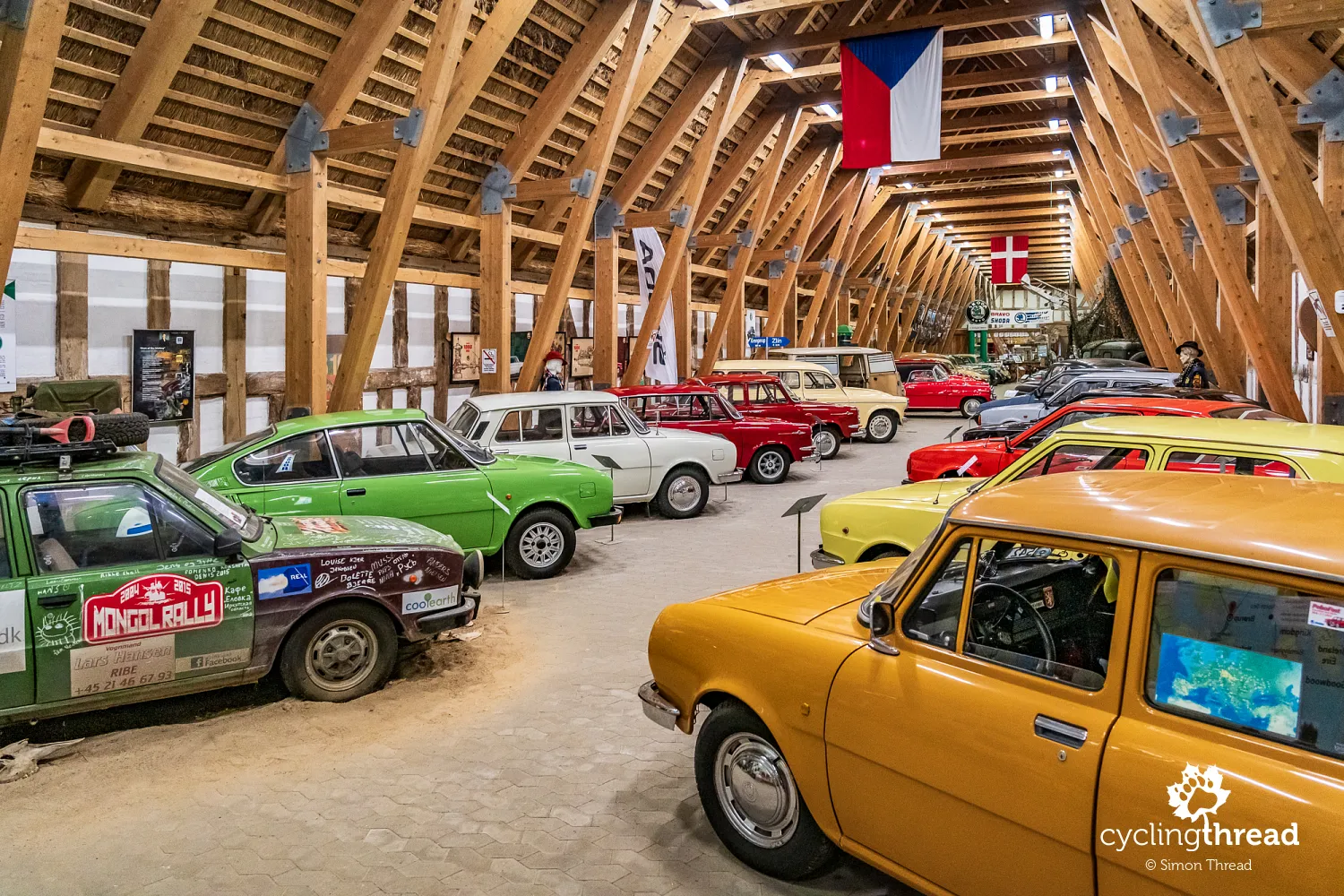
The estate is also home to two museums. One tells the story of flax growing, spinning and weaving, highlighting the importance of these traditional crafts to the region. The other occupies one of the former farm buildings and displays an impressive collection of beautifully preserved Škoda cars, ranging from pre-war models to much more recent vehicles that illustrate the development of the Czech manufacturer over the decades. The collection is no coincidence - the owners of Krengerup were Škoda importers and dealers in Denmark for many years, which allowed them to build such an exceptional collection.
Where to eat on Funen Island
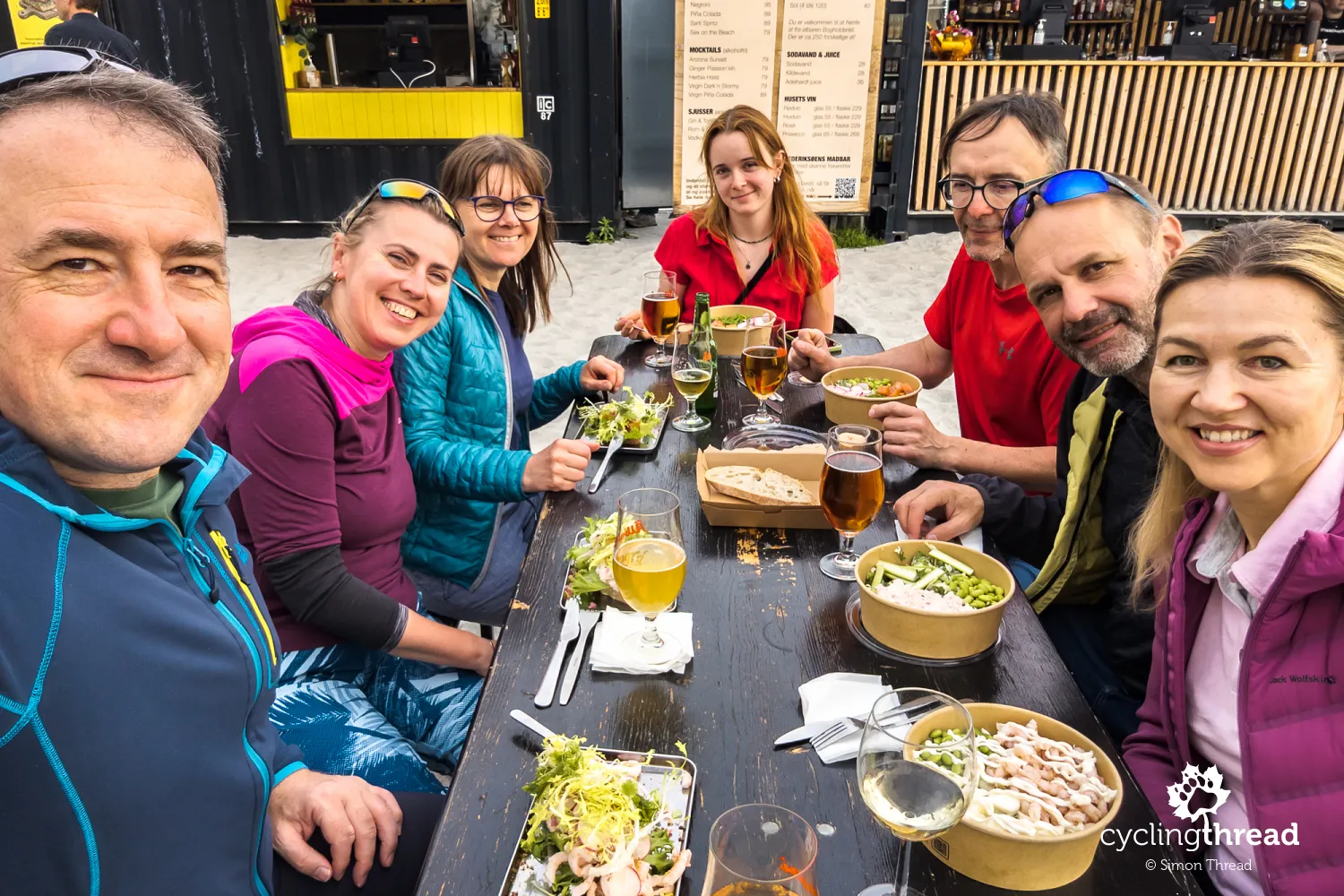
On our first day, we also discovered that outside the larger towns, Funen is not the easiest place to find a good meal. On many cycling routes in neighbouring Germany, it is easy to stop at a restaurant, inn or traditional Gasthof. In the countryside on Funen, however, such places are much less common. The most reliable option for a quick lunch is often one of Denmark's fast-food outlets, usually located next to supermarkets or along the main roads. The situation improves in the larger towns, where there is a wider choice of restaurants and it is easy to enjoy a proper meal. When planning your route, it is worth checking in advance where you are likely to stop for lunch, or carrying some food for the quieter sections of the route.
Historic Brahesborg Manor before Assens
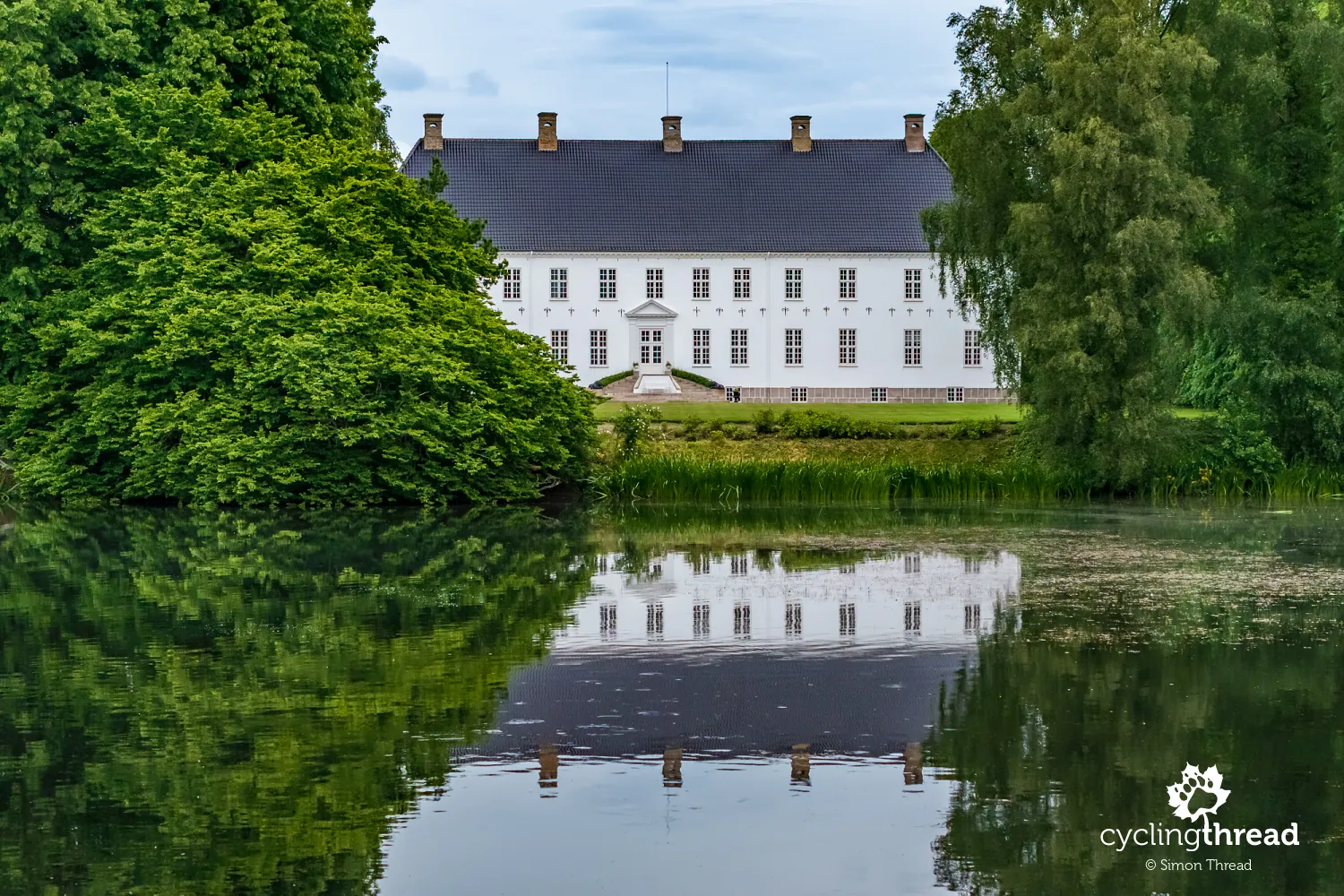
One of the most beautifully located estates on the first stage of our journey was Brahesborg, just before Assens. Although the present manor house dates from the mid-17th century, the estate itself is much older and has long been associated with one of Denmark's most important noble families. It was built by Jørgen Brahe, once known as the "Little King of Funen", while its present, more classical appearance is the result of an 18th-century renovation. The estate is privately owned and not open to visitors, but the nearby road offers excellent views. The most picturesque viewpoint is across a small pond, where the white façade of the manor is reflected in the calm water beneath its mature trees. It is well worth stopping here for a few minutes.
Exploring historic Assens and its museums
After Middelfart, the next seaside town on our route was Assens, beautifully situated on the shores of the Little Belt. It is one of Funen's oldest towns, having received its town charter in the 13th century. For centuries, it prospered as an important trading port on the island's western coast. In the 19th century, it also became one of Denmark's main ferry ports serving connections with Jutland, before its importance declined following the opening of modern crossings over the Little Belt. Today, Assens has retained its peaceful small-town atmosphere. Walking through its cobbled streets, you pass colourful merchants' houses, small squares and the harbour, making it one of the most pleasant places to stop for a break or an overnight stay while exploring western Funen.
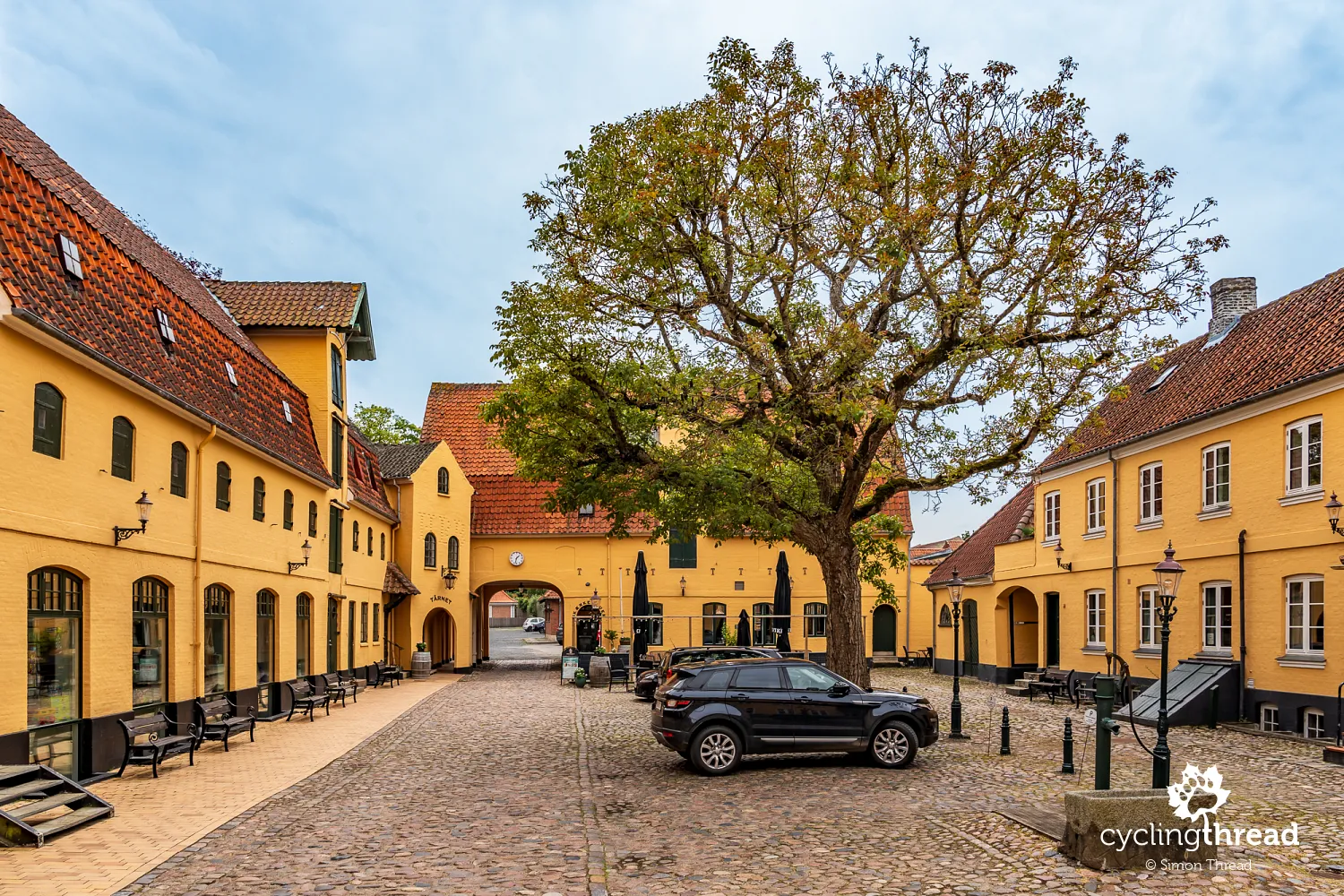
Assens' main attractions are its well-preserved historic centre and two interesting museums. As you stroll along Østergade, the town's main street, it is worth looking through the gateways leading to small courtyards and hidden gardens, some of the town's most charming corners. Museum Ernst, housed in the former residence of local industrialist Frederik Ernst, displays an impressive collection of art, porcelain, antiques and silverware, while also telling the story of the town's historic silver factory. Museum Willemoes, located in a 17th-century half-timbered house, is dedicated to Peter Willemoes, one of Denmark's most celebrated naval heroes.
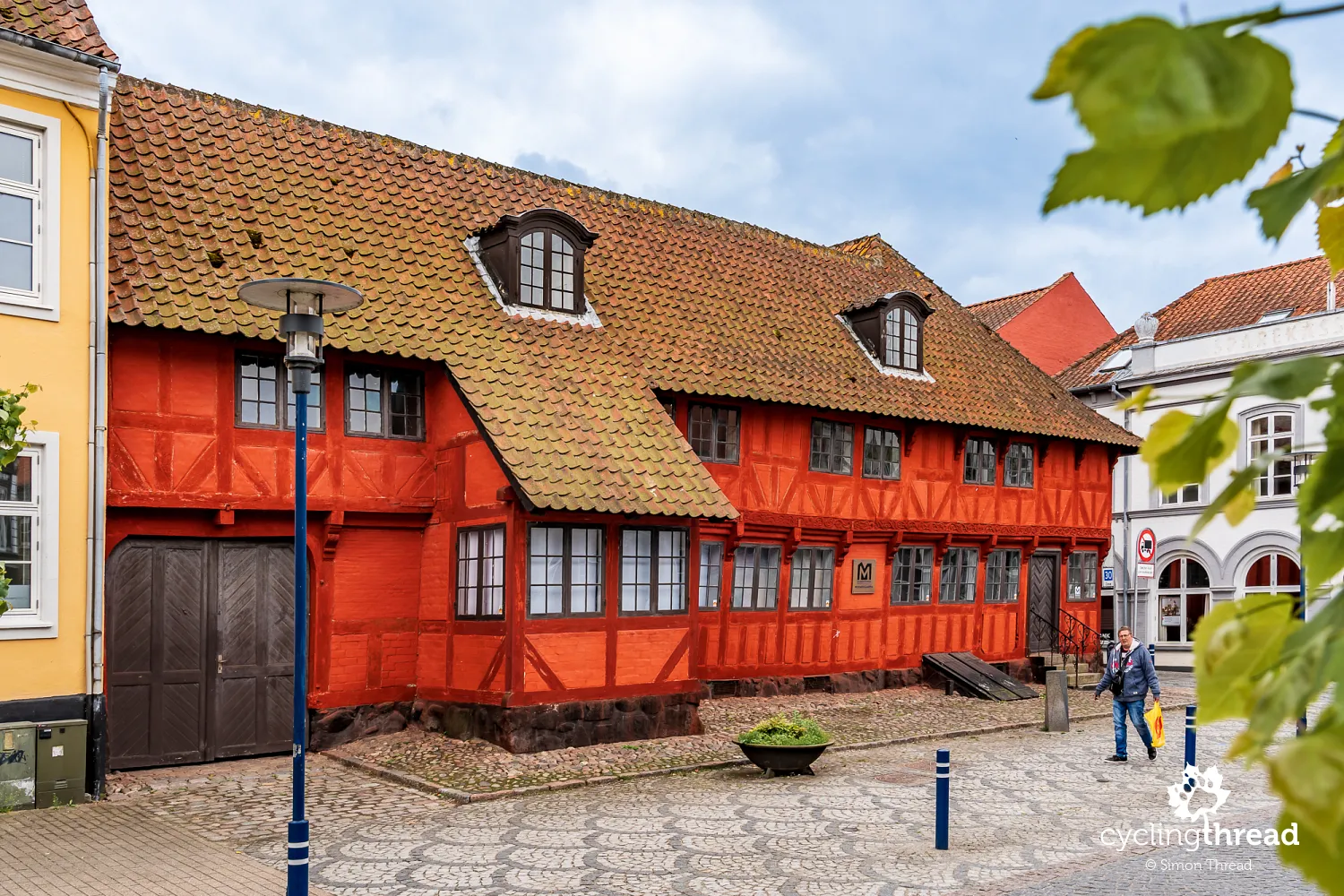
One of Denmark's largest country estates
After Assens, the Castle Route passes through Hagenskov, one of the largest country estates on Funen. The estate dates back to the 16th century, while the present palace was built in the second half of the 18th century as an elegant Neoclassical residence surrounded by a large park. For a time it was known as Frederiksgave, in honour of King Frederick V, before its historic name, Hagenskov, was restored in the 20th century. The estate remains privately owned by the Ahlefeldt-Laurvig family and is not open to visitors, but the cycling route passes through the grounds. From the road, you can also see a nearby hill with the remains of an earlier fortified site that once stood here before the present residence was built.
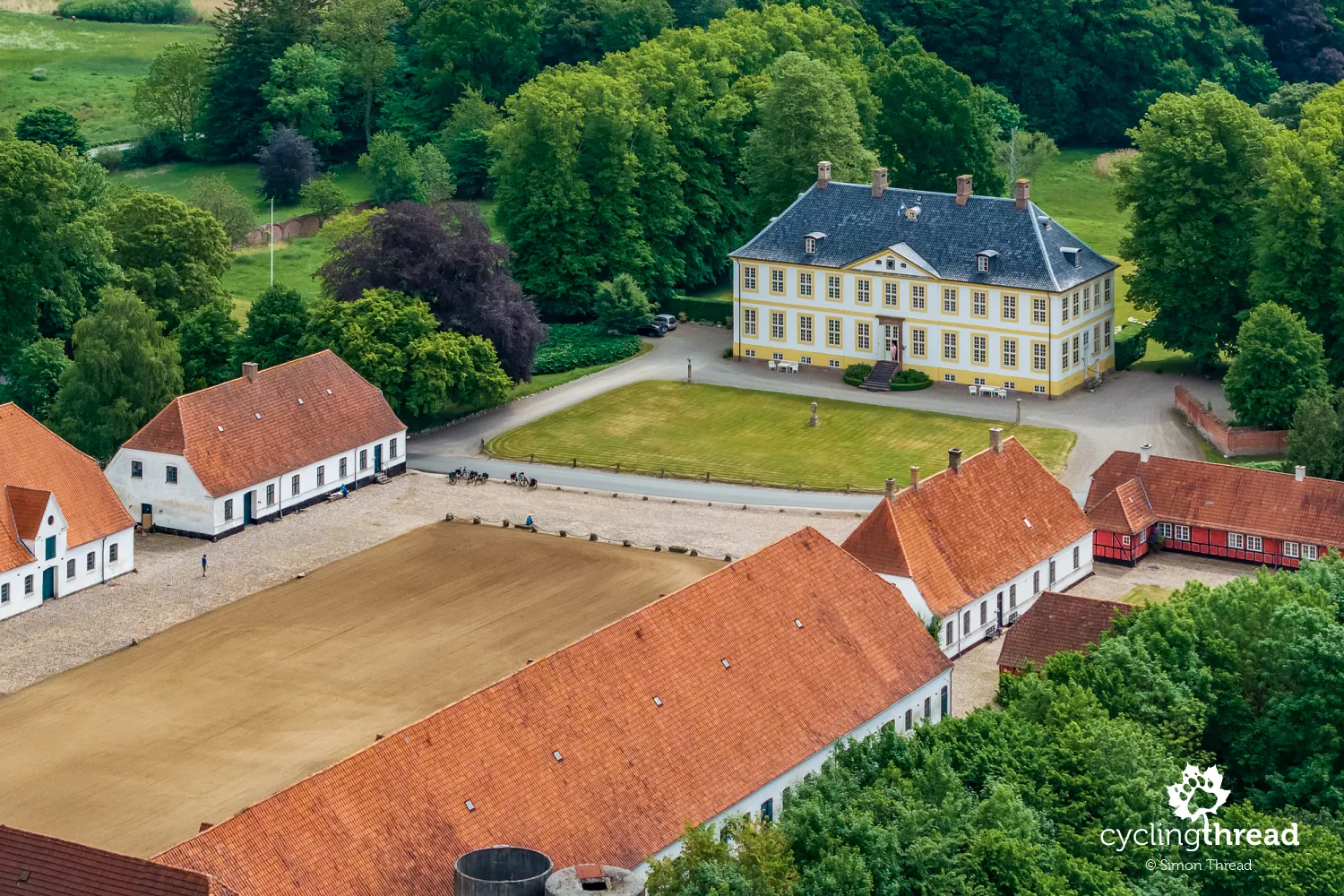
A hotel focused on quality and comfort
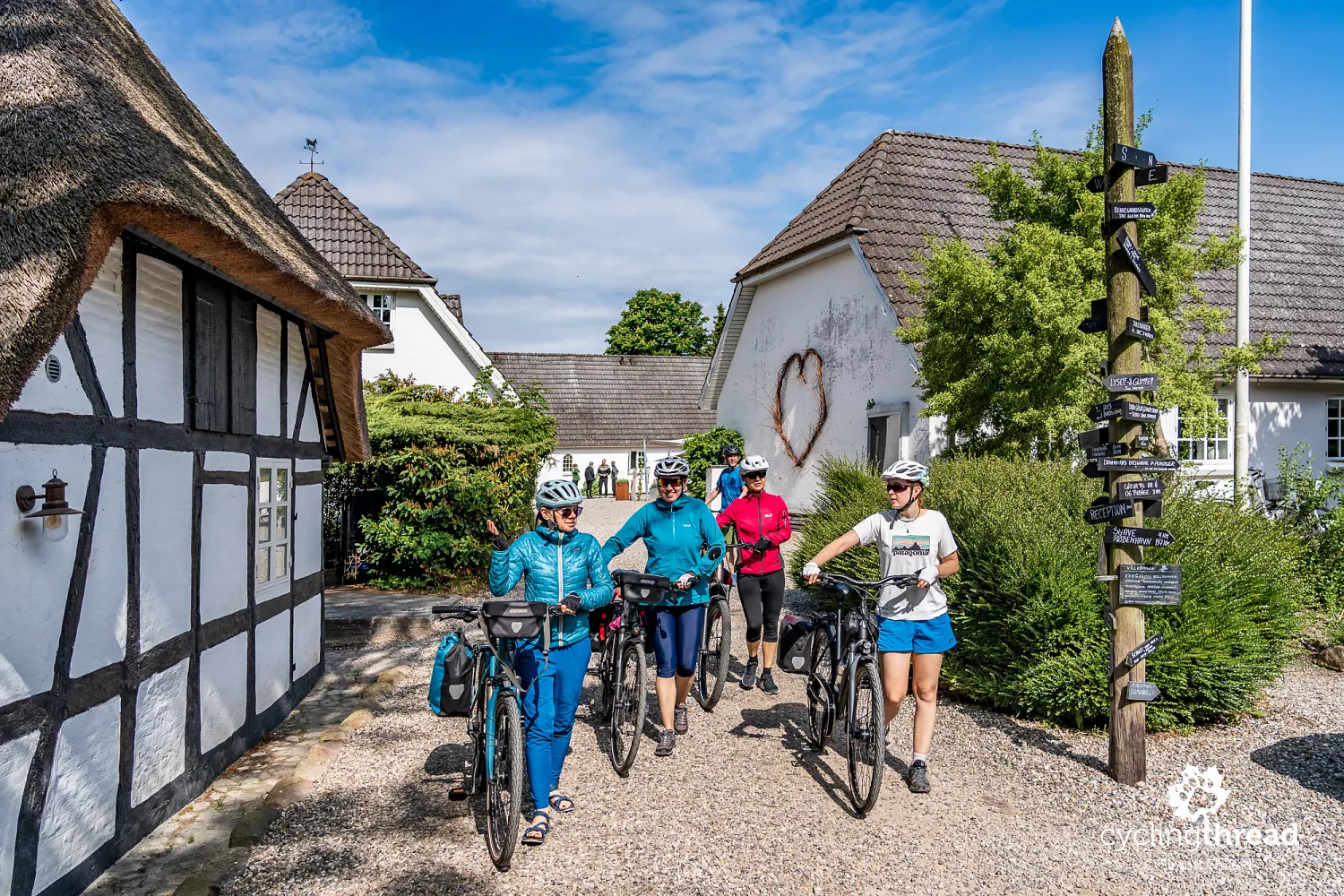
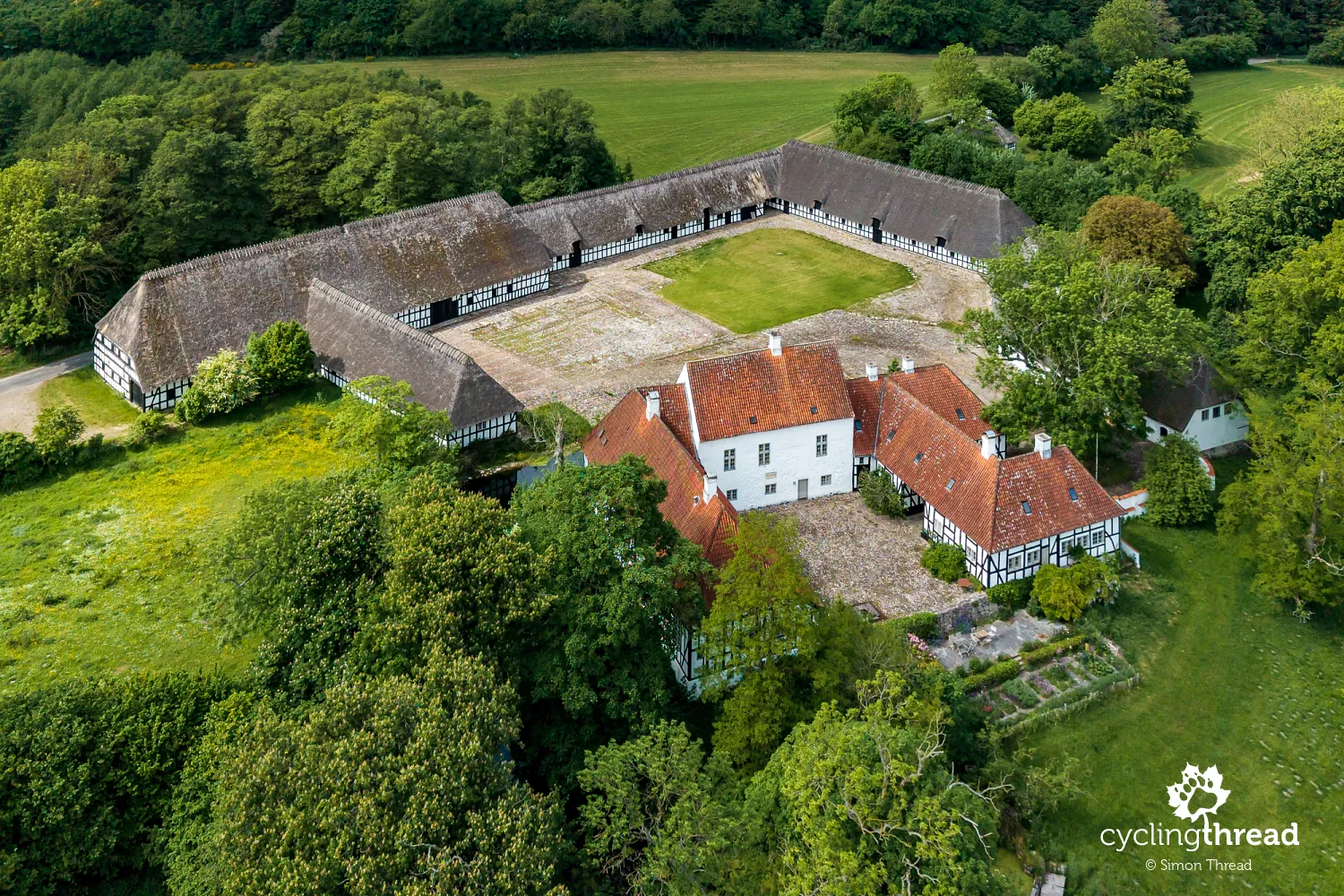
For the night, we stayed at Gl. Brydegaard, a hotel a few kilometres beyond Assens. It is also a great place to experience the atmosphere of a traditional Funen farmstead, with its courtyard completely enclosed by former farm buildings on all four sides. Before being converted into a small hotel, the property served as a working Danish farm for generations. This enclosed layout, typical of historic farmsteads on Funen, once protected people, animals and crops from the strong winds blowing in from the sea. Today, the same old buildings offer guests a peaceful escape from the pace of modern life.
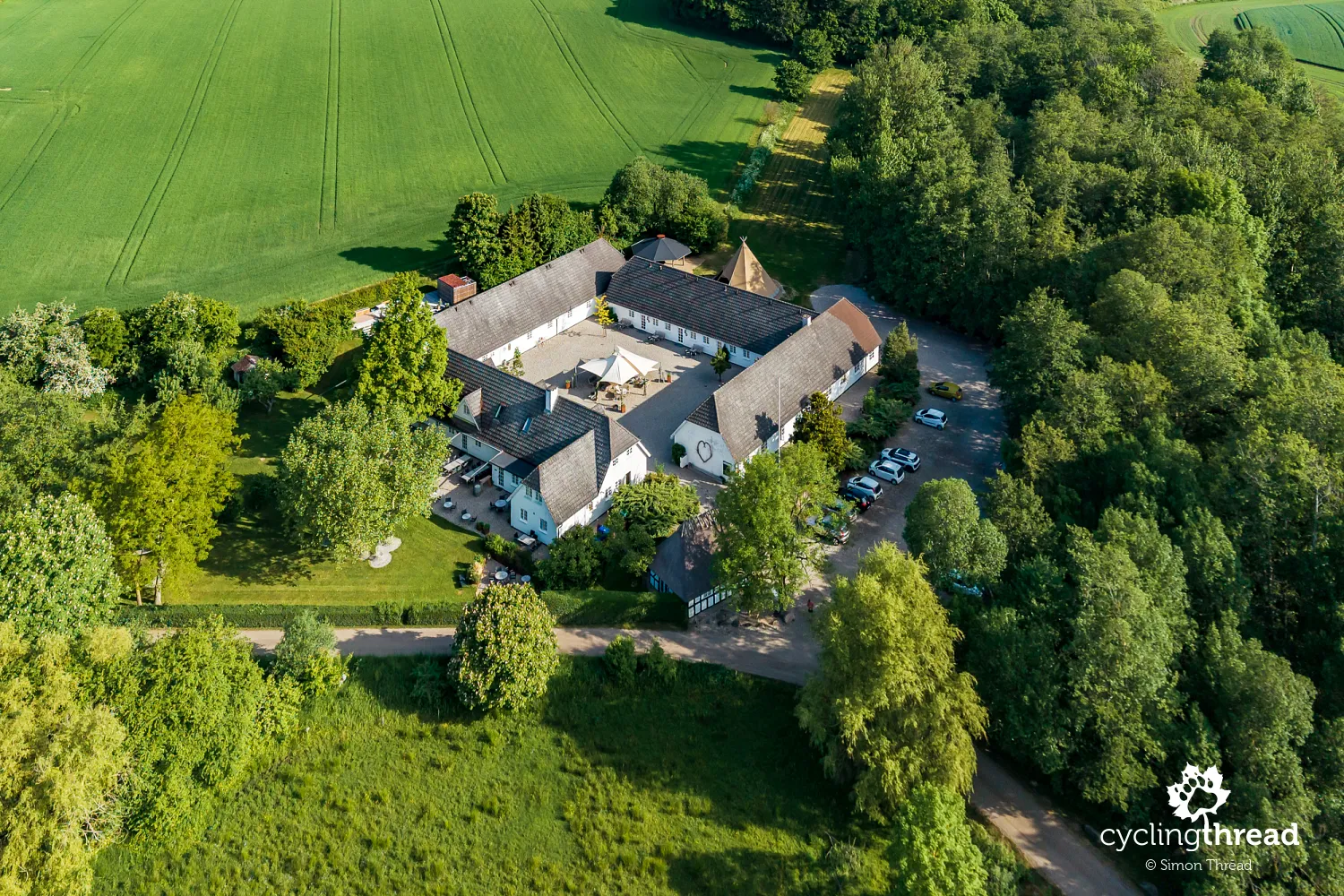
The rooms are simple and bright, decorated in a Nordic style without televisions or minibars. This is a deliberate choice and part of the hotel's philosophy, which focuses on peace, nature and taking a break from everyday life. It reflects the Danish idea of comfort - owning less and enjoying more time and space. The same philosophy can be found in the hotel's restaurant. The menu is based on seasonal, locally sourced ingredients, used to create modern versions of traditional Danish dishes. Breakfast is equally simple. Instead of offering dozens of options, the buffet features a small selection of carefully prepared, high-quality products, most of them supplied by local producers. Here, quality and local origin matter more than quantity.
An undiscovered historic manor house
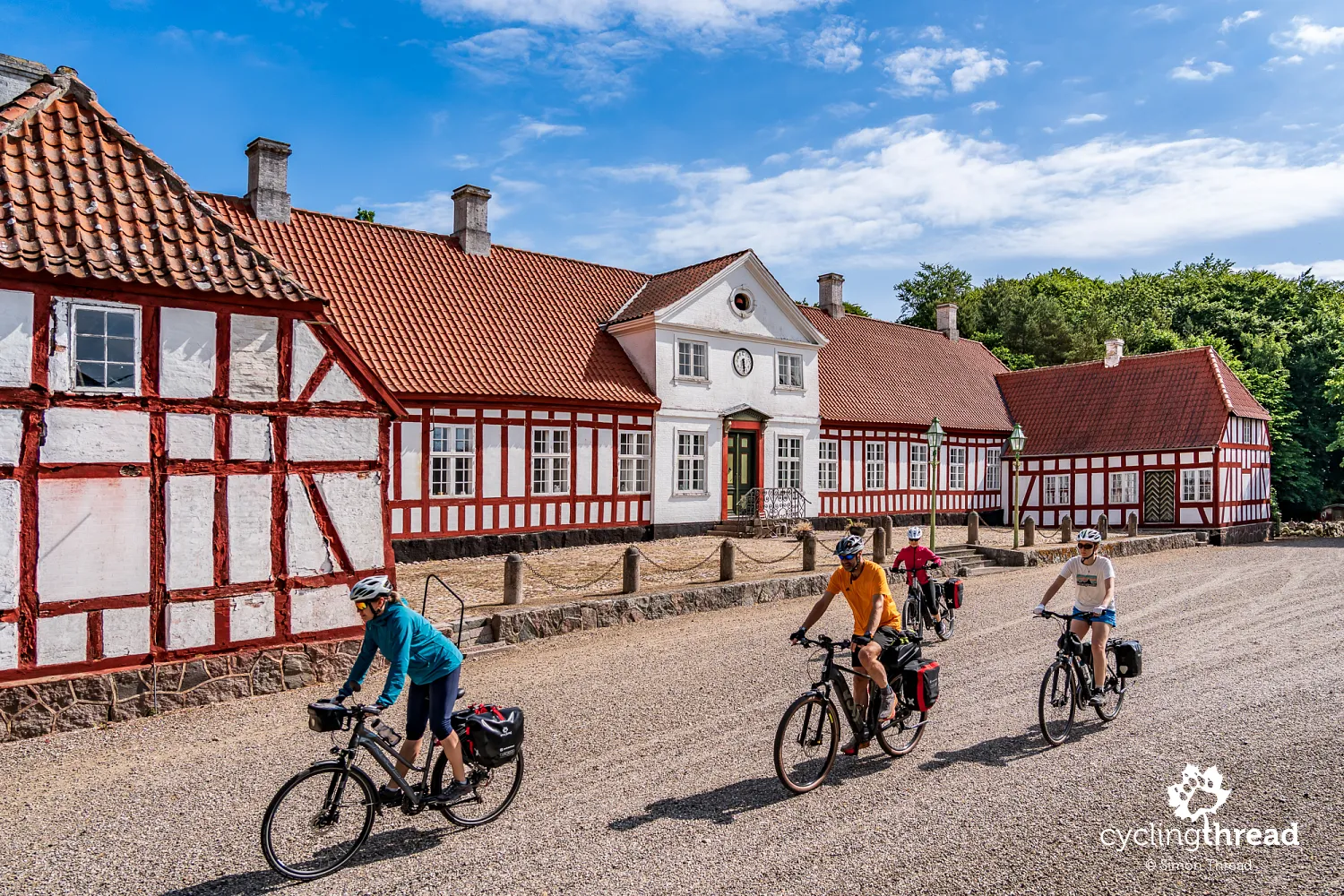
The next morning began with an unexpected discovery - a beautiful manor house standing right beside the route, about which it was surprisingly difficult to find any information. It is not even marked on Google Maps, and none of the image search engines or AI tools we tried could identify it, as if almost nobody had photographed it before. It was a good reminder that even on an island as small as Funen, there are still places that remain largely undiscovered, inviting you to leave the route for a while and explore on your own.
A forest of spectacular ermine moth webs
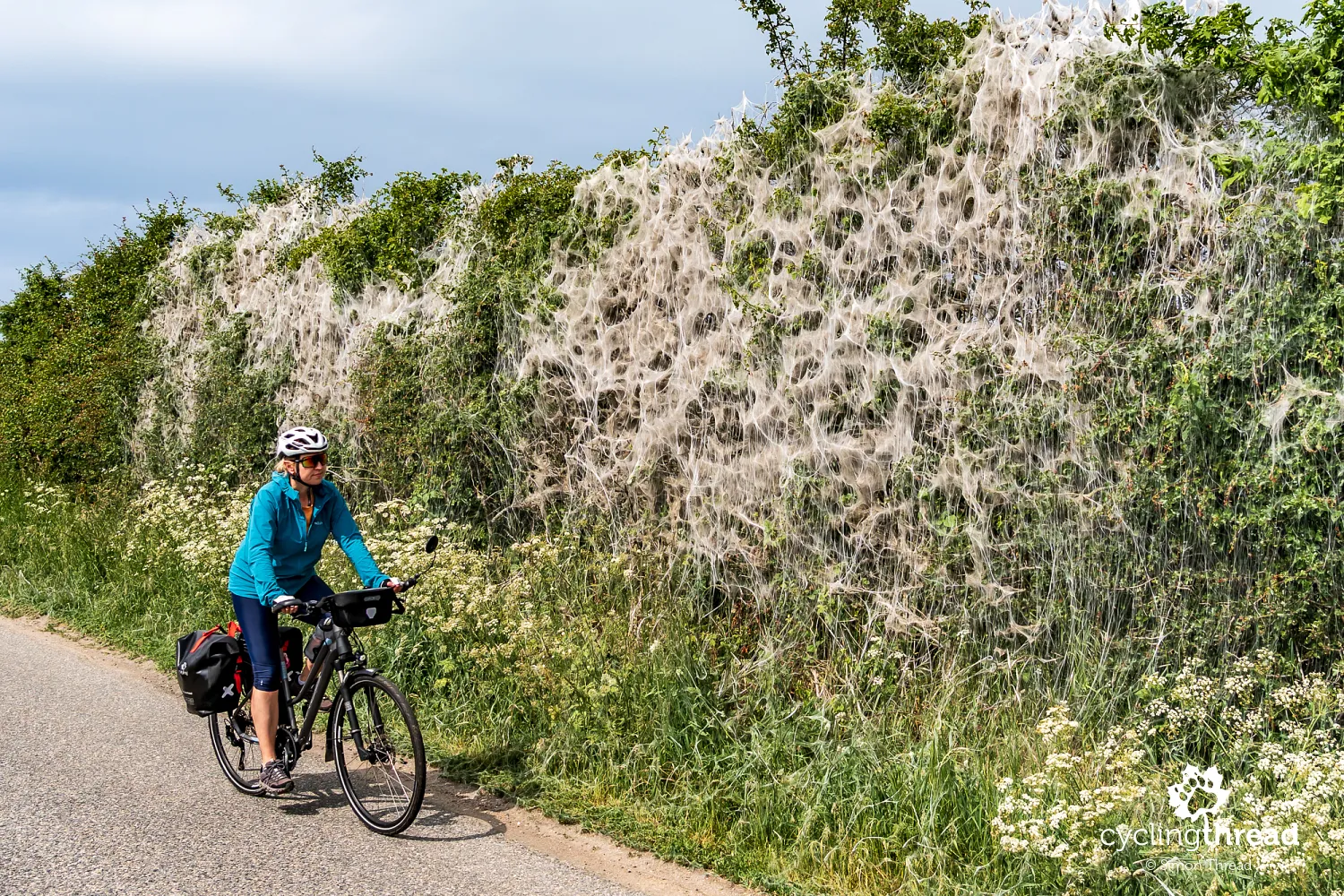
Later that day, we came across something we had never expected to see. For several hundred metres, the roadside trees and bushes were completely covered in a dense white web, creating a scene that looked as if it had come straight out of a horror film. It was not the work of spiders, however, but of ermine moth caterpillars (Yponomeuta). In spring and early summer, they cover entire plants with fine silk, creating protective tents that shield the colony from birds and other predators. Inside the webs, thousands of caterpillars feed on the leaves. Although the trees and shrubs appear lifeless, they usually recover completely and produce fresh leaves later in the same season. I had seen a colony like this only once before, while cycling the Velo Dunajec route in Poland.
The most distinctive church on Funen
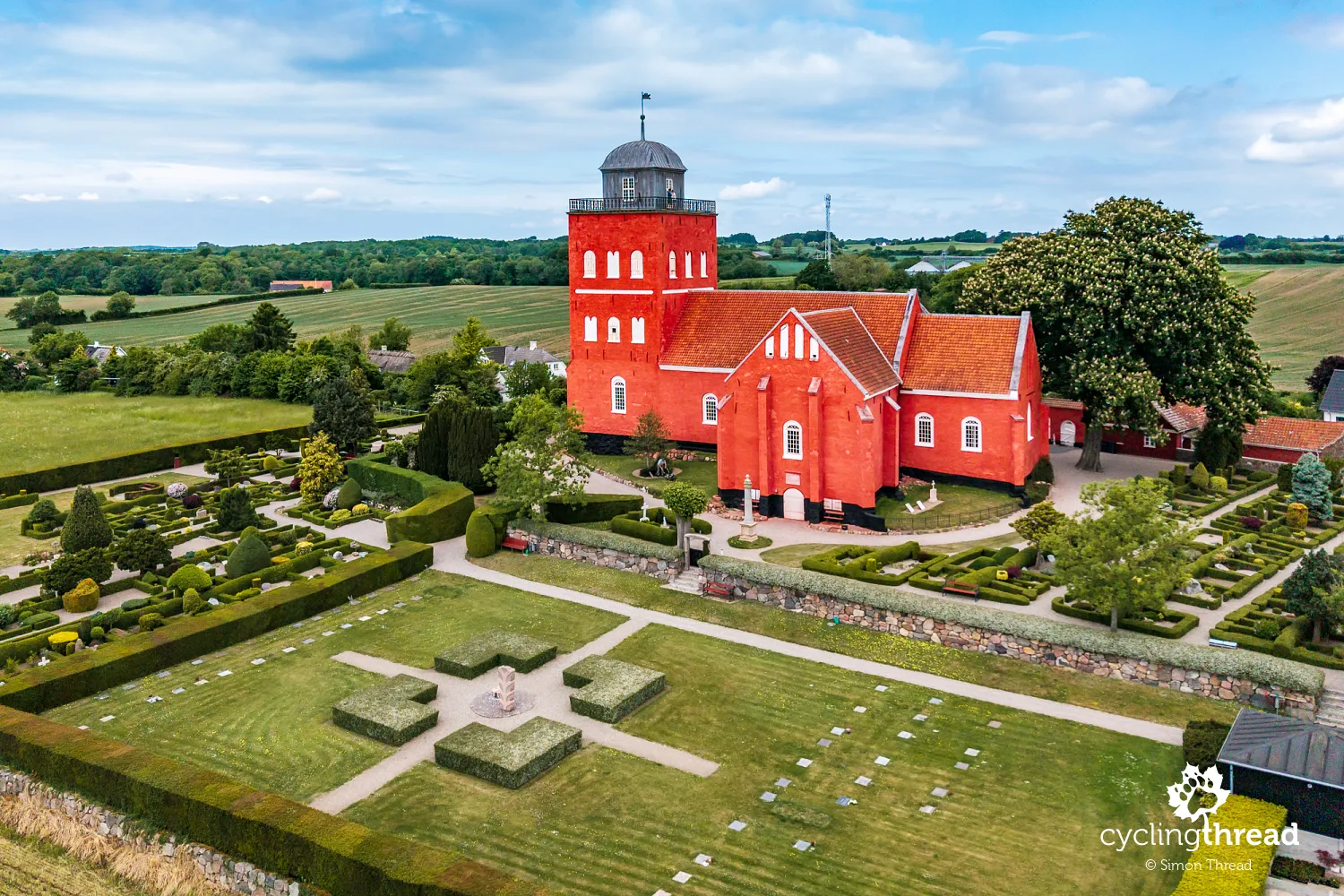
A few kilometres later, we stopped at Dreslette Church, one of the most distinctive churches on Funen. It stands on a small hill overlooking Helnæs Bay and the waters of the Little Belt. The church dates back to the 12th century, but its present appearance is the result of a major rebuilding carried out between 1785 and 1787 on the initiative of Niels Ryberg, owner of the nearby Frederiksgave estate. Its striking red façade and unusual tower with a viewing platform make it look more like a Neoclassical country house than a village church. It is also worth stepping inside, where you can see a harmonious Neoclassical interior and Denmark's oldest working organ, built in 1787 by the Danish organ builder Hartvig Jochum Müller.
Denmark's living rural heritage landscape
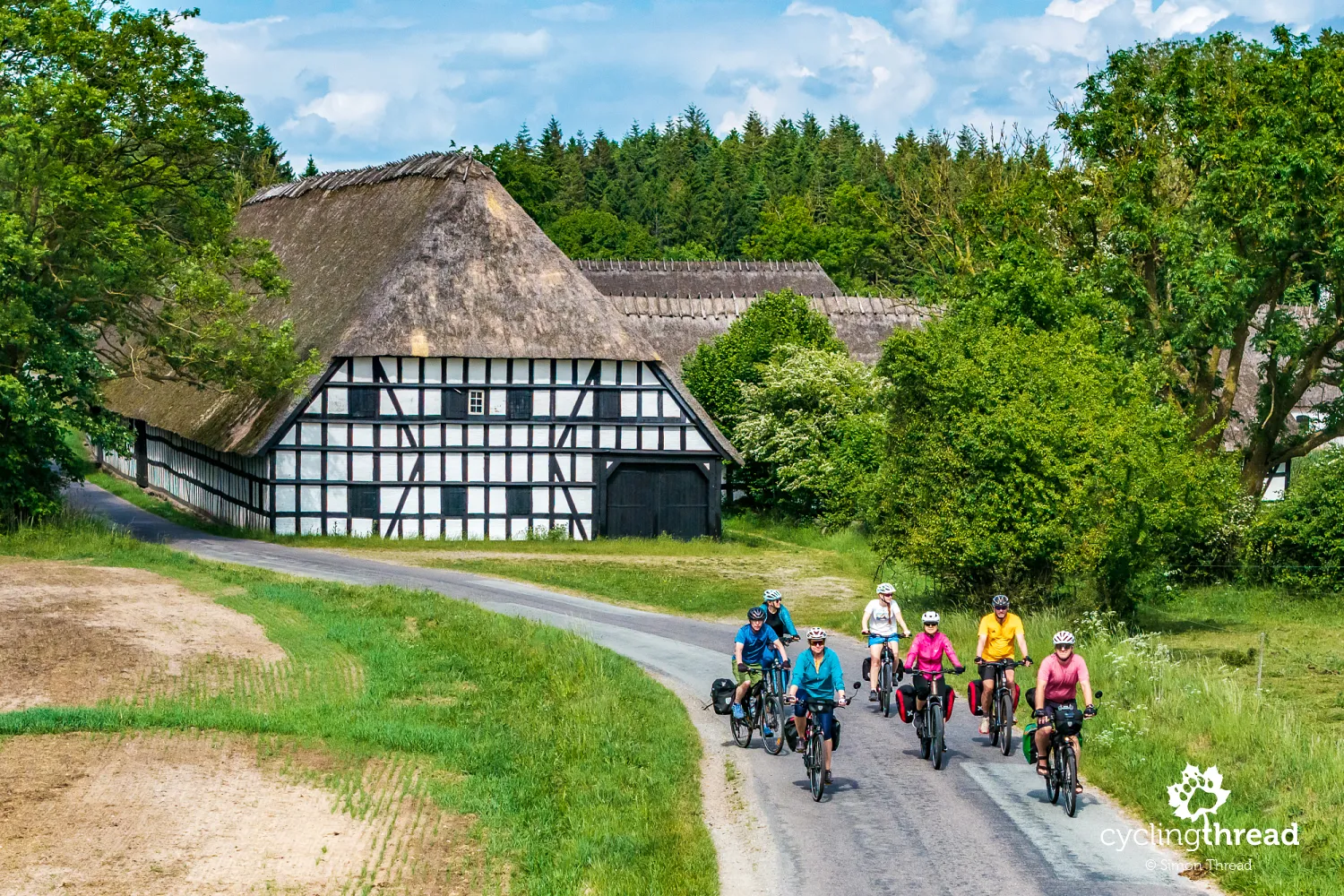
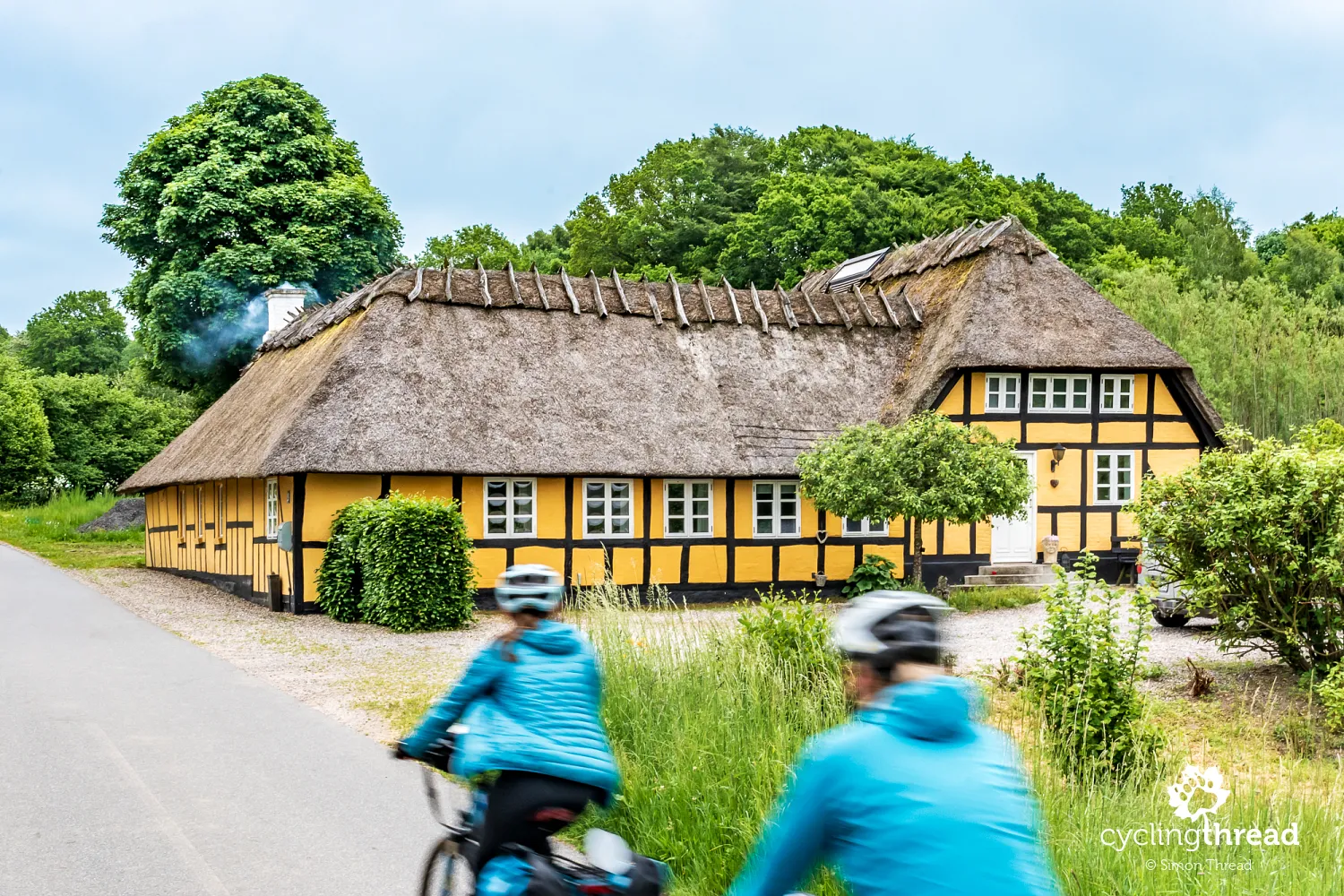
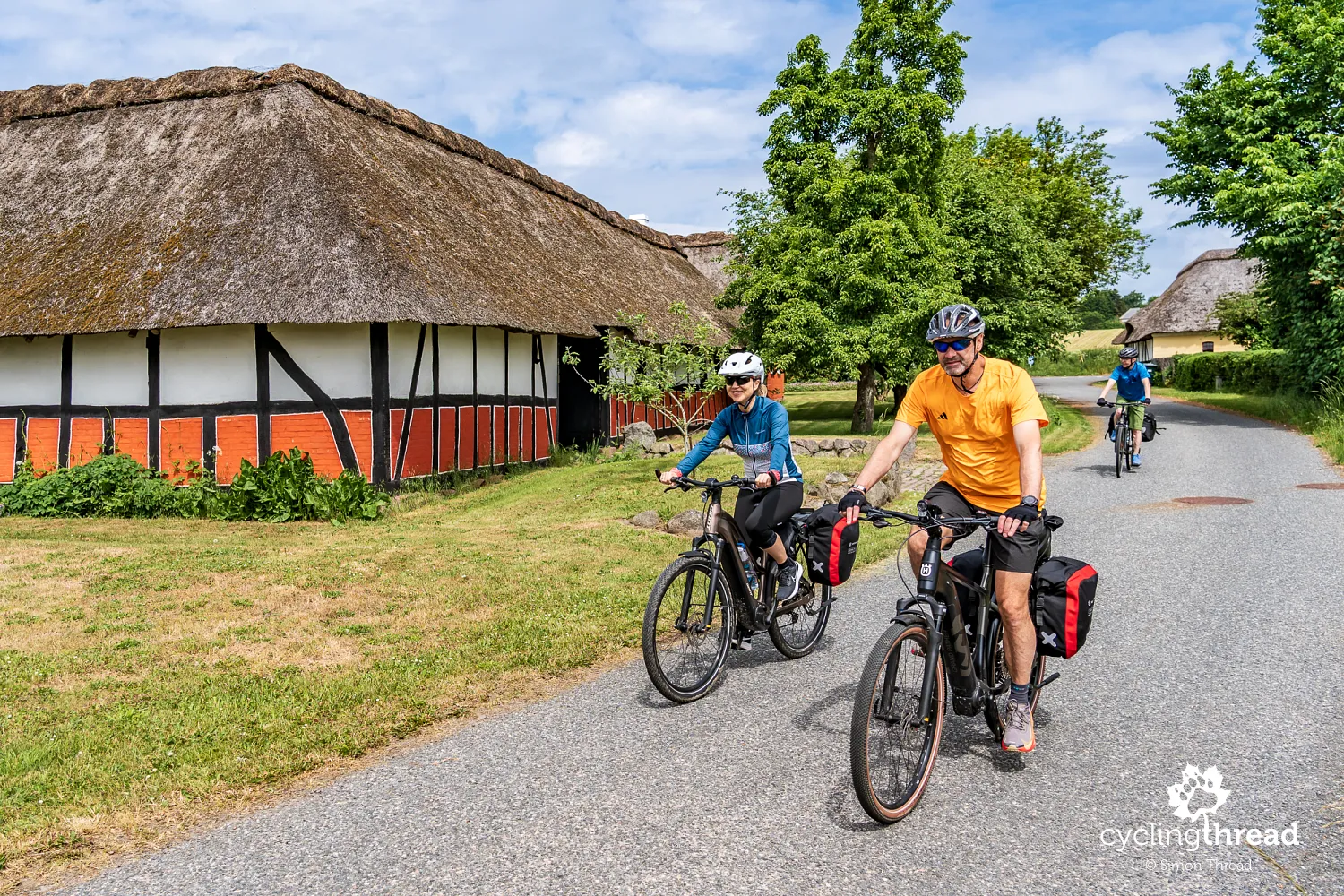
With every kilometre, it felt more and more as though we were cycling through an open-air museum rather than the modern Danish countryside. Funen is home to countless traditional farmhouses that are still used for everyday life rather than preserved as museum exhibits. In almost every village, we passed whitewashed half-timbered houses with dark wooden frames, thick thatched roofs and small windows. Many are surrounded by stone walls, old trees and small gardens, and together they create the impression that very little has changed here over the past one or two centuries. Cycling across Funen sometimes feels like riding through a carefully curated collection of Denmark's finest rural architecture - with one important difference: these are not museum exhibits, but places where people still live and work every day.
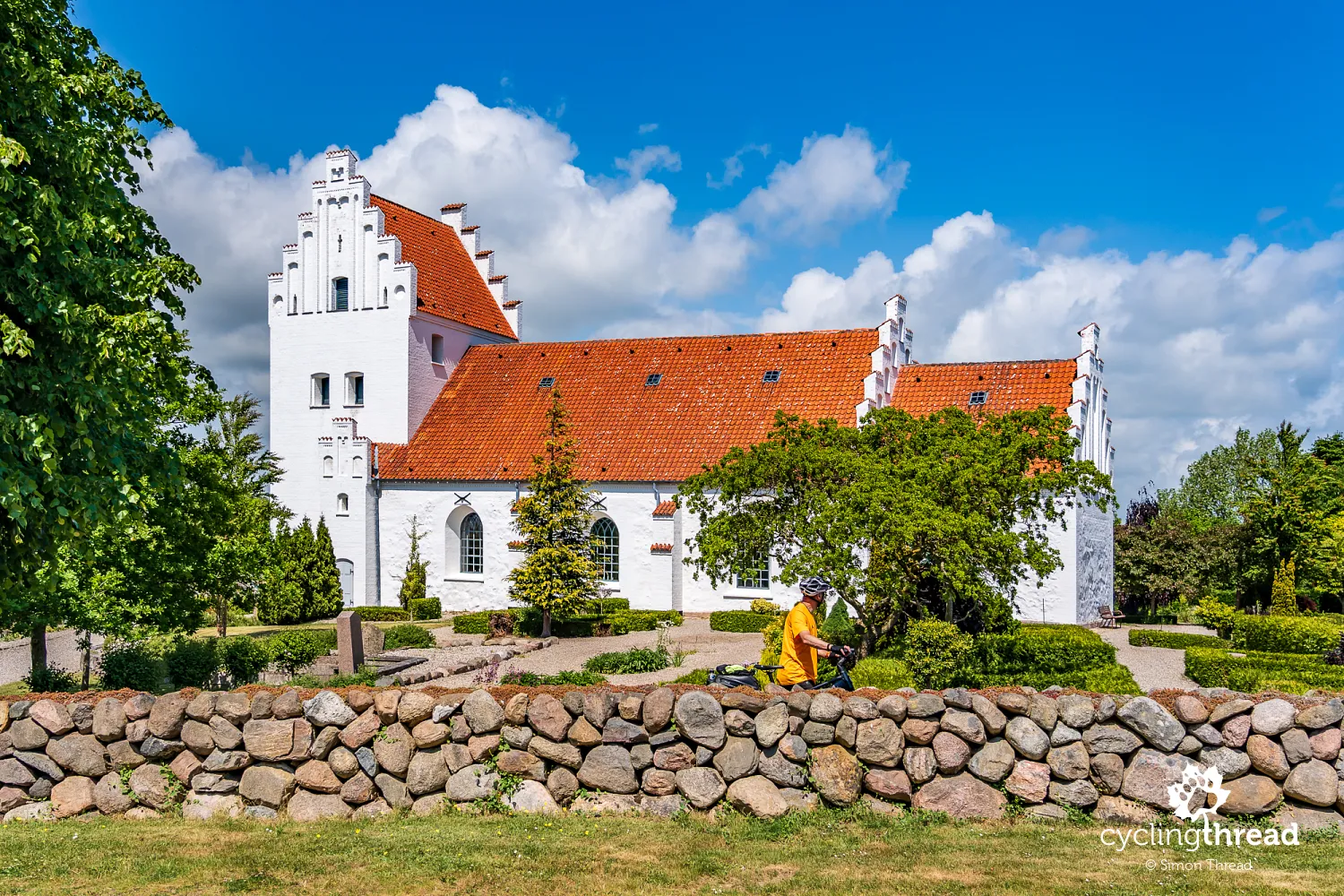
Beautiful Danish churches appeared just as frequently along our route. Their distinctive architecture - whitewashed walls, orange-tiled roofs and solid towers with stepped gables - immediately reminded us of our cycling trip around Bornholm many years ago. Almost every church was surrounded by a well-kept cemetery filled with greenery, old trees and carefully maintained gravestones. Low stone walls or neatly trimmed hedges enclosed these peaceful and orderly spaces. We often stopped for a few minutes, not only to take photos but also to use the almost always available public toilets - something surprisingly difficult to find elsewhere along the route.
Cycling to the famous Queen's View
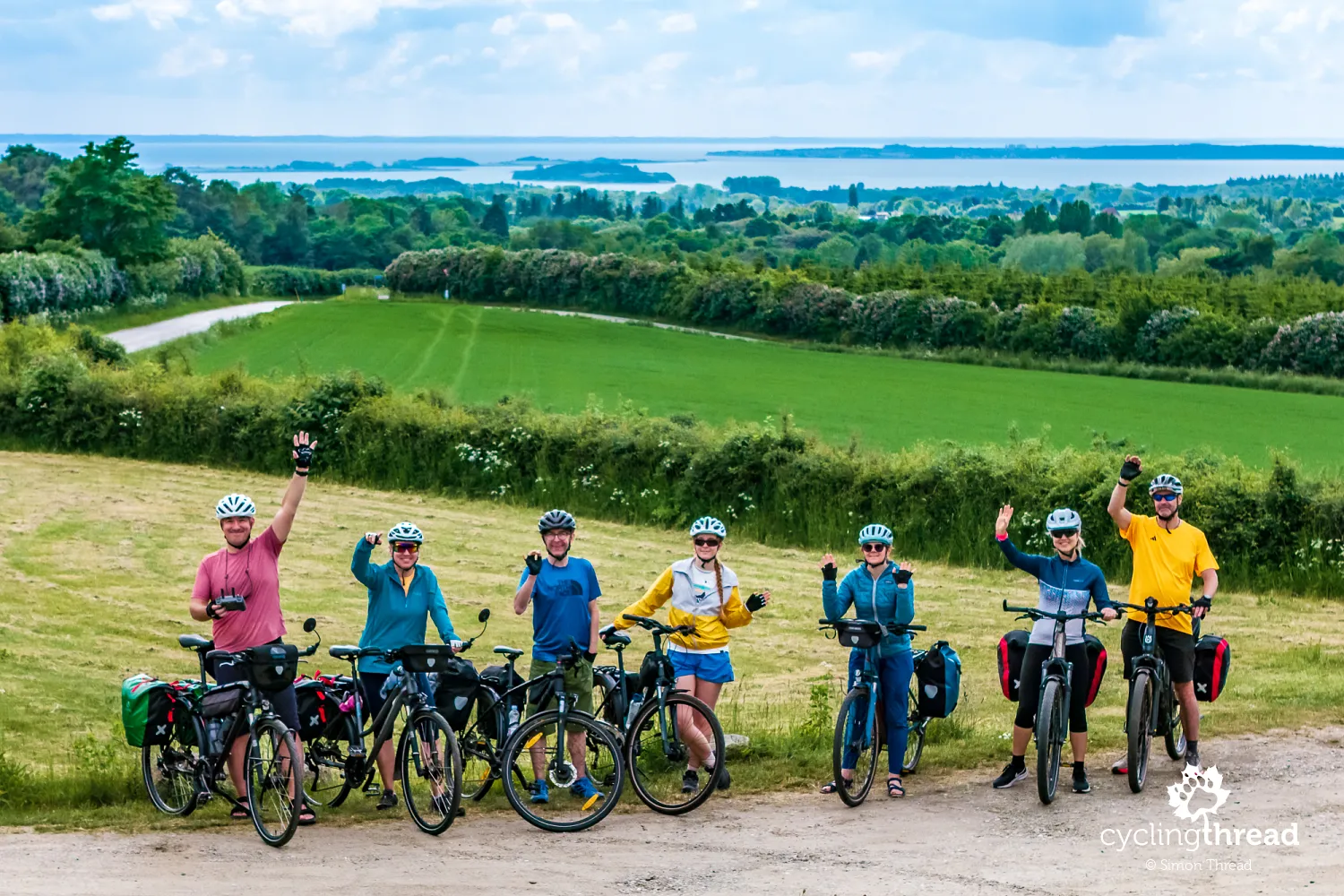
One of the day's climbs ended at Dronningeudsigten, or "Queen's View", a viewpoint at the foot of Trebjerg Hill. Its name dates back to 1842, when Queen Caroline Amalie stopped here and admired the panorama across this part of Funen. Today, it is a pleasant rest area with picnic tables and benches, making it an ideal place for a break. On a clear day, the view stretches across Helnæs Bay and the South Funen Archipelago. In exceptionally good conditions, you can even see the island of Als and the coast of the Jutland Peninsula. If you have a little extra time, it is also worth taking the short walk to nearby Trebjerg, Funen's second-highest natural hill at 128 metres above sea level.
The oldest continuously inhabited manor house
Among the many historic buildings along the route, Østrupgaard deserves special attention. It is considered one of the oldest continuously inhabited manor houses on Funen. The estate dates back to the Middle Ages, and the oldest brick and fieldstone part of the residence was built in the 15th century. Its present appearance took shape in the early 18th century, when two half-timbered wings were added. The large farm buildings surrounding the spacious courtyard, with its historic stone well, are equally impressive. Unfortunately, the oldest part of the manor is difficult to see from the road and is not open to visitors, so the monumental farm buildings are the most visible part of the estate. The property belonged to the influential Brahe family for nearly 300 years and remains a privately owned working farm and forestry estate.
Riding through the scenic Funen Alps
Just before Faaborg, beyond the golf course, the Castle Route passes through one of Funen's most remarkable natural areas - Svanninge Bakker and Svanninge Bjerge, together known as the Funen Alps. This is the island's most distinctive glacial landscape, formed at the end of the last Ice Age by advancing glaciers. The hills stretch for about 16 kilometres and rise to 126-128 metres above sea level. Their gentle yet surprisingly noticeable climbs, wide views and varied landscape of forests, meadows and pastures make this one of the most scenic cycling sections on Funen.
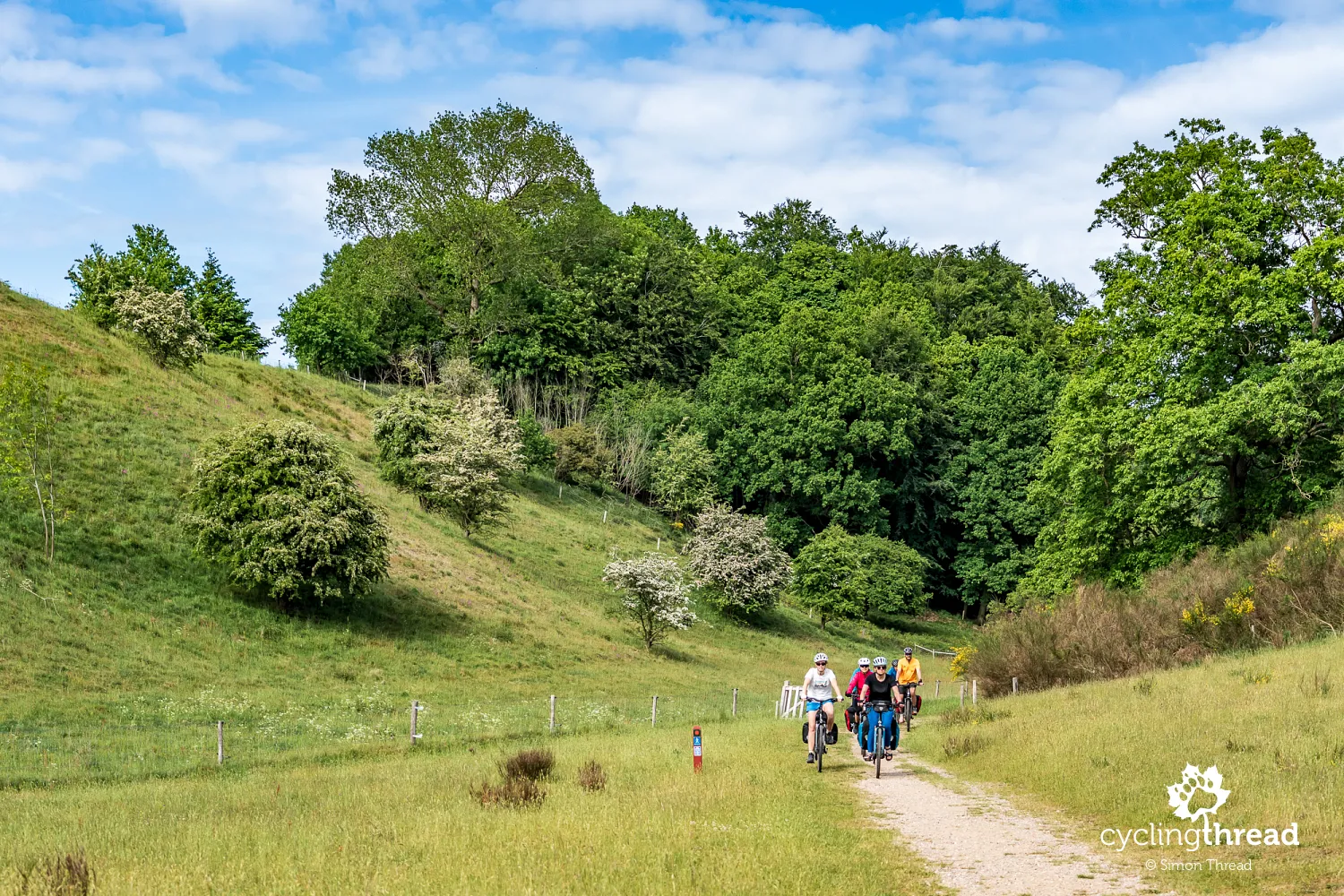
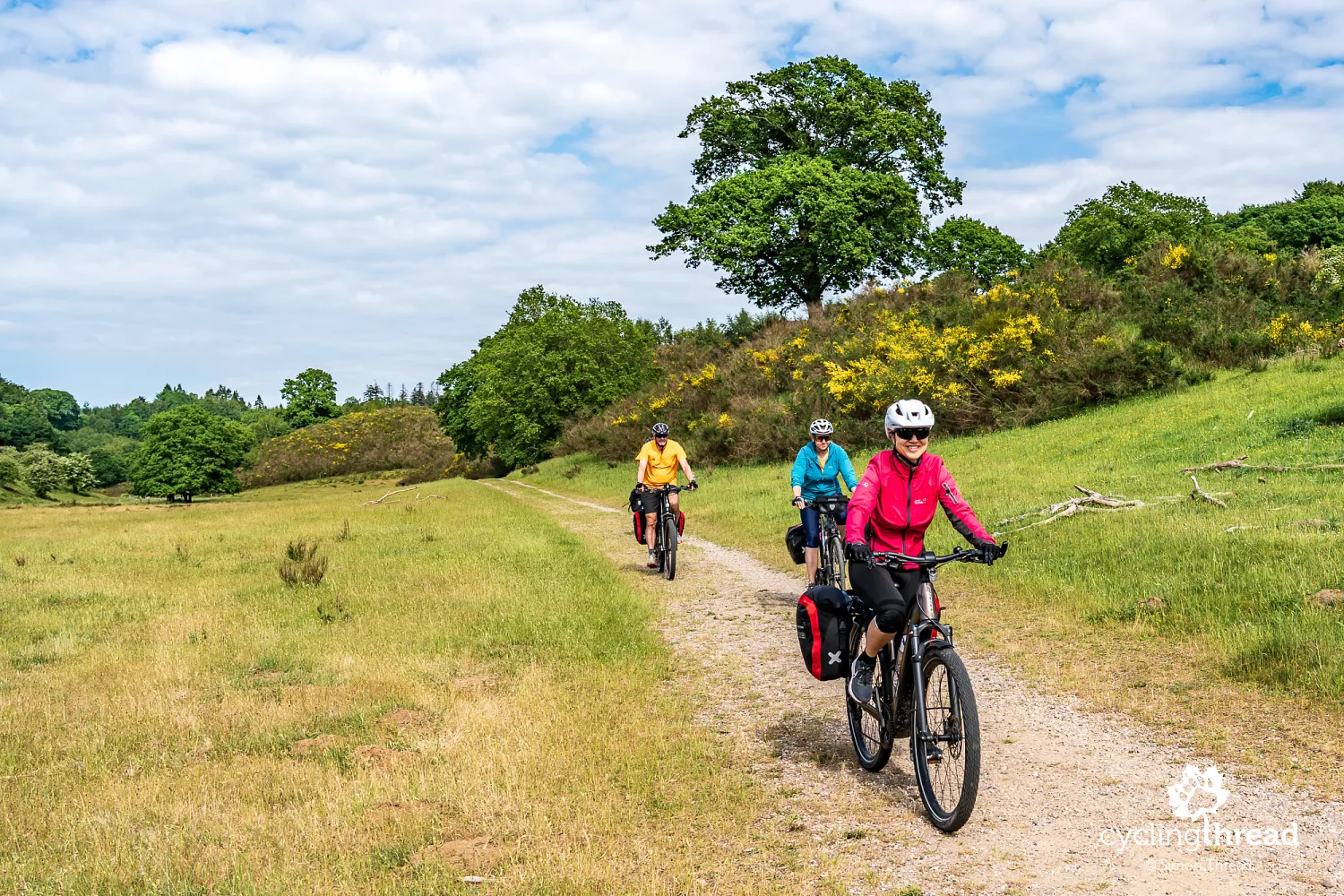
Here, the route leaves the villages behind and follows narrow gravel tracks winding through rolling hills. Along the way, you pass steep ridges, deep meltwater valleys and many traces of past human activity - stone walls, earth banks, old tracks and the outlines of former fields that have remained in the landscape for centuries. This is one of the most scenic sections of the entire Castle Route. Because of the terrain, it is best ridden from west to east, as we did, making the most of the long downhill ride towards Faaborg.
Exploring the historic city of Faaborg
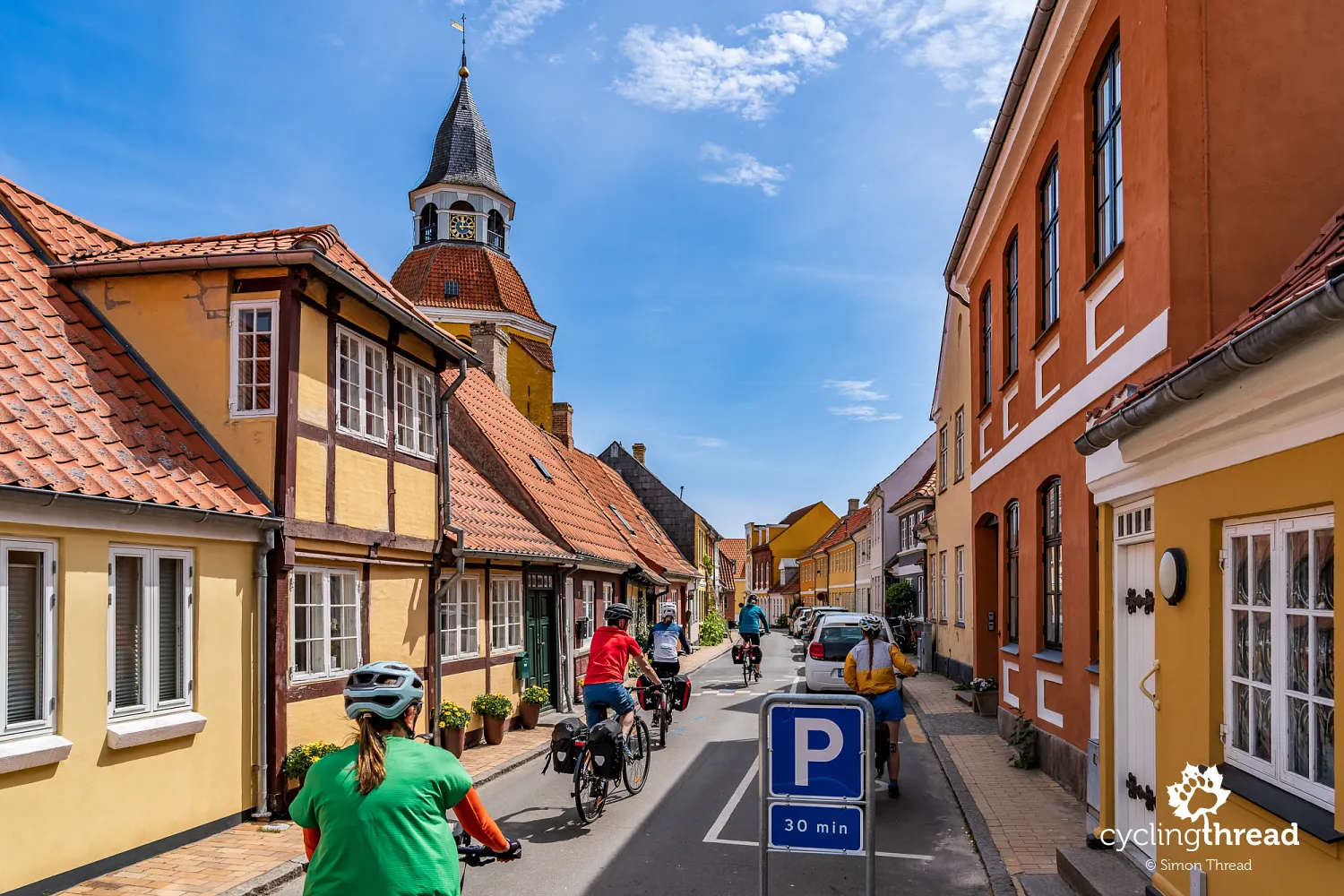
Faaborg immediately made a very good impression on us. It is a perfect example of a Danish seaside town. The historic centre is built around the harbour, which has been the town's economic heart for centuries and today serves as the gateway to the islands of the South Funen Archipelago. Regular ferry services also carry bicycles, making Faaborg an important hub for cyclists travelling between the islands of southern Denmark. As early as the Middle Ages, Faaborg was one of the most important ports in southern Funen, prospering through trade with towns across the Baltic Sea. Its narrow cobbled streets, colourful merchants' houses and small squares make it a wonderful place to explore on foot, with plenty of historic buildings, shops and cafés to discover along the way.
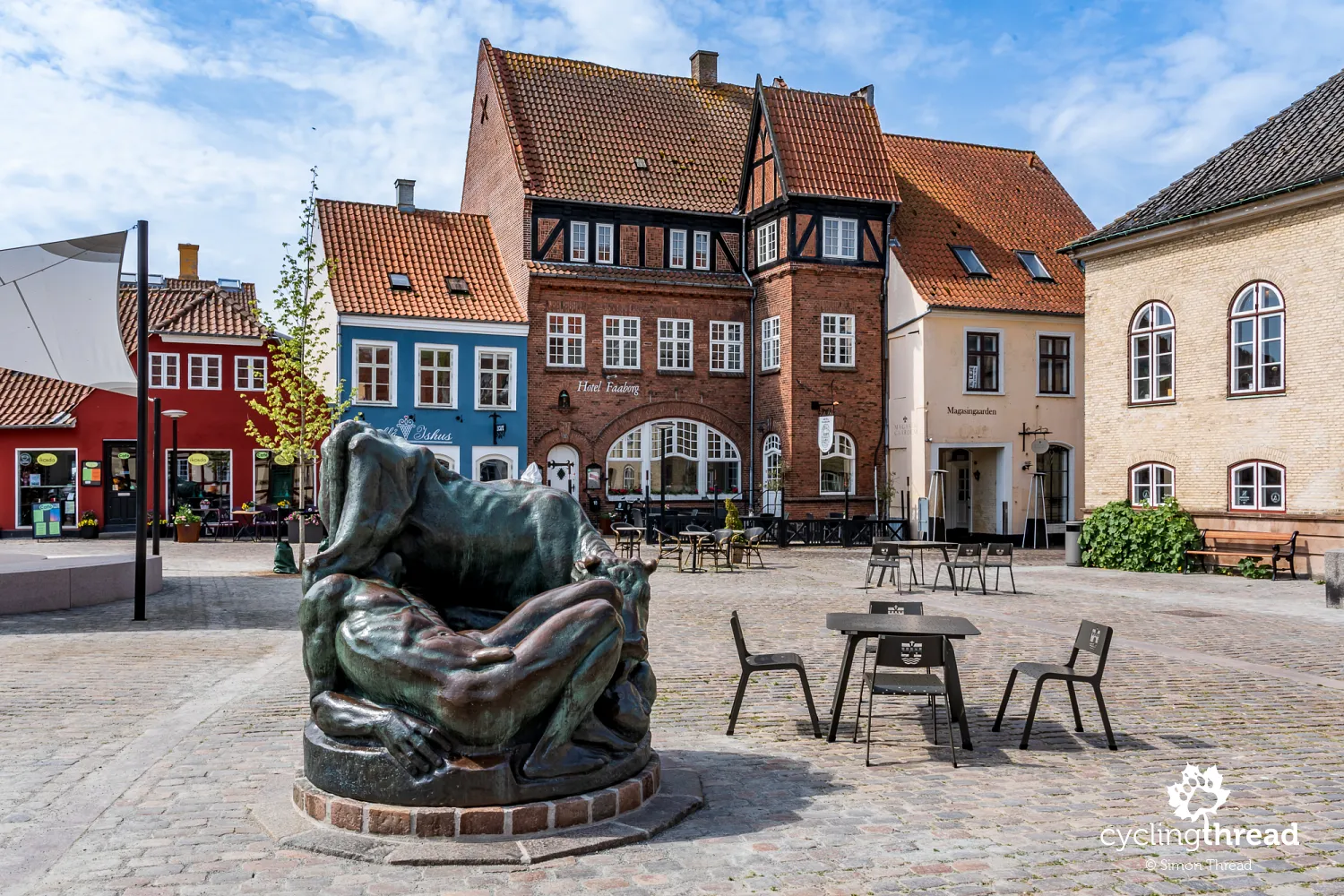
The market square in Faaborg is home to the distinctive Ymerbrønden fountain, depicting the Norse giant Ymir, and nearby stands St Nicholas' Church, whose oldest parts date back to the 13th century. For centuries, the square has remained the heart of the town, preserving much of its medieval layout. The church served both local residents and sailors heading out onto the Baltic Sea, while its tower was used to watch ships entering the bay. For many centuries, Faaborg was surrounded by a complete ring of defensive walls with several town gates, of which only a few fragments survive today. It is worth looking out for these remaining sections of the medieval walls and gates, reminders of the time when Faaborg was one of the best-fortified towns on Funen.
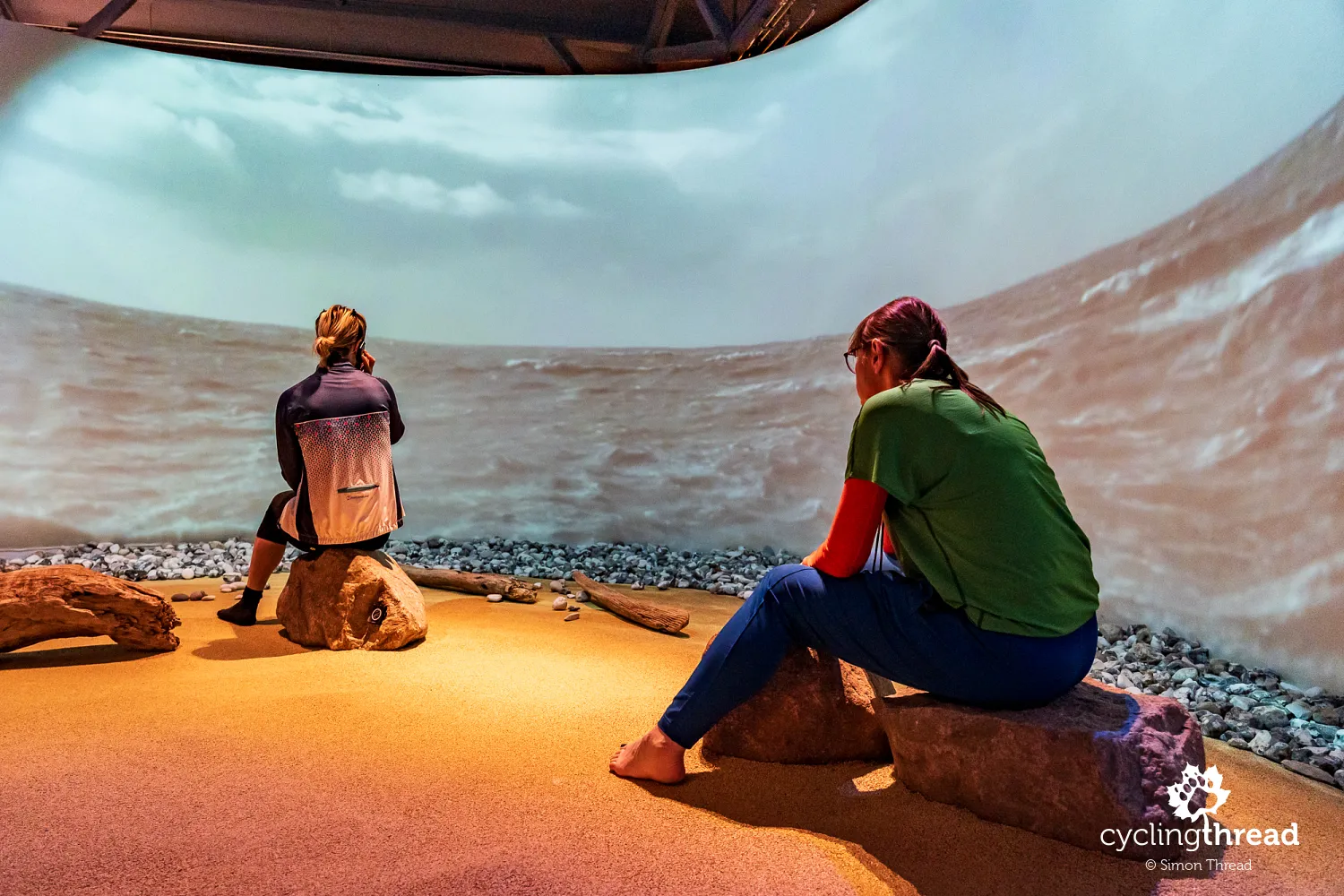
One of Faaborg's most interesting attractions is Øhavsmuseet, a modern museum dedicated to the nature, history and communities of the South Funen Archipelago. Instead of traditional display cases, it uses interactive exhibitions, sound recordings and multimedia installations to explain how this glacial landscape was formed and how people have lived alongside the sea for thousands of years. One unusual feature is that visitors are asked to remove their shoes before entering part of the exhibition, where different natural materials and textures can be explored barefoot. Faaborg is also an excellent place for a longer break or an overnight stay before continuing your journey through southern Funen.
The traditional colours of Danish houses
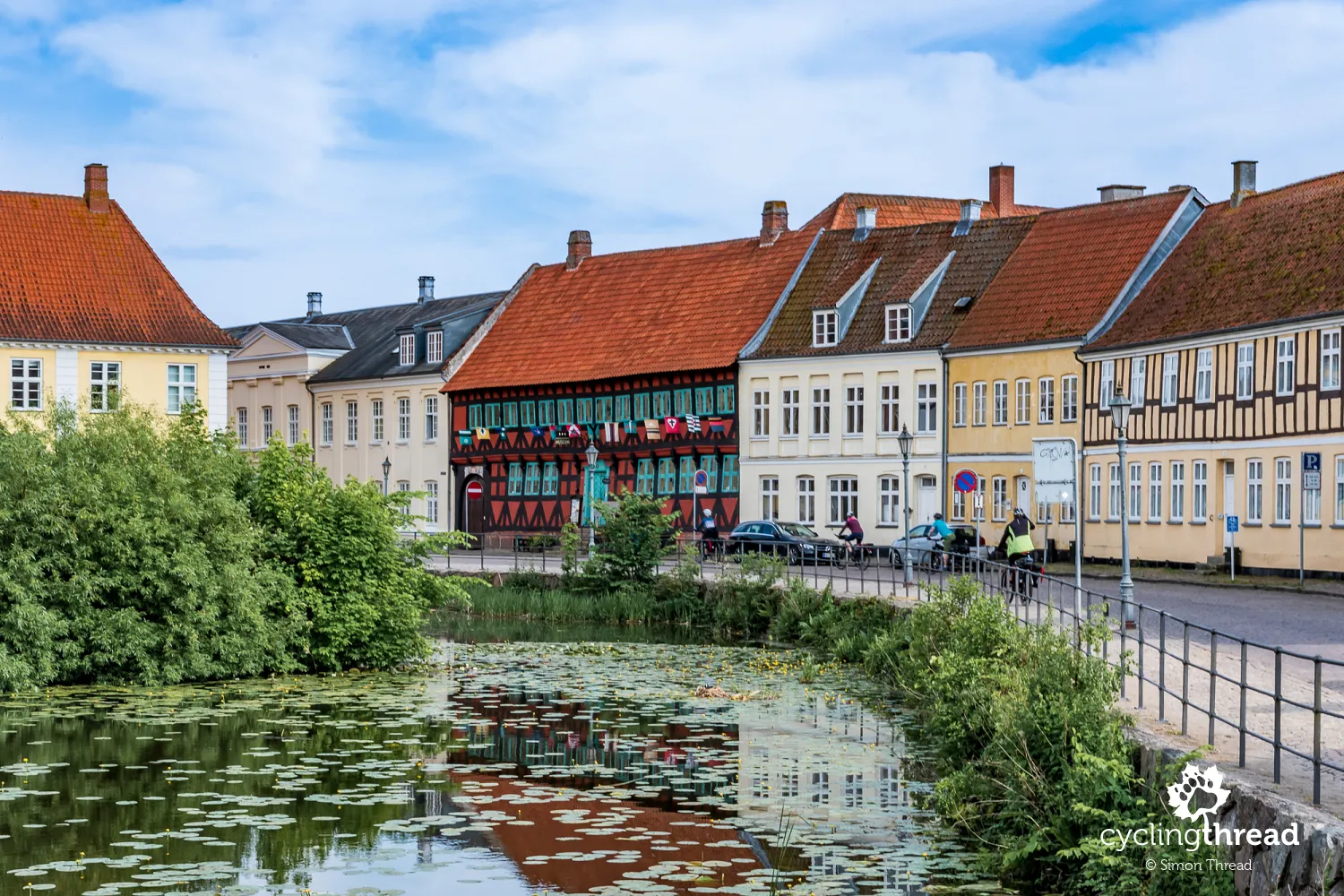
While cycling across Funen, it is impossible not to notice the distinctive colours of the houses. For centuries, two earthy shades have dominated the landscape - yellow ochre and deep red. Their popularity was not just a matter of style. Natural pigments based on iron oxides were durable, widely available and well suited to protecting wood and plaster from the damp coastal climate. The dark red colour, known across Scandinavia as Falun red, was especially common on timber buildings, while yellow ochre became one of the defining colours of Danish architecture. Although lighter shades of cream and grey became more popular from the 18th century onwards, ochre and red still give Denmark's historic towns much of their distinctive character today.
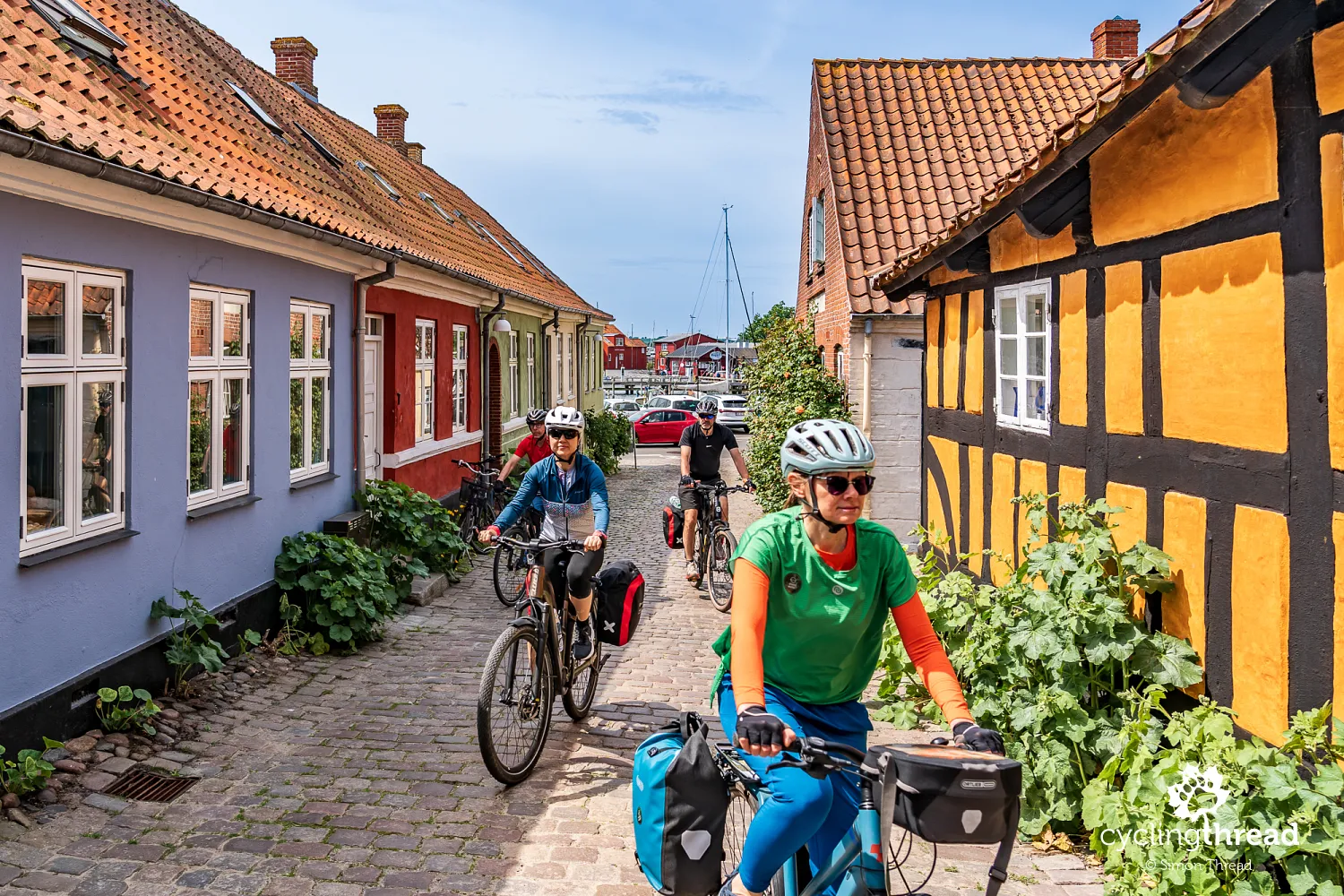
Island-hopping across the South Funen Archipelago
Around Faaborg and Svendborg, the Castle Route splits into two options. One stays on Funen, continuing past more historic estates and attractions in the southern part of the island. The other explores a completely different side of Denmark - the South Funen Archipelago. From Faaborg, you can take a regular ferry to Søby on the island of Ærø, cycle across the island, and then continue by ferry to Langeland. From there, you can either follow the Castle Route's dedicated loop around Langeland or continue across the bridges via the island of Tåsinge back to Svendborg on Funen. We chose this option and can highly recommend it. The two ferry crossings, peaceful islands and coastal scenery make it one of the most enjoyable and scenic sections of the entire Castle Route.
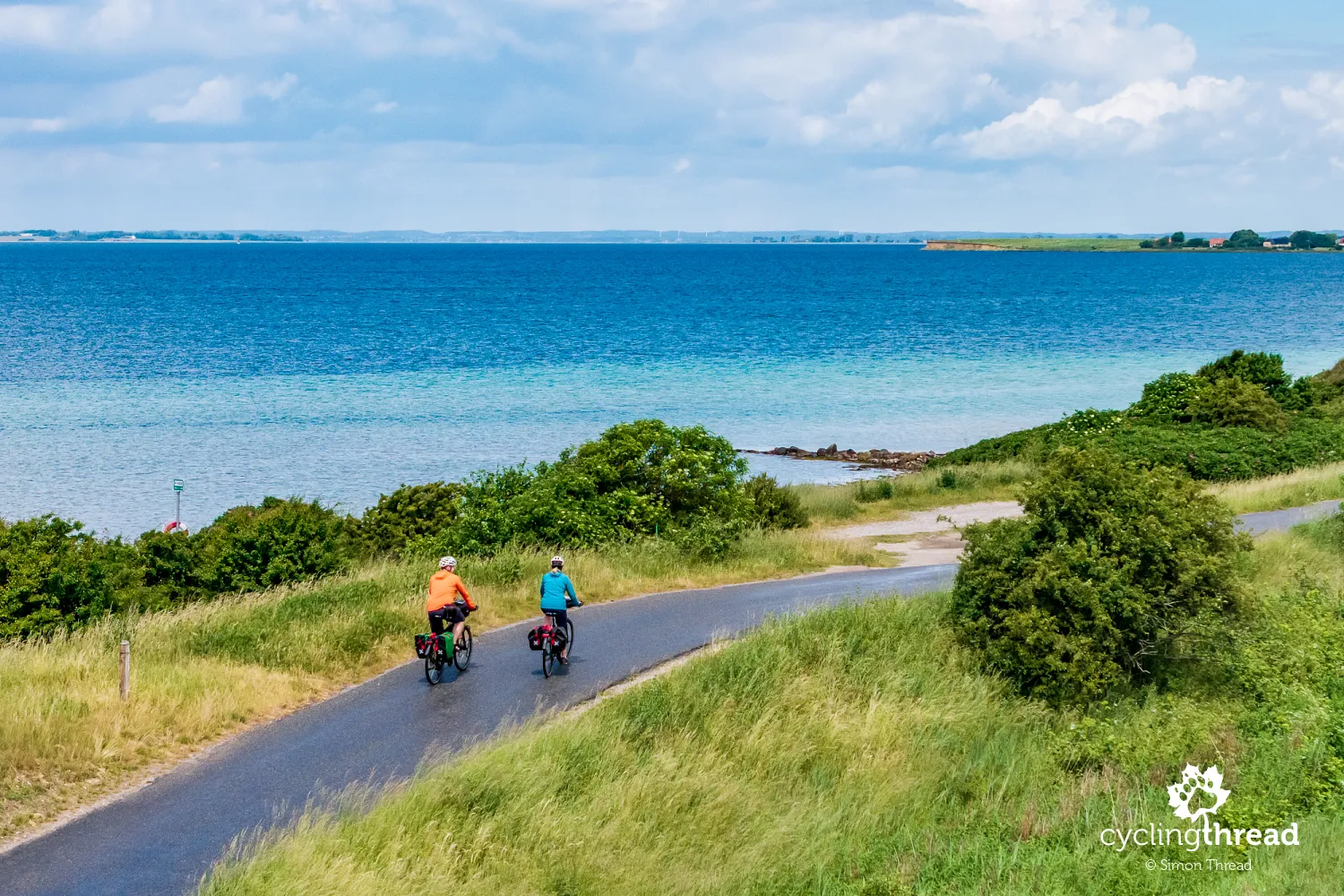
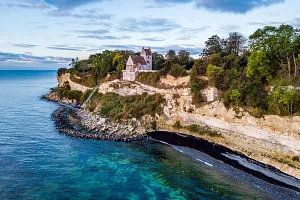
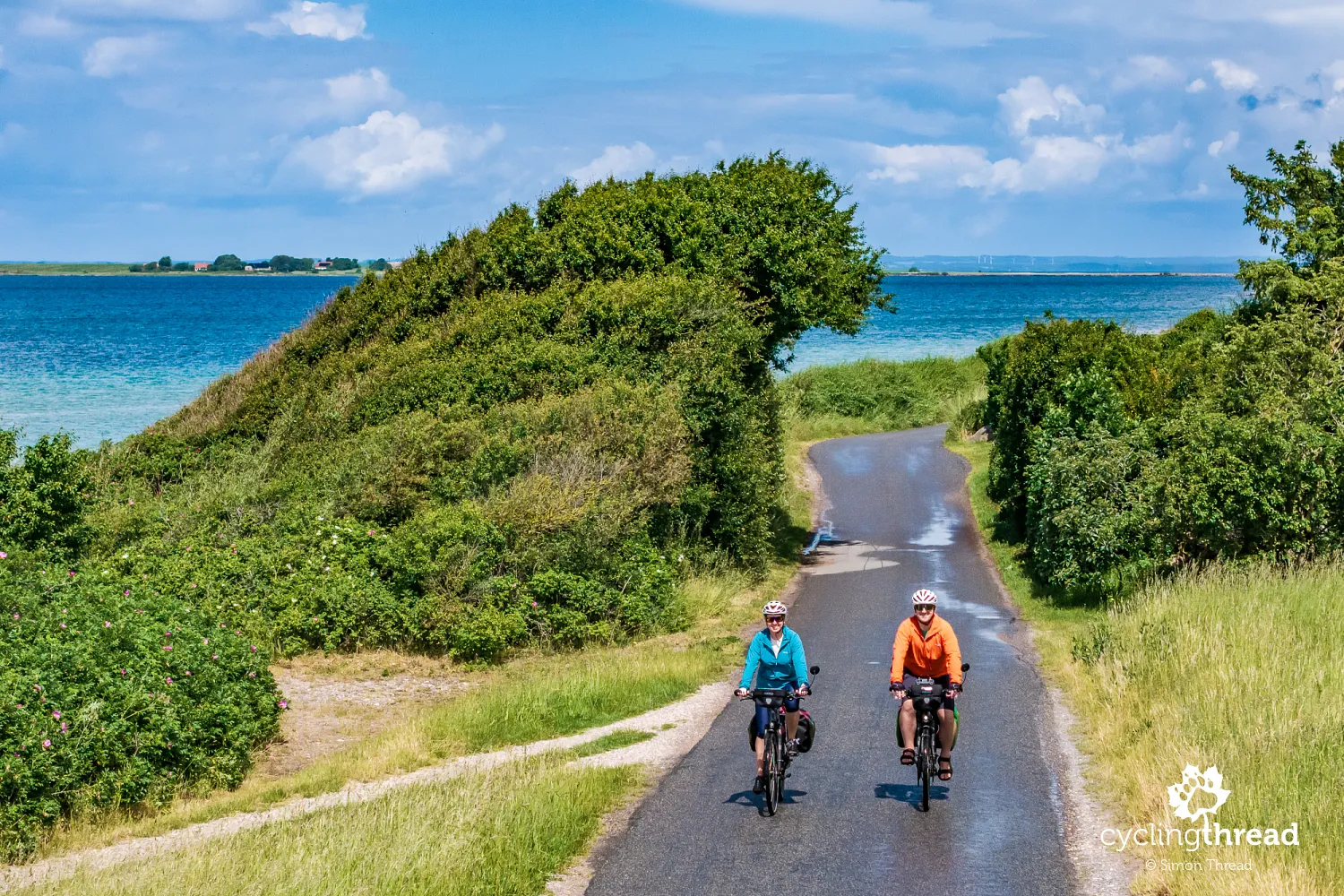
The greatest attraction of Ærø is the island itself. The route begins in the quiet harbour of Søby and passes through small villages, farmland and gently rolling hills before reaching the historic towns of Ærøskøbing and Marstal. The sea is rarely out of sight, while the landscape is enriched by the cliffs of Voderup Klint, traditional windmills and the island's small harbours and marinas. Ærø is not a place of spectacular landmarks. Its greatest appeal lies in its peaceful scenery and the relaxed atmosphere that stays with you throughout the day.
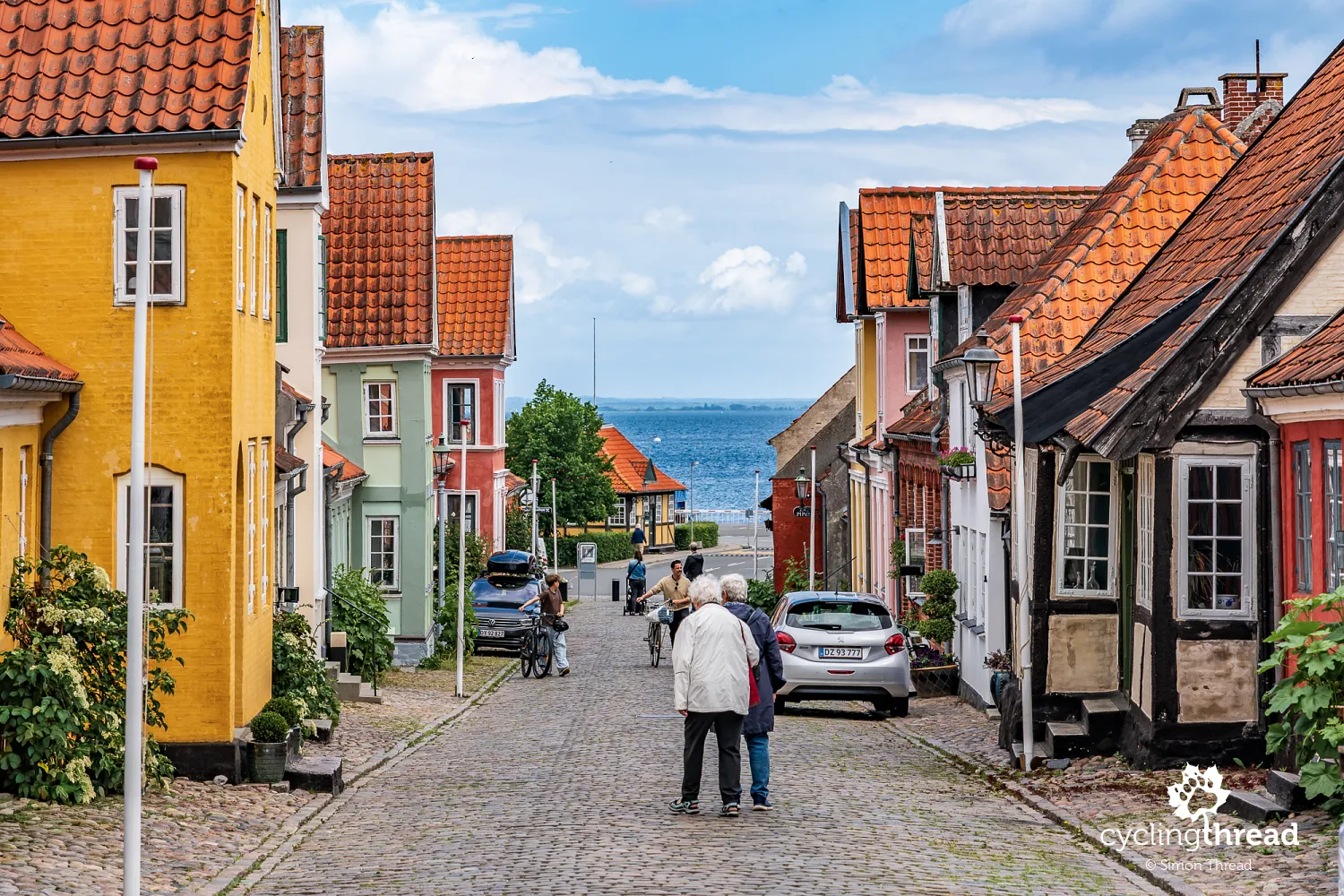
The place we remember most fondly, however, is Ærøskøbing, the island's main town. Walking through its centre feels like stepping back into the 18th century. The street layout and most of the buildings have survived almost unchanged since the town's golden age in the 18th century, making Ærøskøbing one of the best-preserved historic towns in Denmark. Pastel-coloured fishermen's and merchants' houses, cobbled streets, small squares and beautifully kept gardens create one of the country's finest historic town centres. There are no grand monuments or crowds of tourists here. Instead, Ærøskøbing charms visitors with the quiet atmosphere of a small harbour town unlike anywhere else.
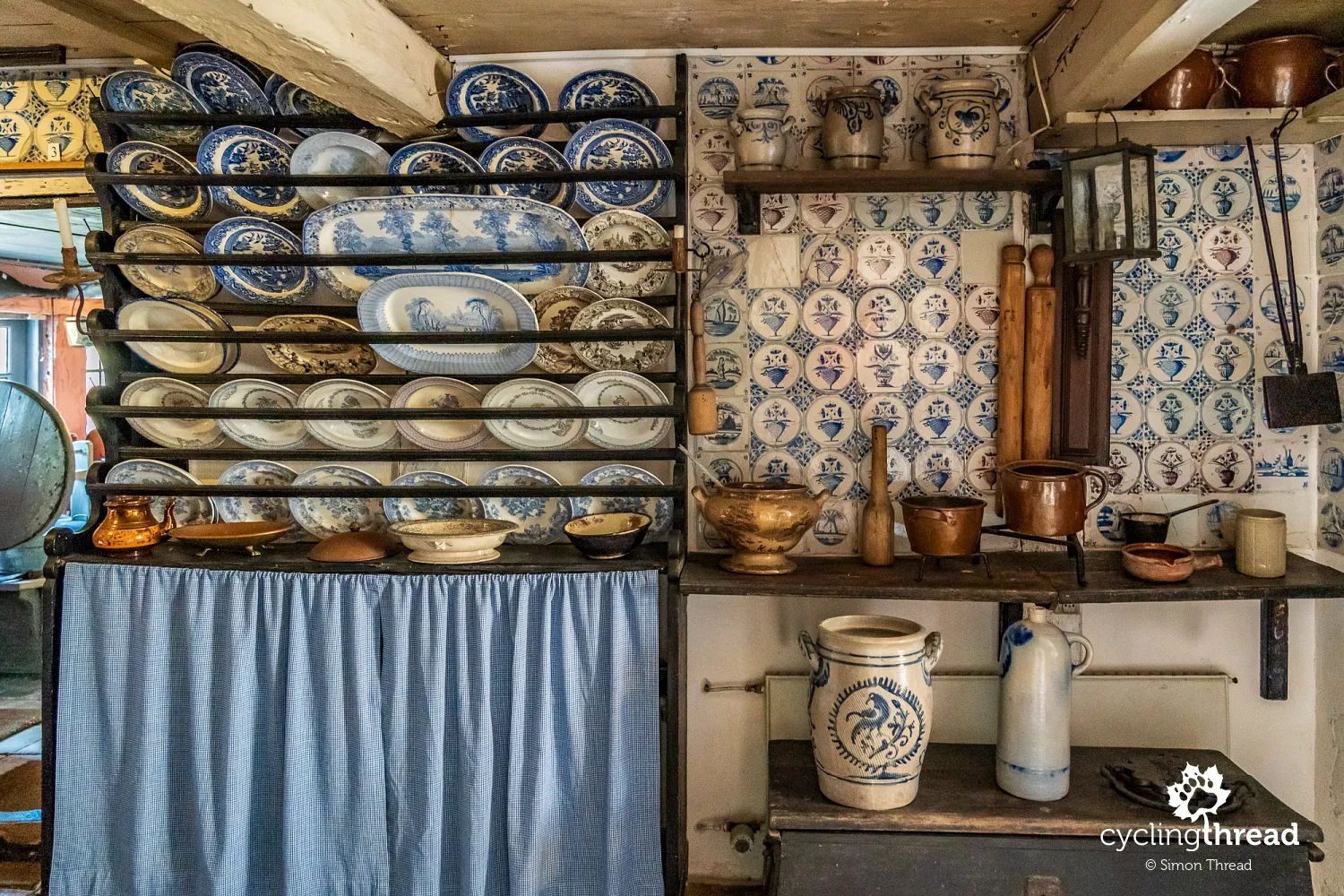
One of the best places to experience this atmosphere is Hammerichs Hus. This small merchant's house has been preserved almost exactly as it was left by its last residents. As you walk through the rooms, it feels as though the family has only just stepped outside. Original furniture, kitchen utensils, porcelain, paintings, family photographs, books and everyday objects are all still in place. Rather than feeling like a traditional museum, it feels like a real home where ordinary family life continued for generations. It was one of the most memorable historic interiors we visited during our journey across Funen and its neighbouring islands.
Cycling beside the Danish sea
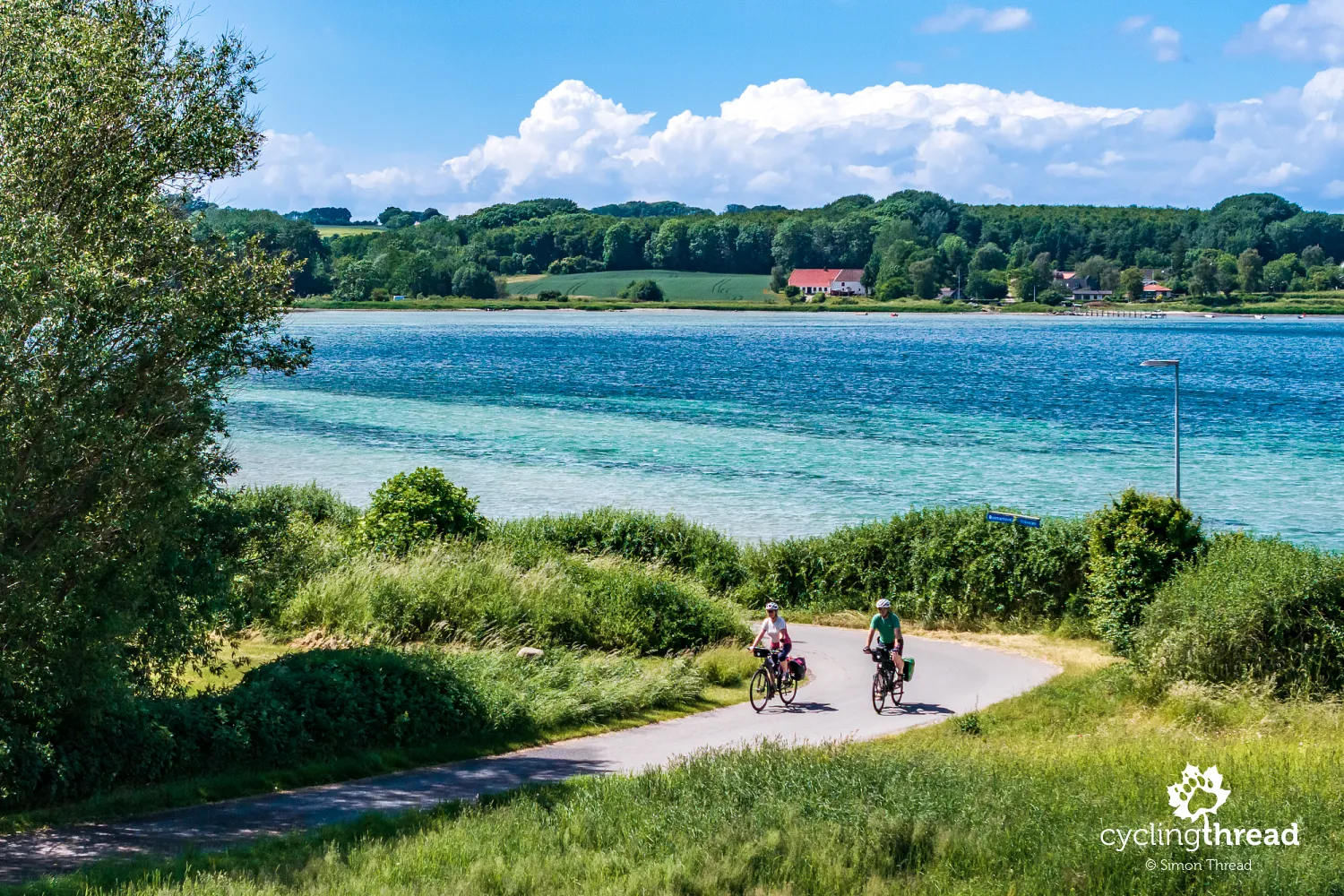
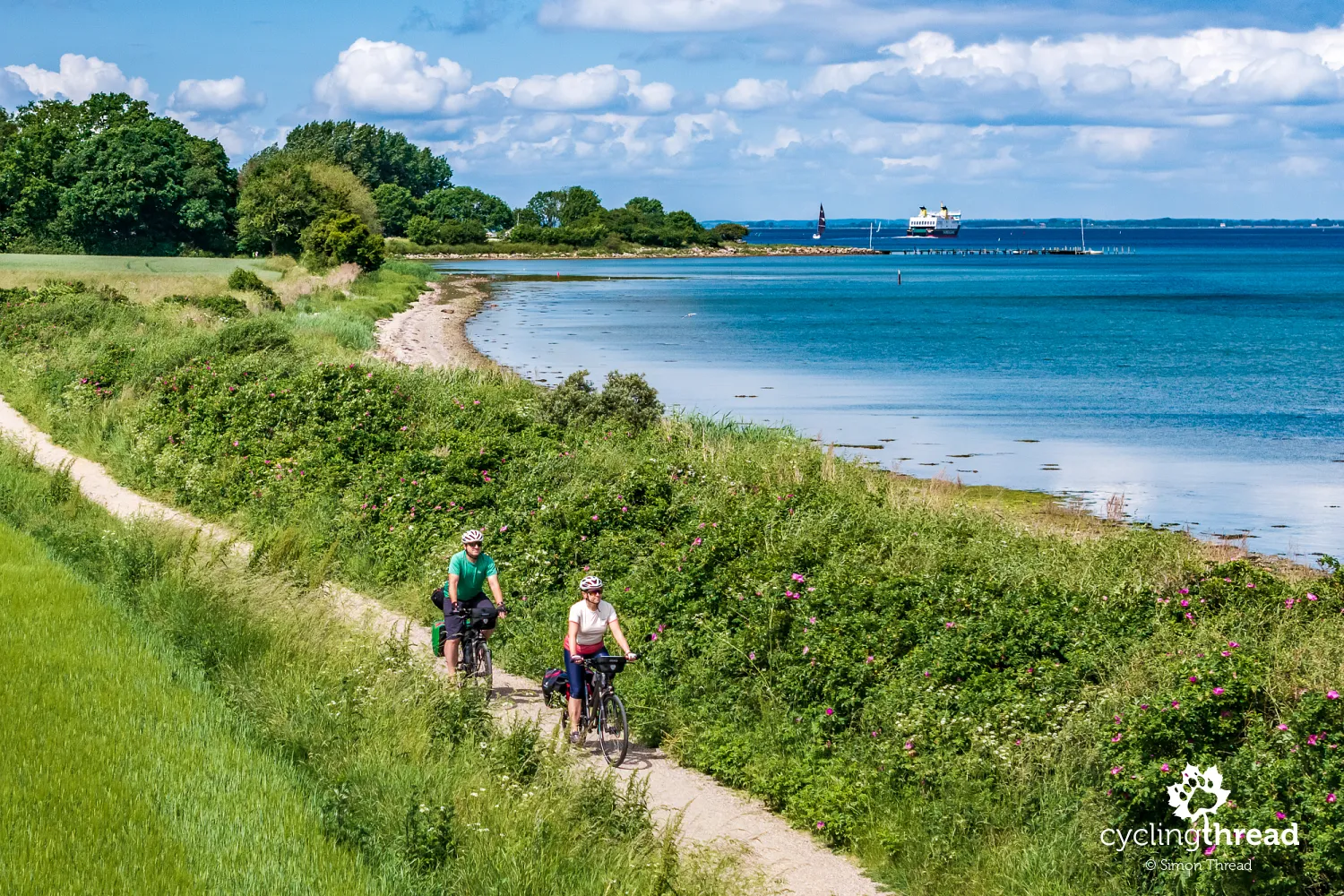
On Ærø, the Castle Route includes several beautiful stretches that run almost alongside the sea - first on quiet asphalt roads and later on narrow gravel tracks. A few kilometres before reaching Ærøskøbing, we were caught in a short but heavy downpour that made the surrounding meadows and fields look even greener. Soon afterwards, we were cycling along a narrow coastal road towards Marstal, partly sheltered from the sea breeze by flowering wild rose bushes. The clouds quickly disappeared, the sun came out, and within minutes the temperature had risen enough for us to take off our jackets. Weather like this is perfectly normal on the Danish islands and shows just how strongly the surrounding sea influences the local climate.
Marstal and its Maritime Museum
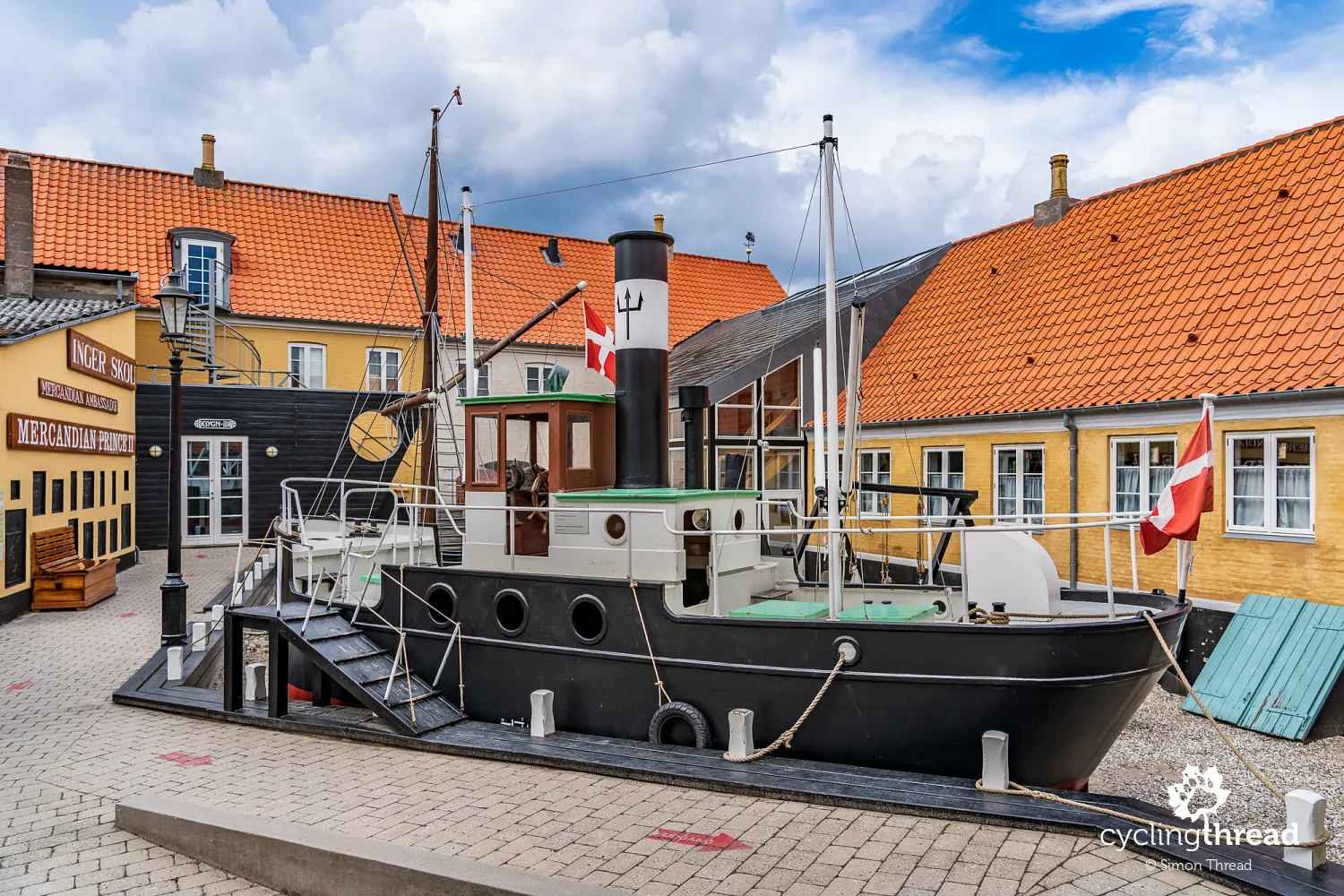
We left Ærø from Marstal, taking the ferry to Langeland. Before boarding, we spent some time exploring the town and visiting the Marstal Maritime Museum. Marstal has lived from the sea for centuries. In the 19th century, its merchant fleet was one of the largest in Denmark, with ships sailing to ports all over the world. At that time, almost everyone in the town was connected with the sea as a sailor, captain, shipowner or shipbuilder. Today, these maritime traditions live on in the harbour, the historic vessels moored there and the Marstal Maritime Museum, one of Denmark's leading museums dedicated to the country's seafaring history.
Taking bicycles on local Danish ferries
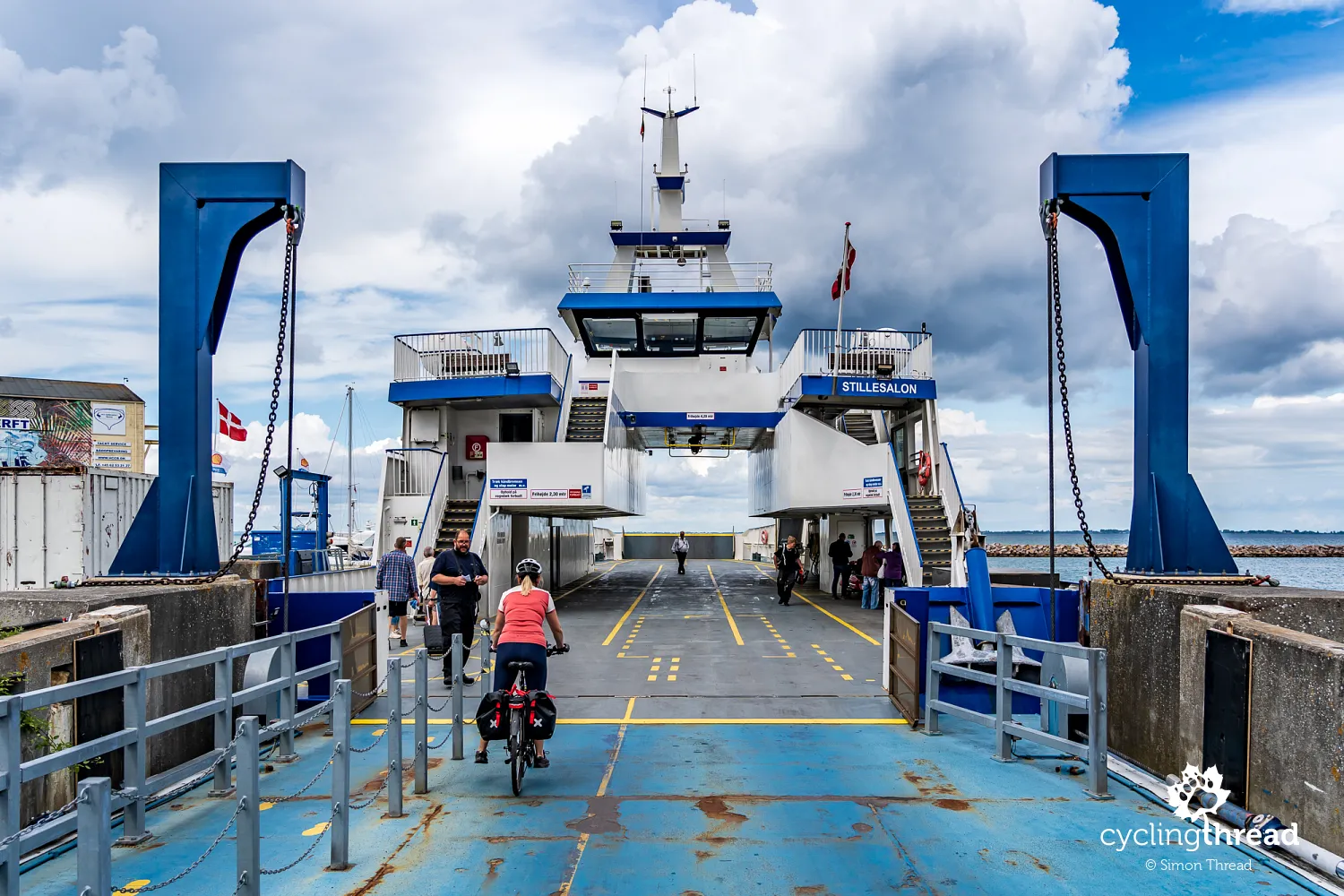
There is no need to worry about travelling with a bicycle on the local ferries. Cyclists are a familiar sight, using them not only for touring but also for everyday journeys to work, school or the shops. Every ferry has a dedicated space for bicycles, usually along the sides of the main vehicle deck. After boarding, the crew directs cyclists to the correct parking area. We booked our tickets in advance on the ferry operators' websites, and both passenger fares and bicycle supplements were reasonably priced. Once the ferry departs, everyone leaves their vehicle behind. Drivers, motorcyclists and cyclists all head up to the passenger decks, where you can enjoy the views of the islands of the South Funen Archipelago.
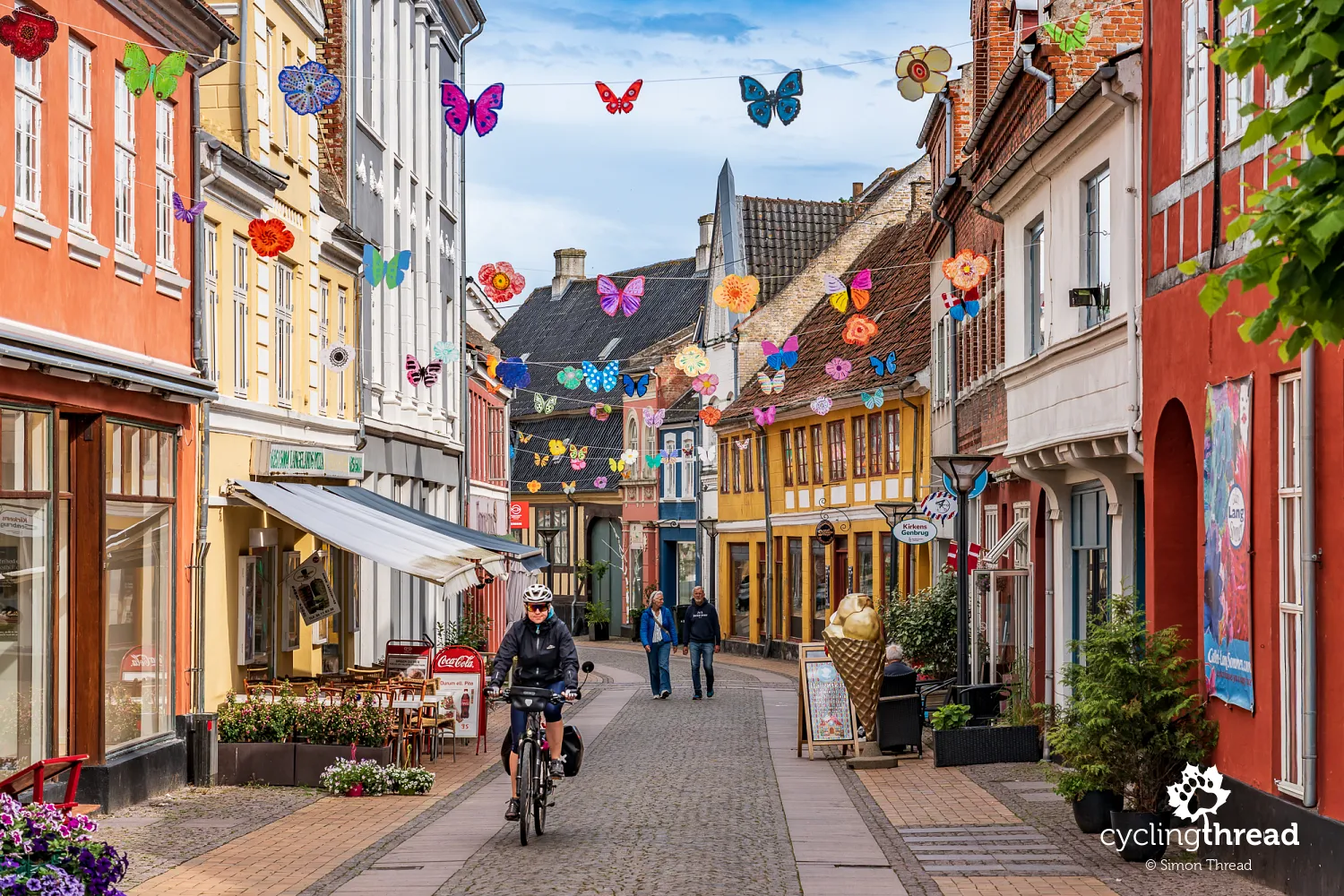
Langeland has its own charm, although for us it was just a short stop in the island's main town, Rudkøbing. Even before the ferry reaches the harbour, one building immediately catches the eye - the historic warehouse standing on the waterfront. Built in the mid-19th century, it was used for decades to store grain and other goods transported between the Danish islands, recalling the time when the harbour was the town's main gateway to the outside world. Just a few steps away begins the historic centre, with its cobbled streets, colourful merchants' houses and well-preserved 18th- and 19th-century buildings that give Rudkøbing the relaxed atmosphere of a small Danish harbour town.
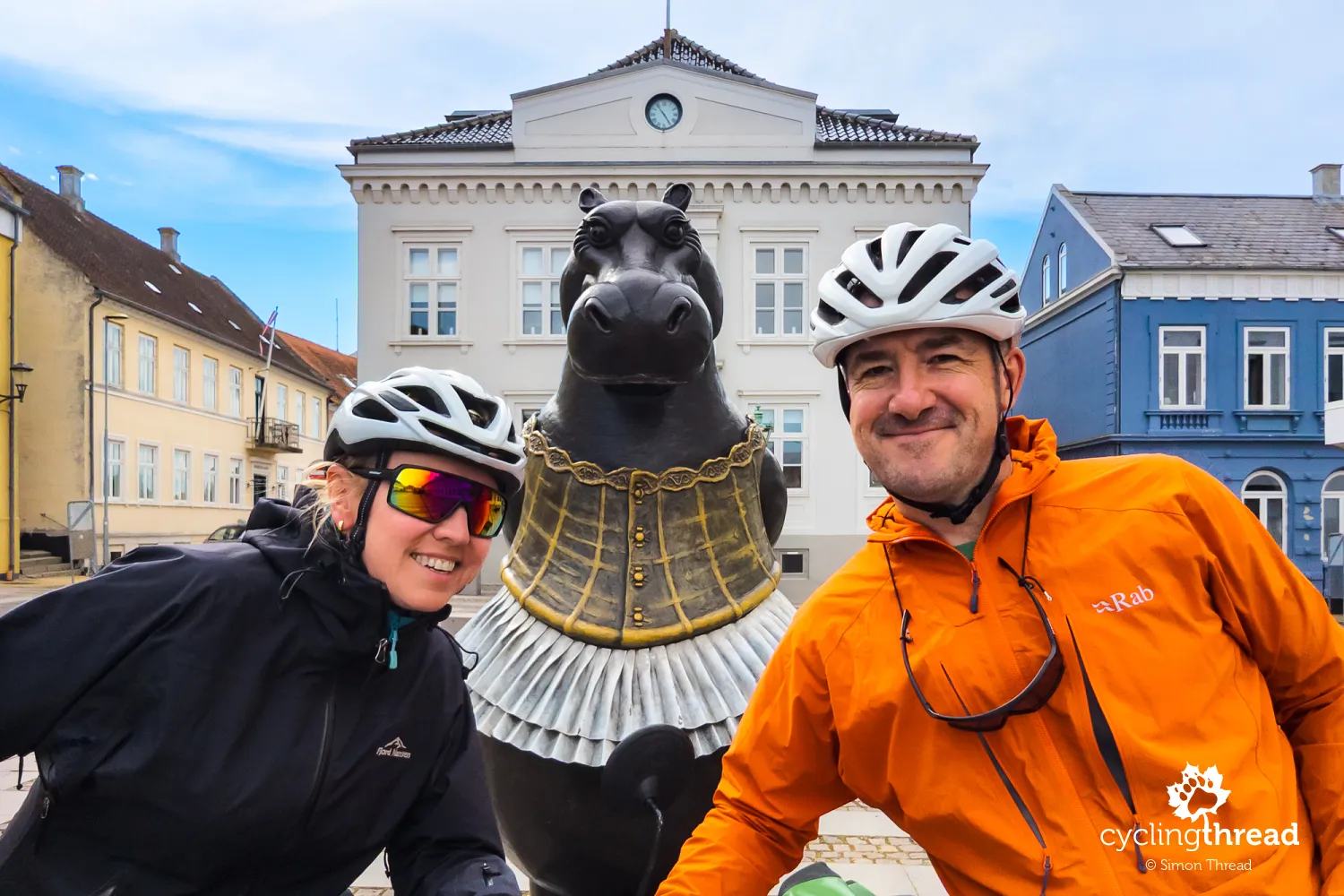
We also could not resist taking a selfie with Hippo Ballerina, the almost one-tonne sculpture of a ballet dancer in the form of a hippopotamus. It was created by Bjørn Okholm Skaarup, the internationally known sculptor who was born in Rudkøbing and is famous for his humorous animal sculptures inspired by human figures. Hippo Ballerina is a playful tribute to the famous ballerinas painted and sculpted by Edgar Degas. Originally installed as a temporary artwork, it became so popular that local residents raised the money to keep it permanently. Today, it is one of Rudkøbing's best-known landmarks.
Crossing the iconic Langeland Bridge
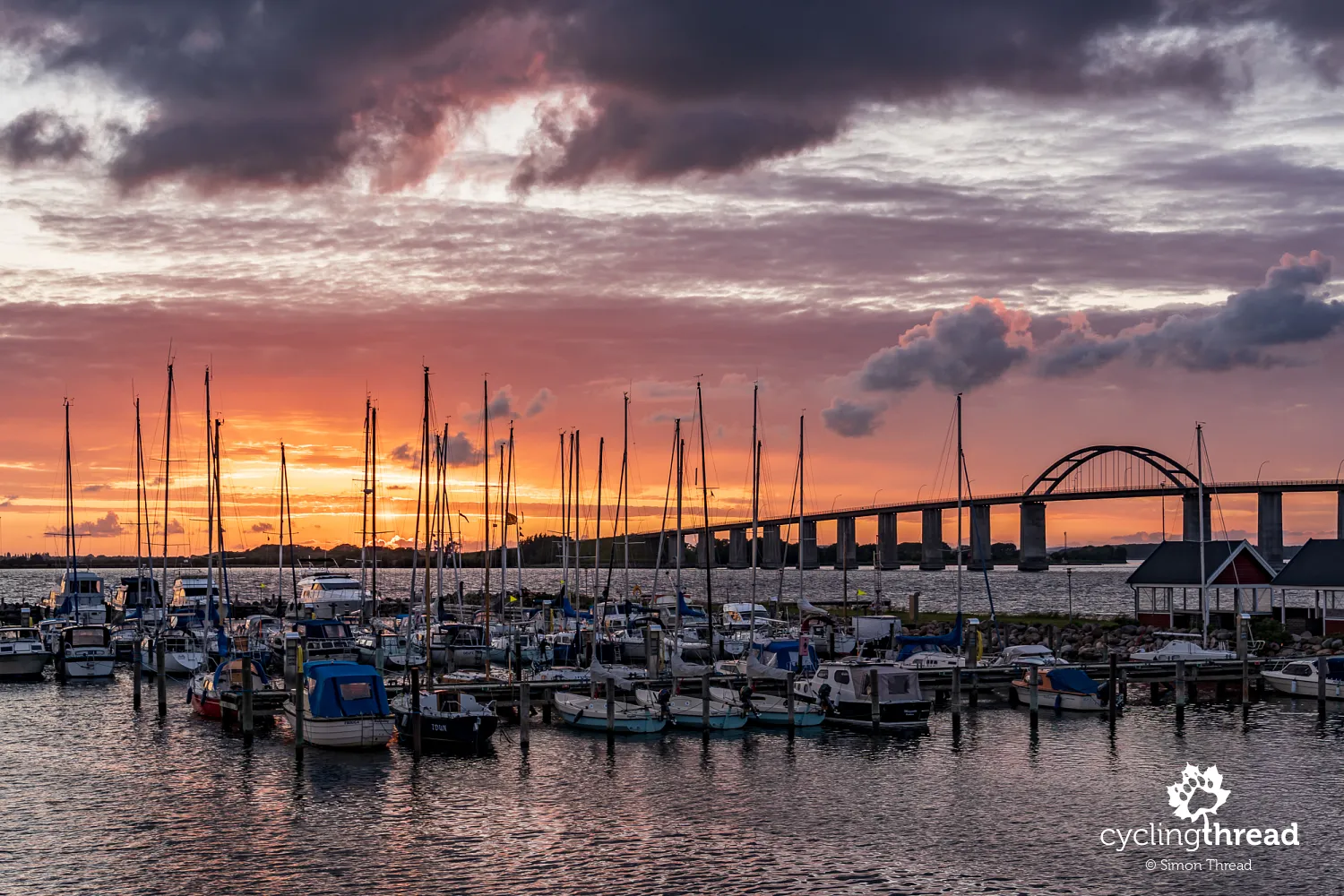
Leaving Rudkøbing, we crossed the Langeland Bridge (Langelandsbroen), an almost 800-metre-long bridge opened in 1962 that provided the first permanent road connection between Langeland and the neighbouring islands. Its high central span allows sailing boats and larger vessels to pass through the Langeland Belt below. This is probably the least interesting section of the entire Castle Route, with the cycle path following a busy main road for several kilometres. Eventually, the route turns right towards Valdemars Slot before heading back to the main road and crossing another bridge to return to Funen and the town of Svendborg.
The impressive Valdemars Slot
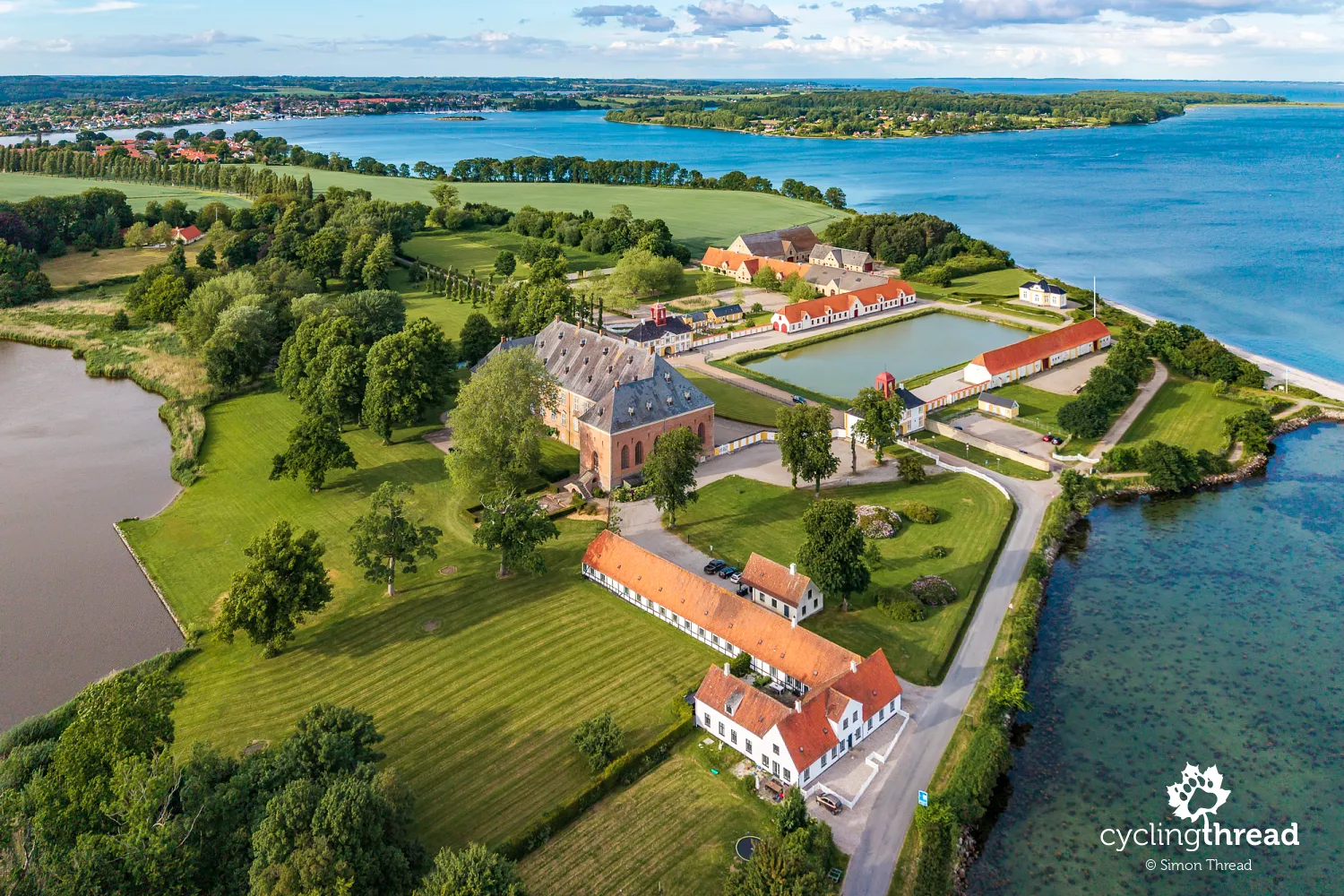
Valdemars Slot is just as impressive for its setting as for its history. The Baroque mansion stands on the eastern shore of the island of Tåsinge, overlooking the waters of Lunkebugten Bay. It was built between 1639 and 1644 on the orders of King Christian IV for his son, Valdemar Christian, although the prince never had the chance to live there. For centuries, and right up to the present day, the estate has remained in the hands of the descendants of the famous Danish admiral Niels Juel. Today, it is one of Denmark's largest and best-preserved historic country estates. After several years of closure, it has once again opened its doors to visitors. Since 2025, the castle and its surrounding buildings have hosted contemporary art exhibitions between May and September. Historic interiors are combined with modern artworks, creating an unusual contrast between the estate's heritage and contemporary culture.
The mainland Castle Route option
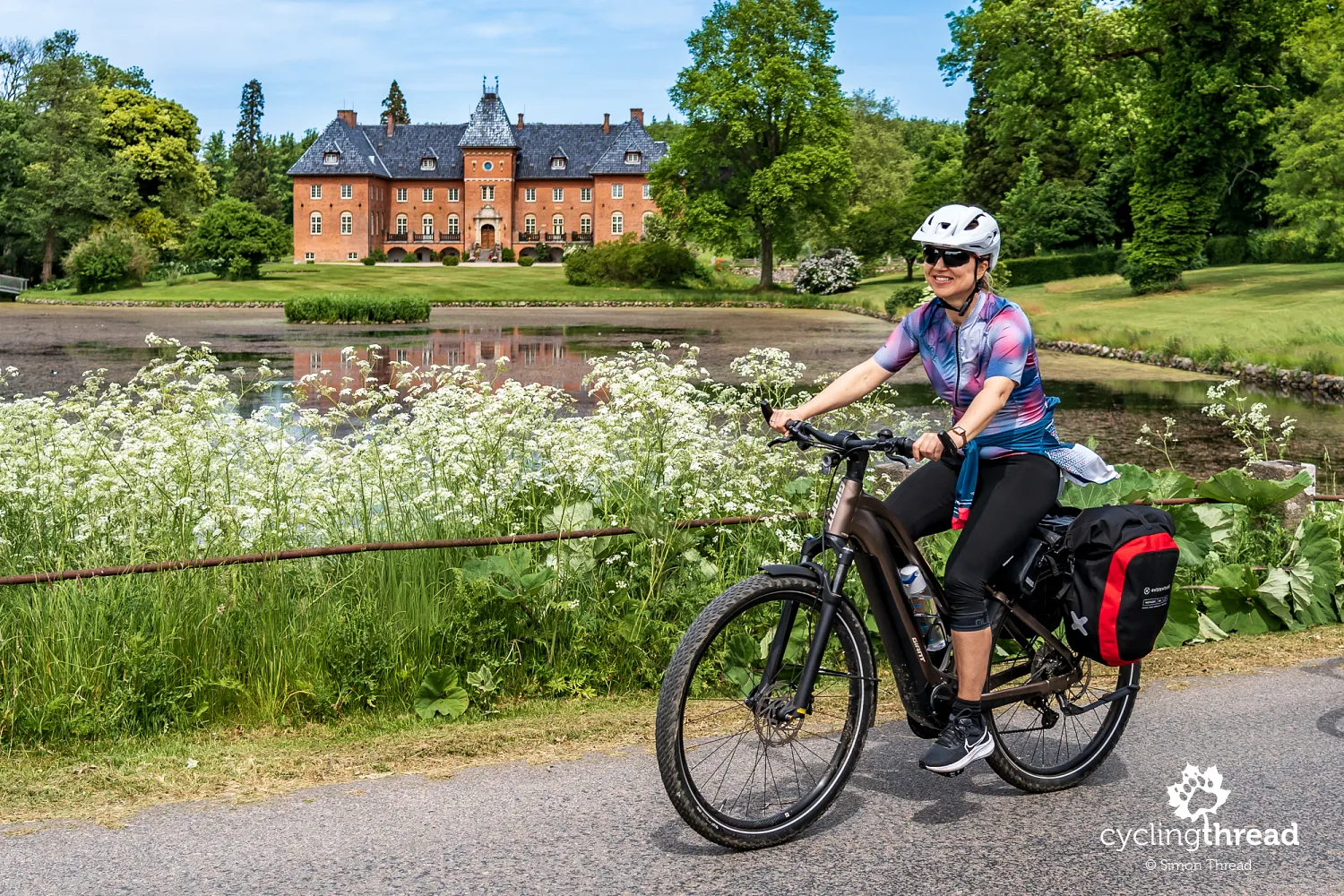
Svendborg marks the end of the island variant of the Castle Route, although cyclists following the mainland route from Faaborg also arrive here. That route has its own highlights. Shortly after leaving Faaborg, the Castle Route passes Holstenshuus, an estate whose origins go back to a fortified manor built in the early 14th century. Over the centuries, it belonged to several Danish noble families and has been owned by the Holstein-Holsteinborg family since 1753. The present mansion dates from its reconstruction after a fire in 1908. Although the estate is privately owned, it can be clearly seen from the route, while the surrounding park and former farm buildings form one of the best-preserved historic manor complexes in southern Funen.
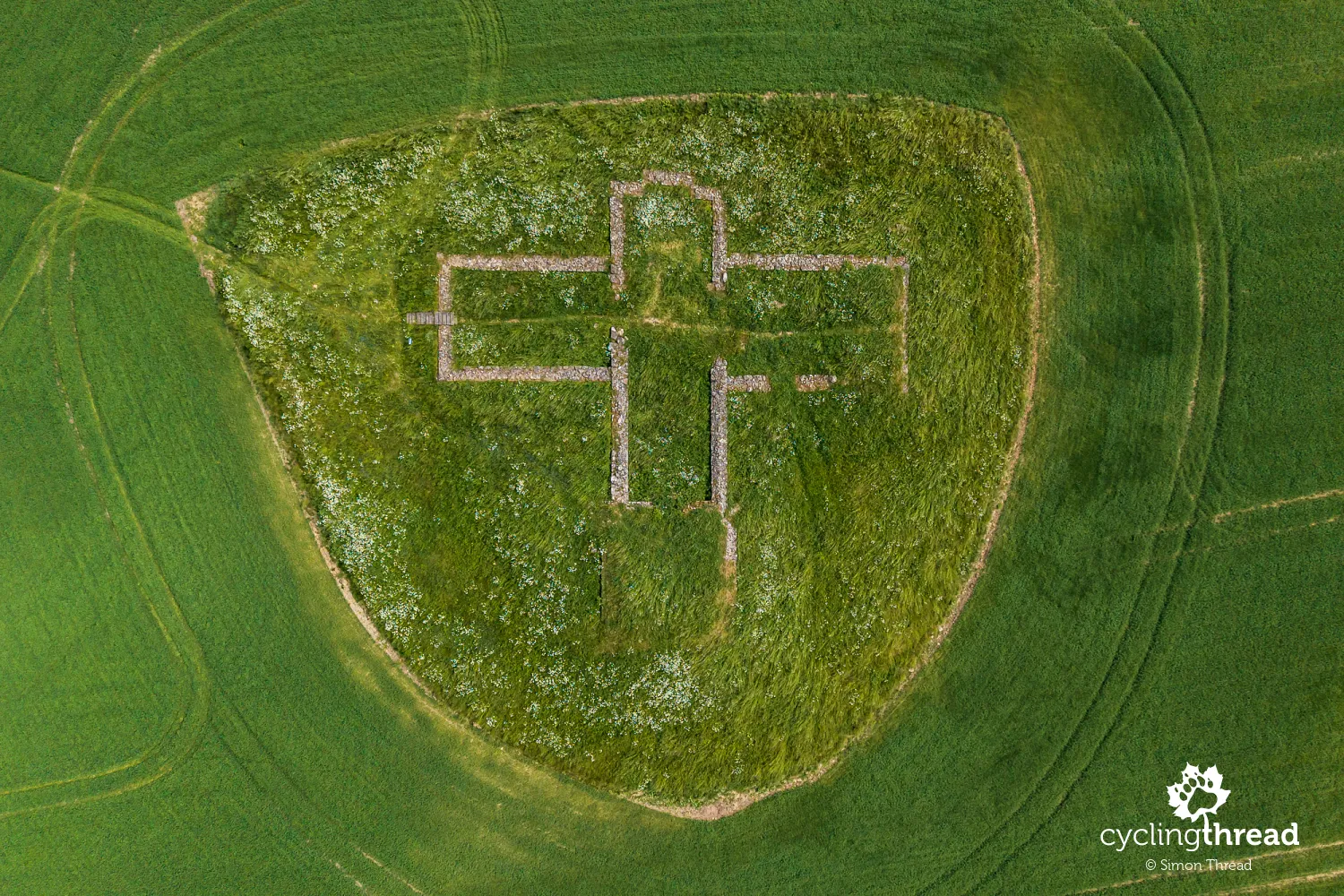
Just a short walk from the road, near the entrance to Holstenshuus Park, stand the ruins of the medieval church at Finstrup. Only the stone foundations remain, but the church's unusual, almost symmetrical cross-shaped layout makes it one of Denmark's most intriguing medieval church sites. Historians believe it may once have served as a pilgrimage church, attracting visitors from distant parts of the country. No one knows exactly why it disappeared, although it was already described as an abandoned ruin by the end of the 16th century.
Traditional Danish half-timbered farmhouses
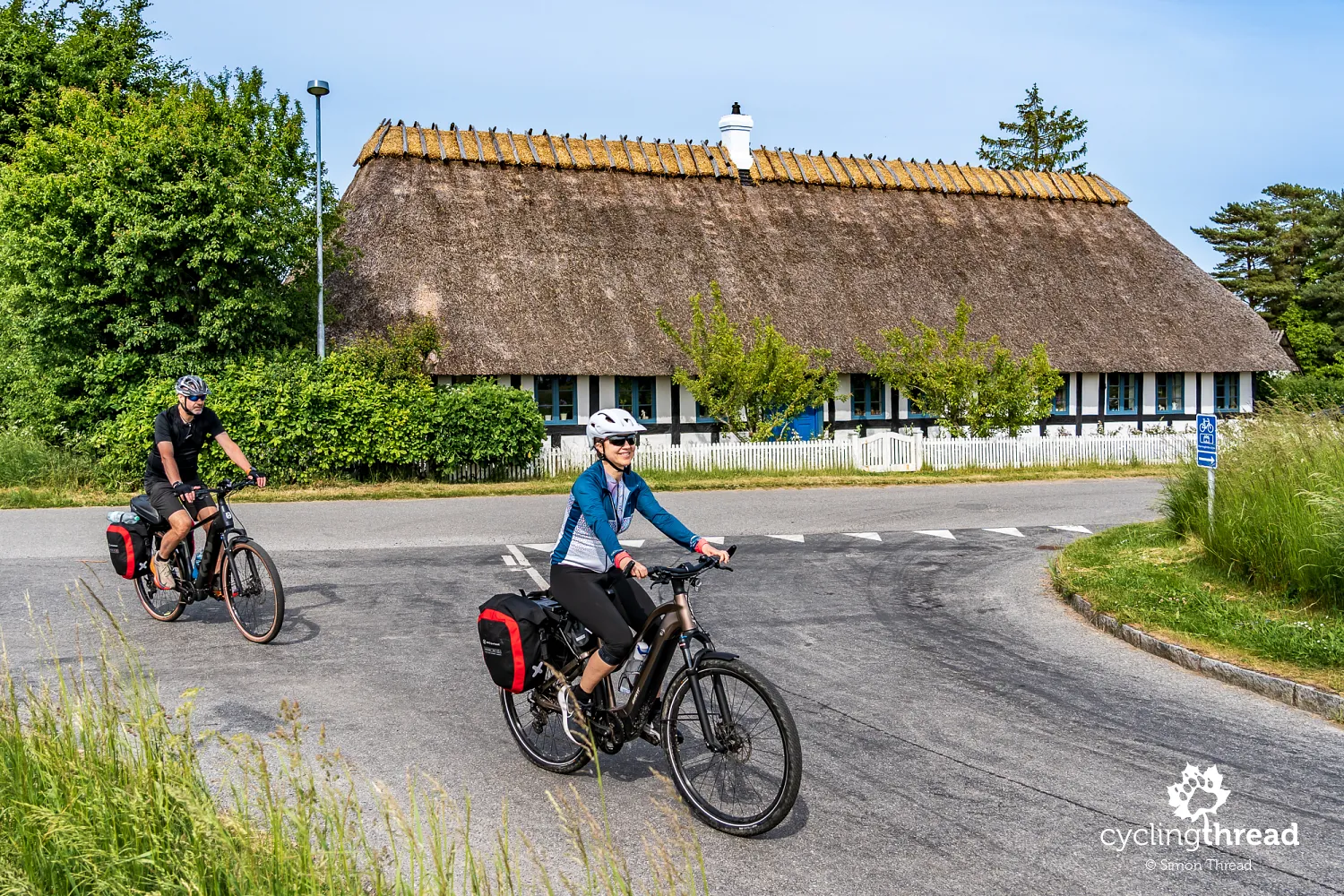
While following the Castle Route, it is worth paying attention not only to the castles and manor houses but also to the traditional farmsteads along the way. Many still retain their original half-timbered construction, with timber frames filled with brick or clay and thick thatched roofs. This style of building was perfectly suited to Denmark's damp, windy climate. The thatch provided excellent insulation, while the timber frame could be repaired or extended with relative ease. Thanks to regular maintenance, many of these houses are now 200 or even 300 years old and remain an active part of everyday life on the island.
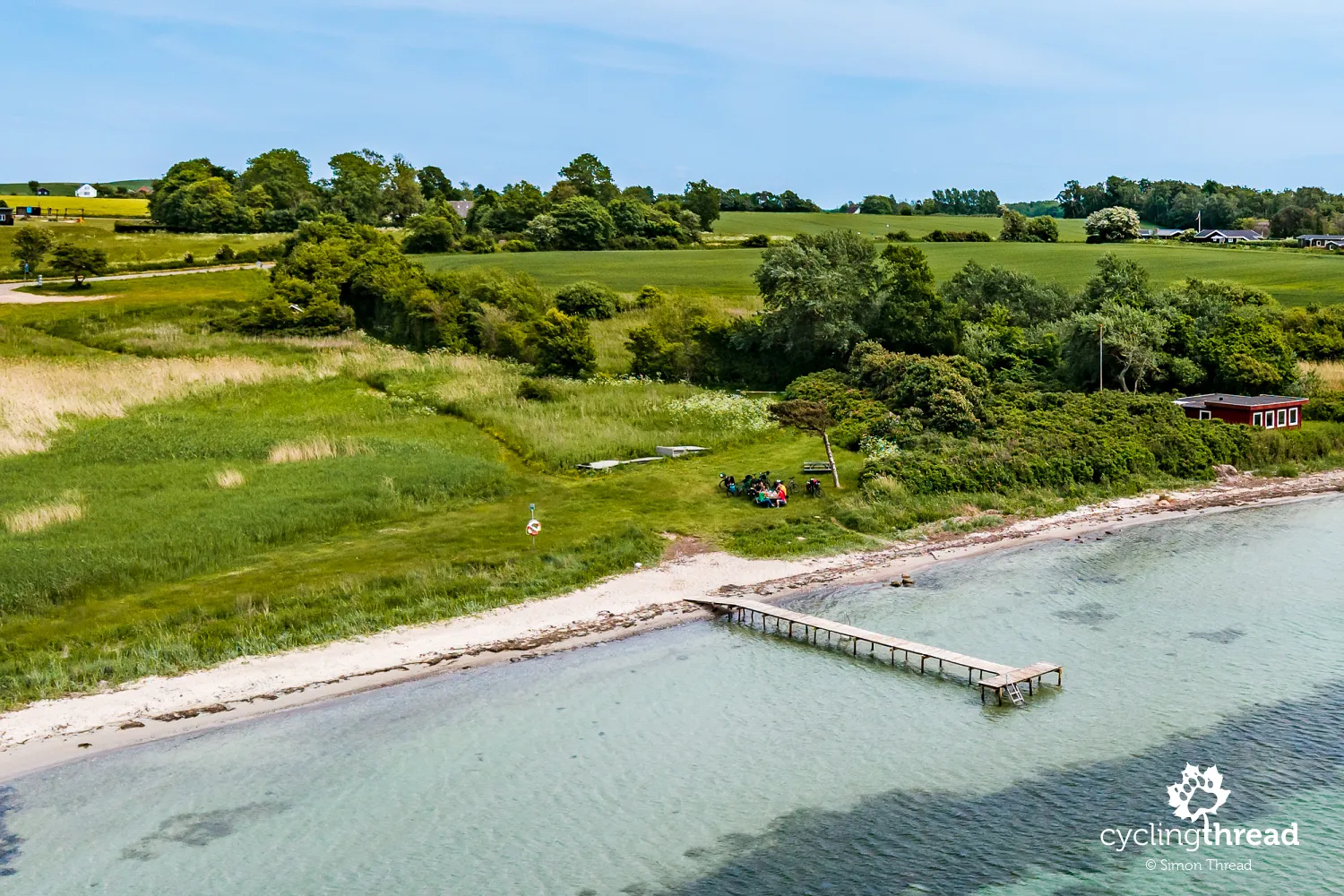
One of the more unusual stops along the Castle Route is Nab Beach, overlooking the waters of Faaborg Fjord and the islands of the South Funen Archipelago. It is one of the best places to take a longer break during the ride. The beach has a jetty, picnic tables and benches, making it an ideal spot to prepare a meal, enjoy lunch or simply relax in the shade. The grassy area is perfect for a short nap, while on warm days you can go for a swim. Nab is an official bathing beach with good water quality and a gently sloping shoreline. It is one of those places where you plan to stop for just a few minutes and end up staying much longer. The only thing missing is a public toilet.
Denmark's National Cycle Route 8
Watching our group cycling along the Baltic coast reminded me that parts of the Castle Route follow Denmark's National Cycle Route 8 - the Baltic Sea Cycle Route. Described by Denmark's national tourism organisation as "hygge on two wheels", this 820-kilometre route is part of Denmark's national cycle network and links the country's main southern islands using a series of ferry crossings. On many sections, it also follows the route of EuroVelo 10, the international cycling route around the Baltic Sea. It shares several stretches with the Castle Route along Funen's southern coast and across the scenic island of Ærø. While National Cycle Route 8 generally stays close to the shoreline, the Castle Route more often turns inland, leading cyclists to historic manor houses, palaces and castles.
A German wartime bunker on Funen
Funen's Second World War history is recalled by the German bunker at Ollerup. It was built in 1944 as part of a complex of bunkers and underground tunnels constructed for around 800 German soldiers stationed at the local folk high schools. Three reinforced concrete bunkers survive today, connected by around 100 metres of underground passages. Their massive construction offers a striking contrast to the medieval castles seen elsewhere along the route, illustrating how defensive architecture evolved over the centuries in response to air raids and modern artillery. The bunkers are now open to visitors and include small exhibitions explaining the site's history. Picnic tables and benches outside also make this a pleasant place for a short break before the final stretch to Svendborg.
The best sights in historic Svendborg
Svendborg was another Funen town where we happily spent an afternoon and were sorry to leave the next morning. It is a lively harbour town, with a waterfront lined by restaurants and cafés, alongside marinas filled with yachts and ferries. For centuries, its prosperity was built on shipping and maritime trade. Today, it remains the main town of southern Funen and the gateway to the South Funen Archipelago. Ferries depart from here to Ærø, Skarø, Drejø and several other nearby islands. The historic centre begins just a short walk from the harbour, creating a seamless connection between the waterfront and the old town that is perfect for exploring on foot.
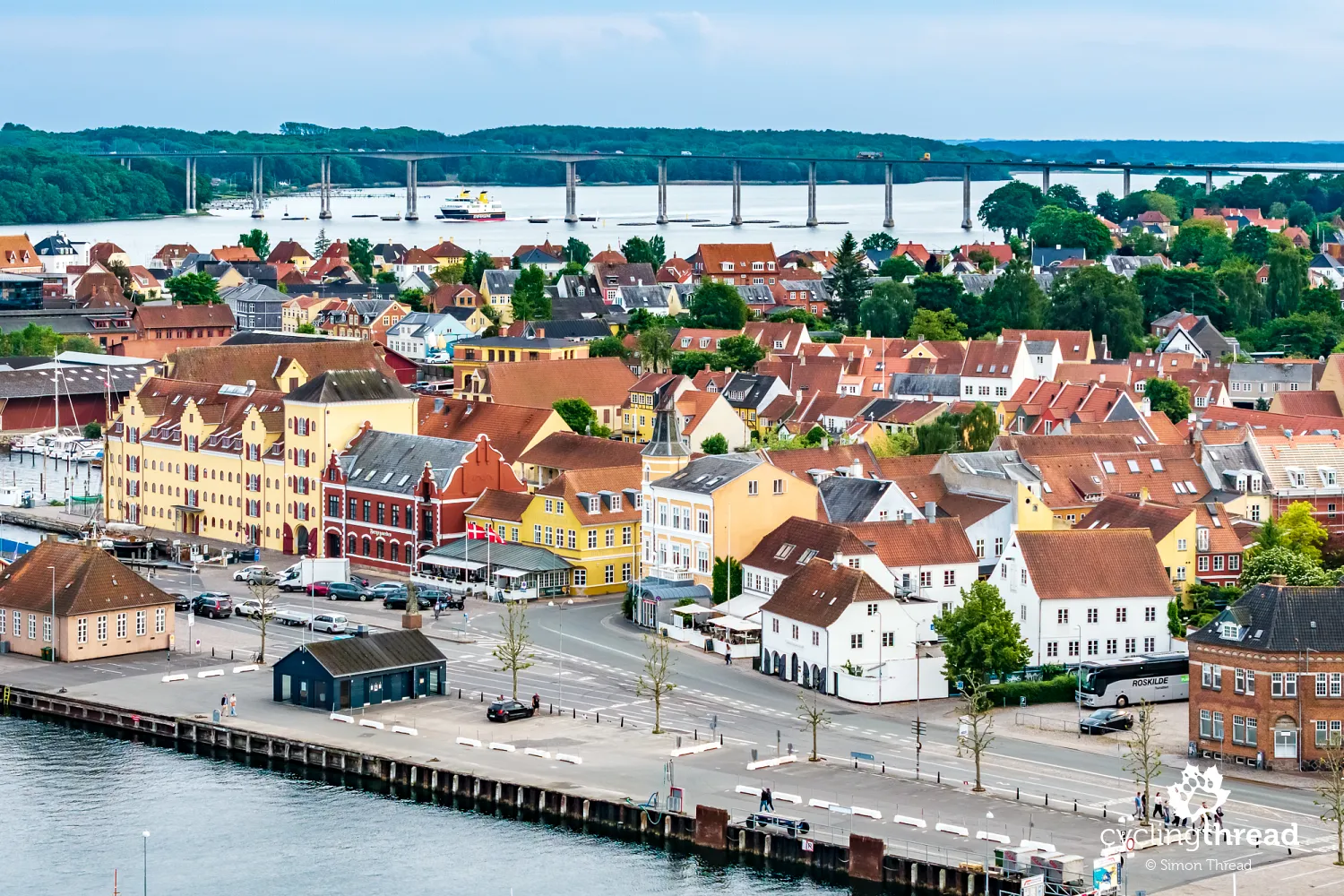
The heart of the old town is Gågade, a lively pedestrian street lined with shops, cafés and restaurants, from which narrow cobbled lanes branch off between colourful historic buildings. It is also worth visiting the Gothic St Nicholas' Church, the modern Naturama museum with its impressive exhibitions on Danish wildlife, and the marina. Another interesting attraction is Danmarks Forsorgsmuseum, housed in a former poorhouse and dedicated to the history of social welfare in Denmark.
Cyclist-friendly hotels on Funen
One of the cyclist-friendly places where we stayed was Hotel Ærø in Svendborg. Guests have access to a separate, locked bicycle storage room equipped with a pump and basic repair tools. This is a standard that more and more cyclists expect on multi-day tours. Thanks to it, we didn't have to leave our bikes unattended or bring them into our room. The bike storage was clearly signposted and easy to find, and being able to leave our bikes there safely allowed us to explore the town on foot and leave them overnight without any worries.
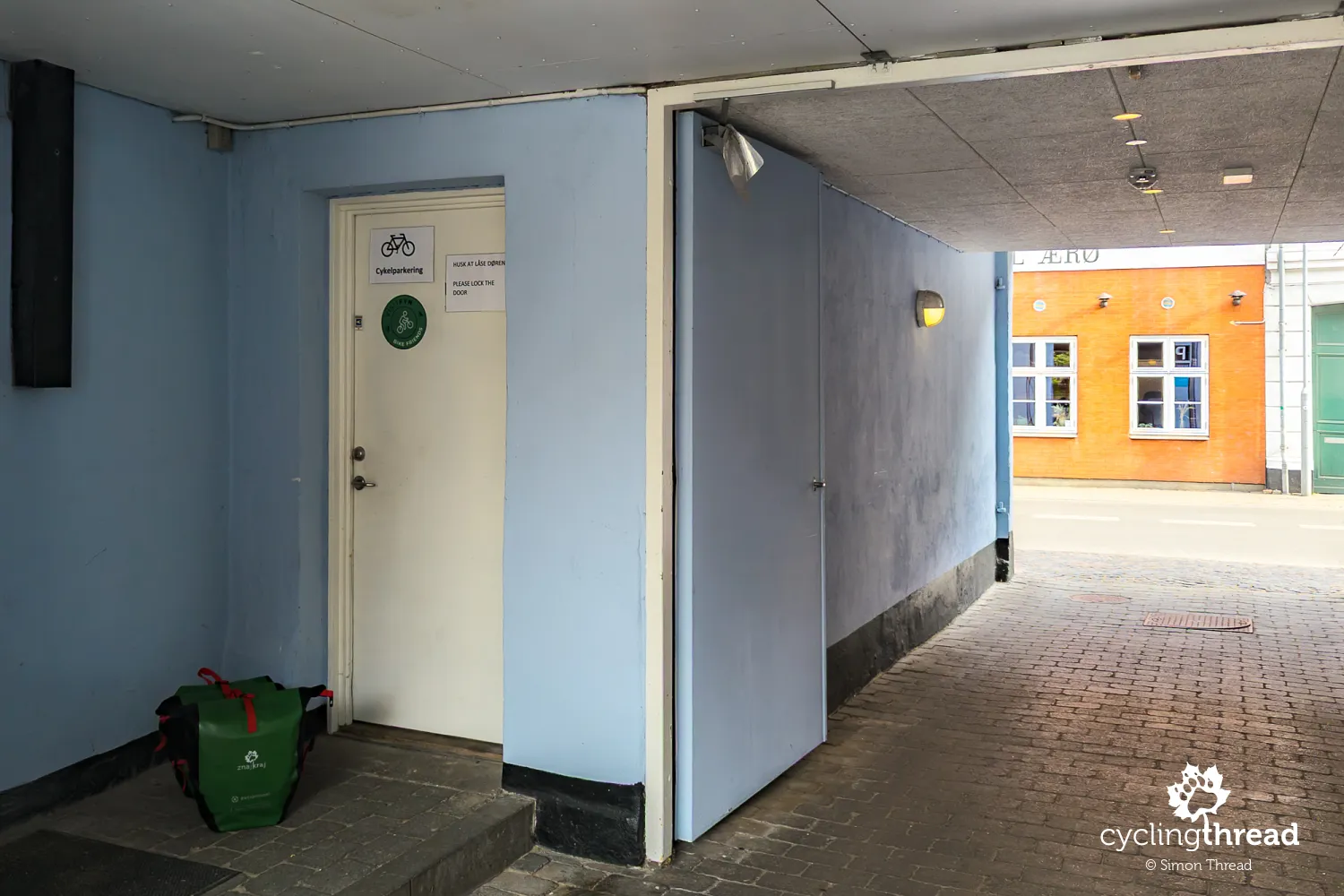
Cycling along a former railway
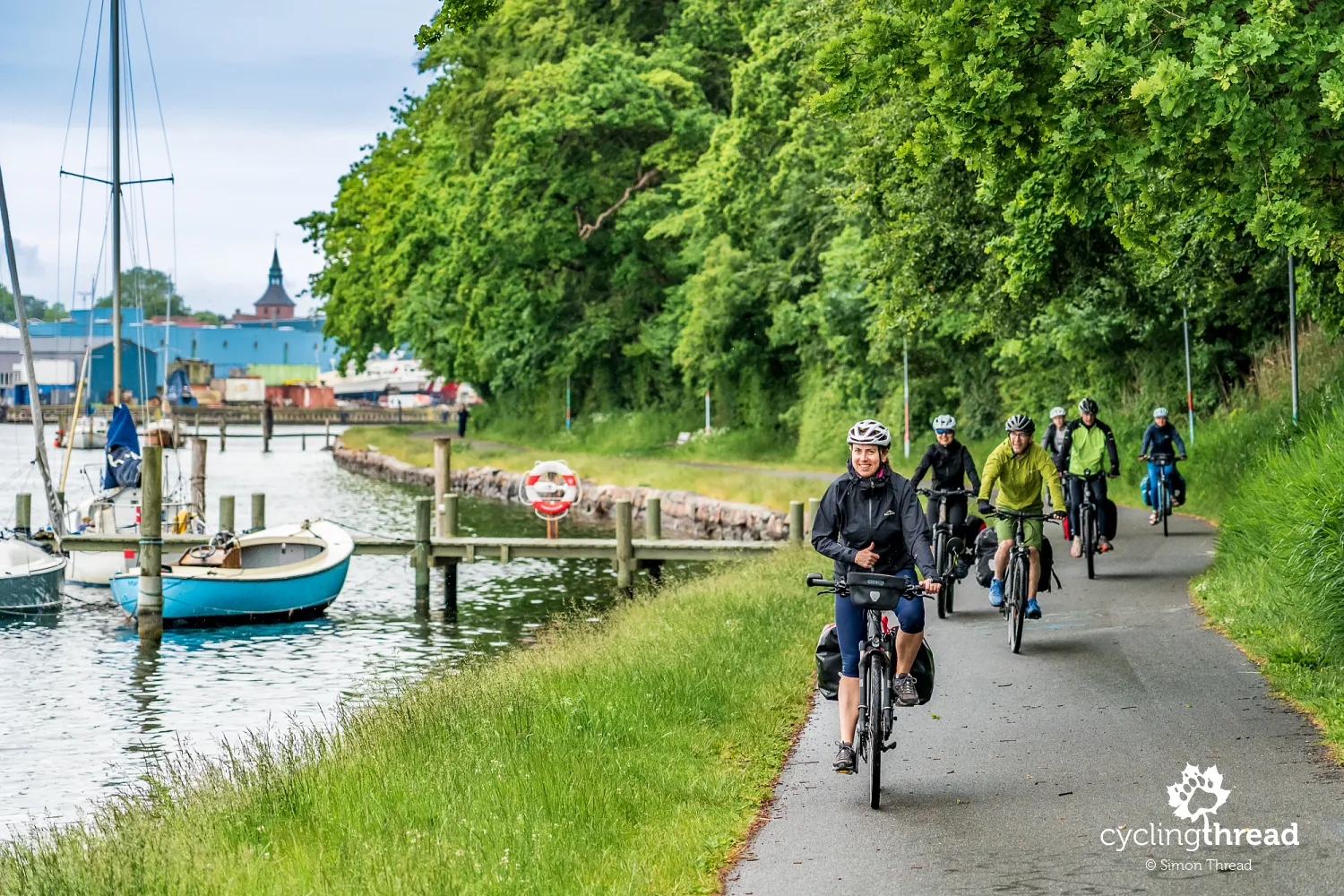
We left Svendborg in style on our final day. First, an excellent cycle path took us out of the town centre along the waters of the Svendborg Sound. Soon afterwards, the Castle Route followed the trackbed of the former Svendborg-Nyborg railway, opened in the late 19th century. For decades, trains carried both passengers and freight between southern and eastern Funen, with the line playing a particularly important role in transporting fruit from the orchards of the island's eastern coast to the rest of Denmark. The railway closed in 1964, and today its former embankment has found a new purpose as a scenic route for local runners, walkers and cyclists following the Castle Route.
The famous Broholm Castle
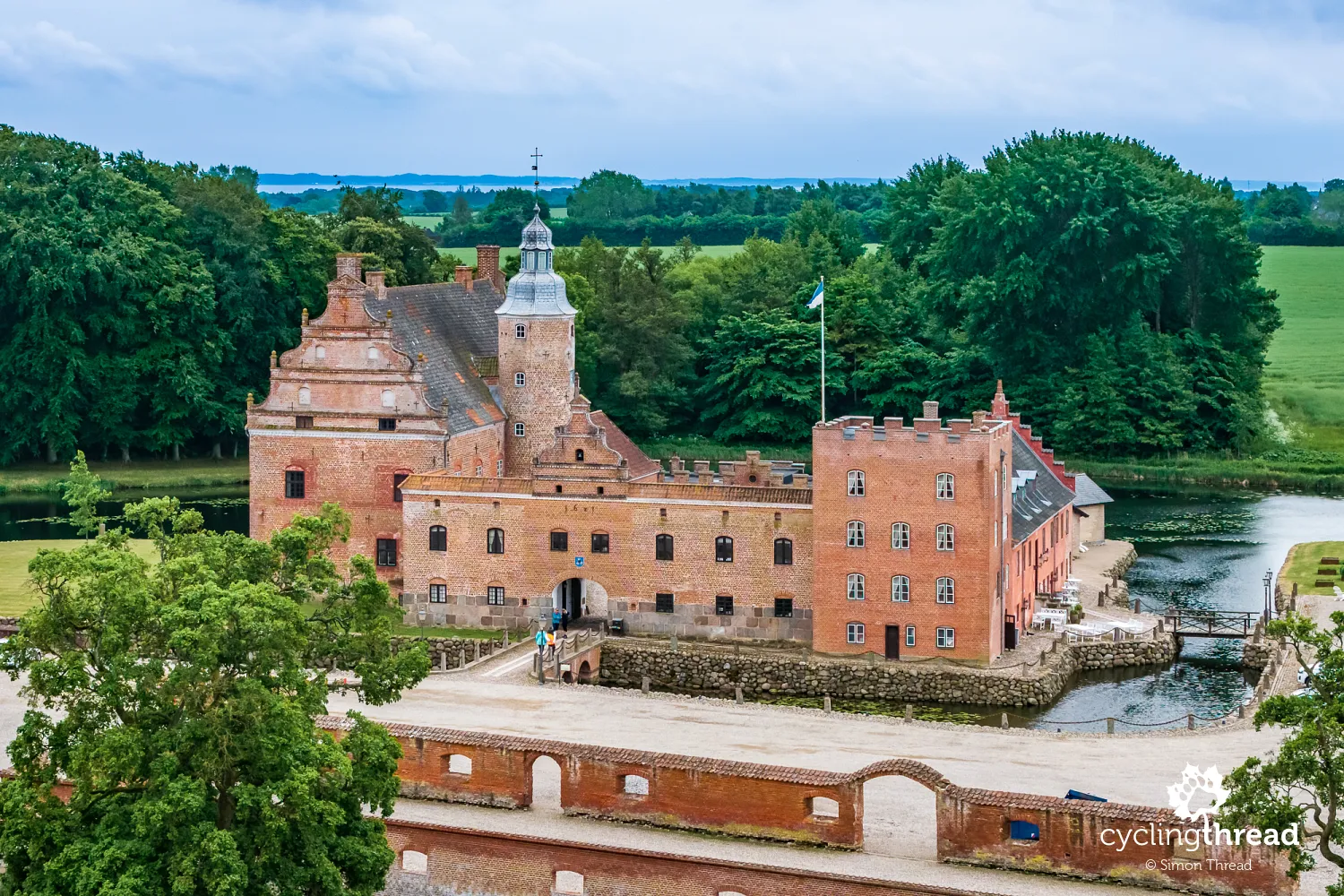
One of the highlights on the eastern coast of Funen is Broholm Castle. The history of the estate dates back to the 13th century, although the impressive mansion seen today, with its distinctive gate tower and broad moat, was built in the mid-17th century. The estate has had a turbulent past. During the Count's Feud (1534-1536), the last civil war in Danish history, the earlier fortifications on the site were burned down by townspeople. Today, the restored buildings house a hotel and restaurant, while the castle is also home to an extraordinary private archaeological collection containing tens of thousands of Stone Age artefacts. Broholm also occupies a special place in the history of dog breeding, as it was here in the 19th century that the Broholmer breed was revived. It is still regarded as one of Denmark's national dog breeds.
The largest Iron Age settlement in Scandinavia
In this area, the route briefly follows an excellent cycle path - a wide two-way track running alongside the road to Gudme. Today, Gudme is a small town, but around AD 300 it was the largest settlement in all of Scandinavia. It had around 500 inhabitants and was up to five times larger than a typical settlement of the period. Archaeologists have uncovered hundreds of gold and silver objects, along with the remains of monumental halls almost 50 metres long, believed to have been the residence of a local ruler. The name Gudme means "home of the gods", and the names of nearby hills and places suggest that it was one of the most important religious and political centres in Iron Age Scandinavia. Today, this remarkable history is presented at Gudme Kongsgård, where you can see the outline of the former royal hall and a small exhibition devoted to the archaeological discoveries.
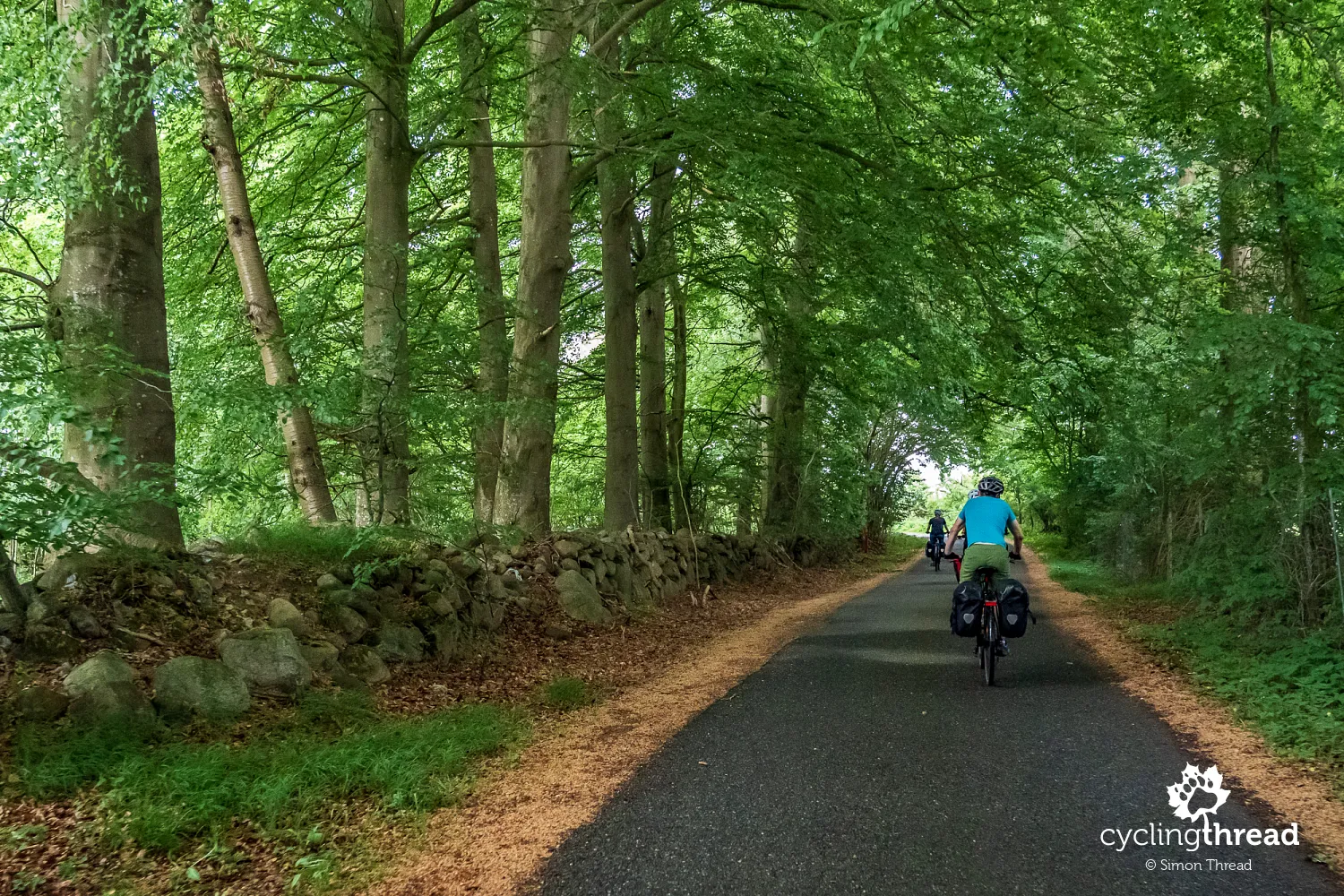
Another fascinating reminder of the past is the network of stone walls surrounding Rygård Forest. Many mark boundaries that date back to the Iron Age, the Viking Age or the Middle Ages, making them some of the oldest surviving features of Denmark's cultural landscape. For centuries, they defined the borders of estates, and many still follow their original alignments today. Over time, they have also become valuable habitats for many species of plants and animals. As a result, all historic stone walls in Denmark are now protected as important cultural monuments and lasting evidence of centuries of land use.
Glorup Gods historic estate
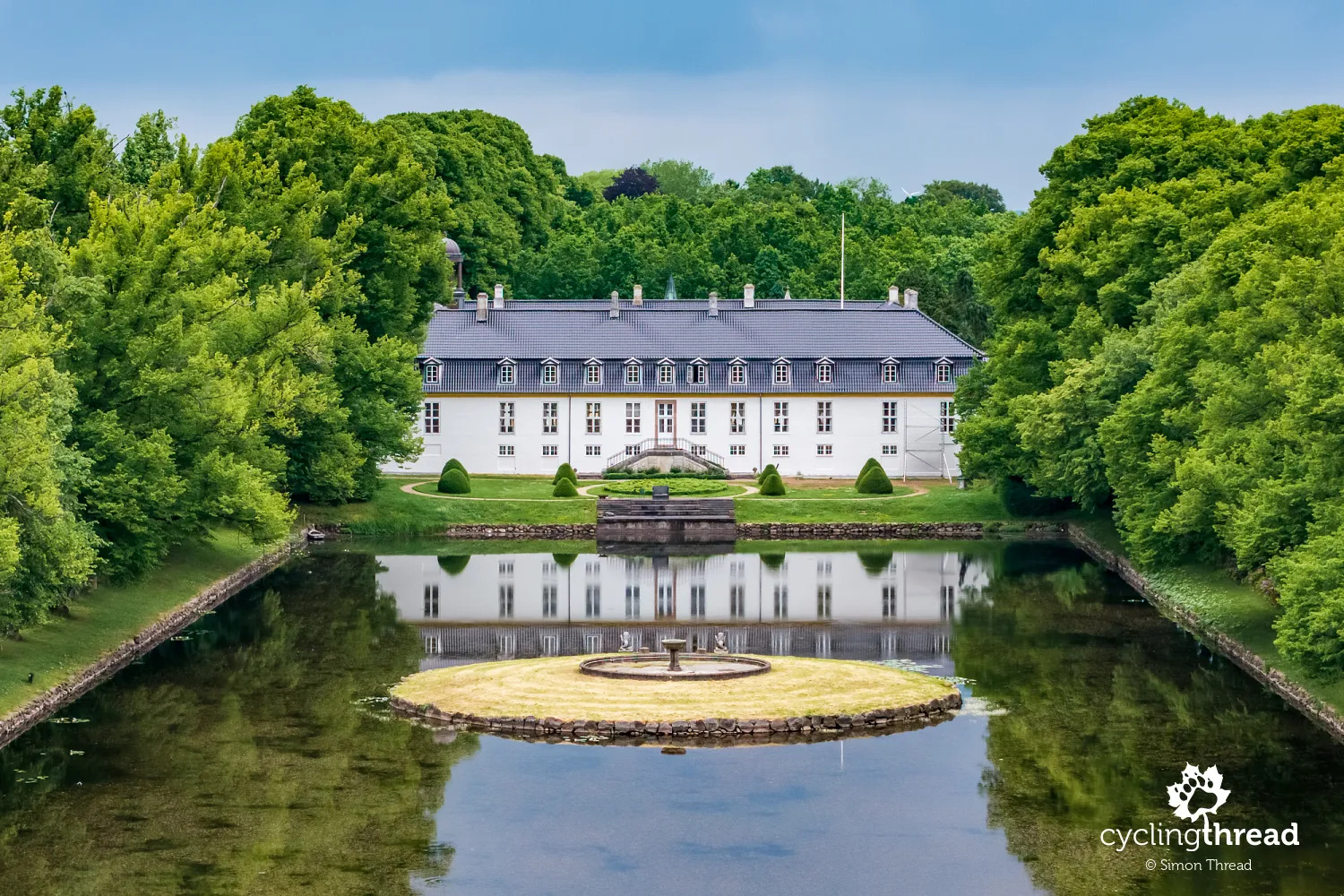
Just a few minutes further on, Glorup Gods is another grand estate along the route, and by no means the last of the day. The history of the property dates back to the late 14th century, although the present palace was built in the second half of the 18th century during the Baroque transformation of an earlier Renaissance residence with four corner towers. The white mansion is surrounded by formal gardens and an extensive landscape park, considered one of the earliest English landscape parks in Denmark. Since the beginning of the 19th century, the estate has belonged to the Moltke-Huitfeldt family and remains a privately occupied residence. Glorup is regarded as one of the finest examples of Danish country house architecture and was included in the Danish Culture Canon in 2006. Hans Christian Andersen was also a frequent guest here and wrote enthusiastically in his letters about both the palace and its surrounding park.
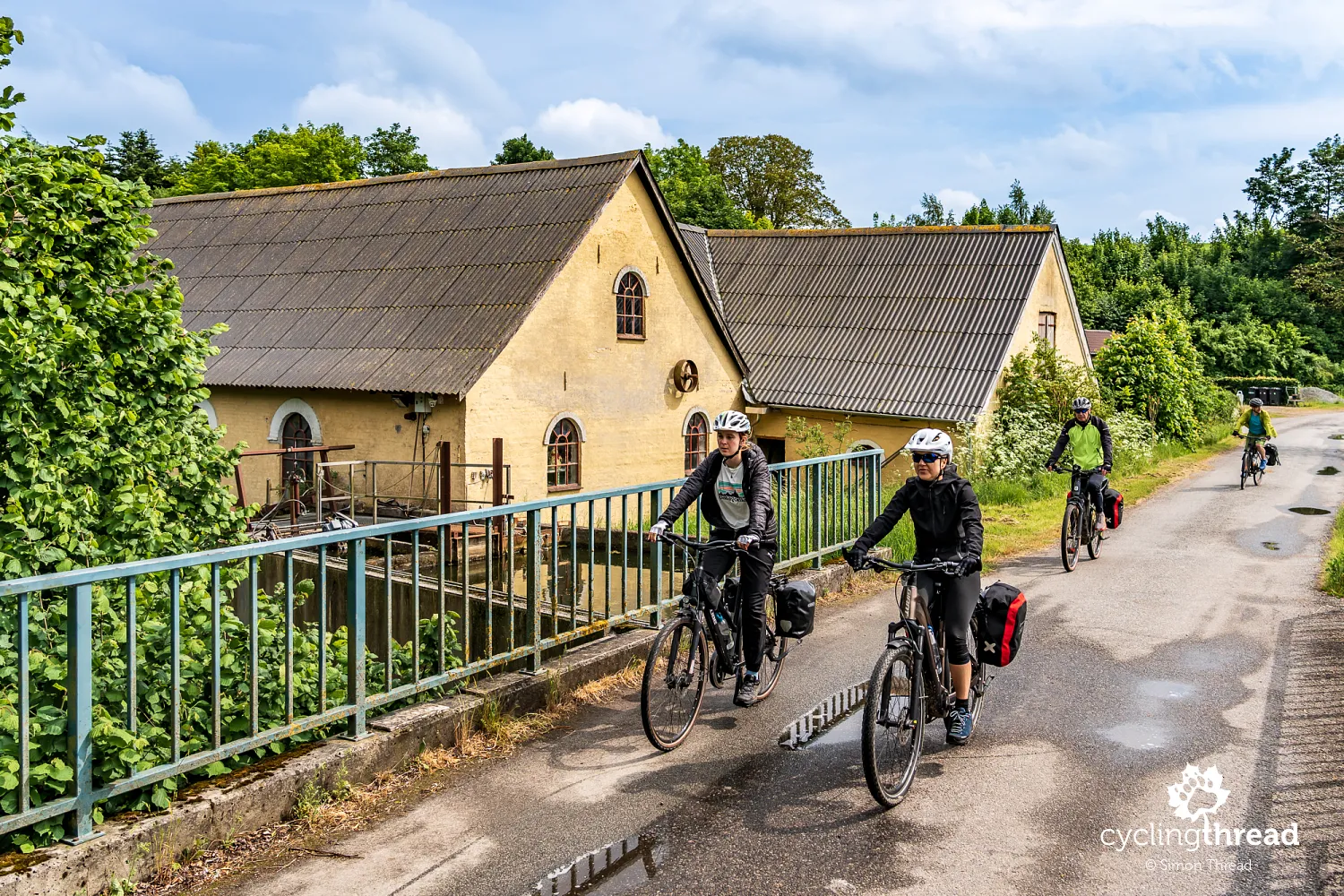
A little further on, the route passes Kongshøj Mølle, a former watermill and ironworks that reflect the changes brought to Denmark by the Industrial Revolution. In the second half of the 19th century, a local entrepreneur, working together with the owner of Glorup Gods, established what was then a modern industrial complex powered by the dammed waters of the Kongshøj Å river. The seven-metre-high dam is still the tallest on Funen. Although the ironworks closed in the early 20th century, the mill continued operating for many years, and from 1921 it drove a turbine generating electricity. Remarkably, the hydroelectric plant is still in operation today, supplying power to the Danish electricity grid.
When Nyborg became Denmark's capital
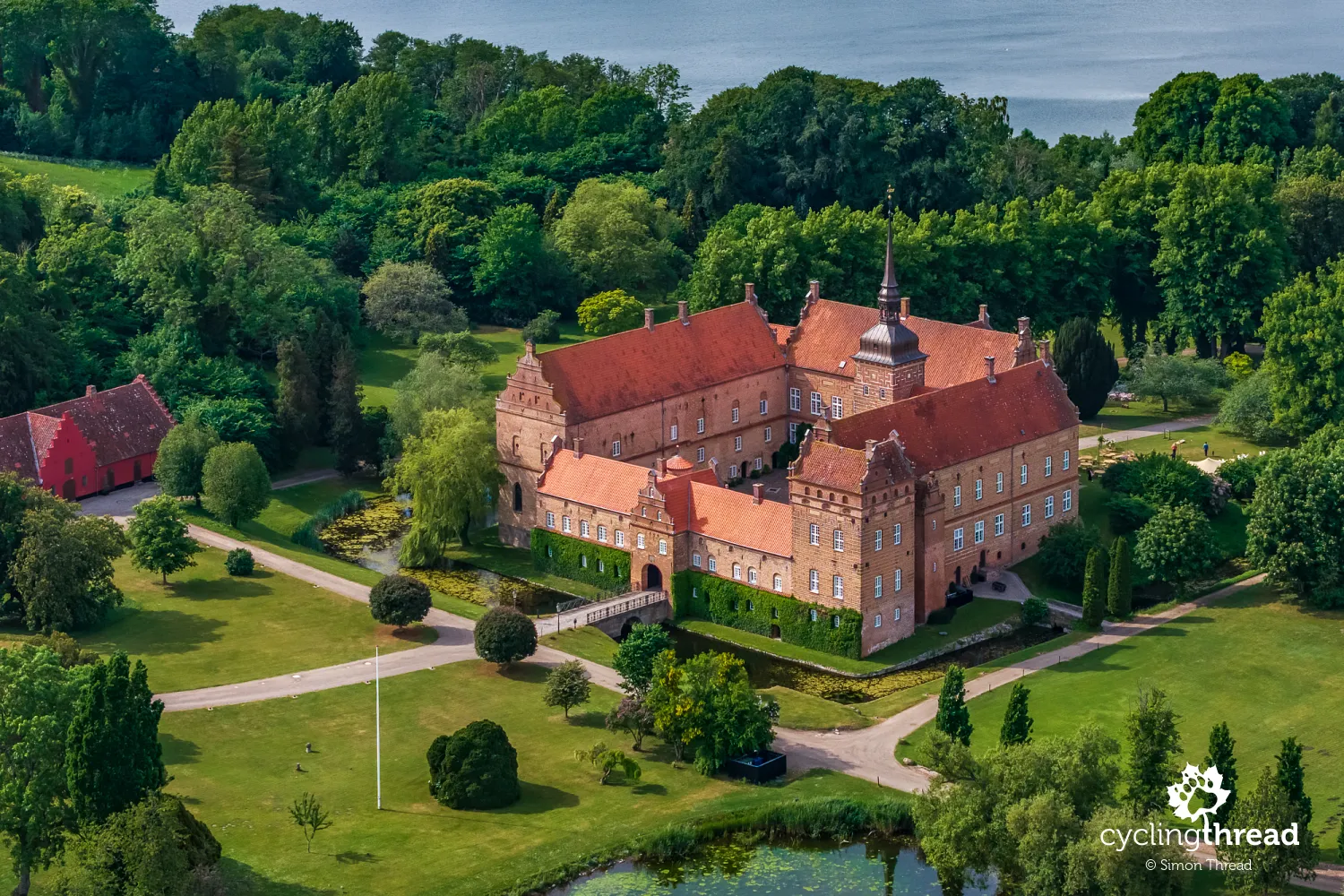
Shortly before reaching Nyborg, we leave the Castle Route and follow National Cycle Route 8 instead, allowing us to visit the beautifully situated Holckenhavn Palace. The estate dates back to the late 16th century, when Chancellor Jacob Ulfeldt built a Renaissance residence surrounded by a moat. The palace received its present name in 1672 from Eiler Holck, one of King Christian V's closest advisers. It has remained in the hands of his descendants ever since, making it one of the longest continuously family-owned estates in Denmark. Its red brick façades, corner towers and surrounding waters create one of the most distinctive views on the eastern coast of Funen.
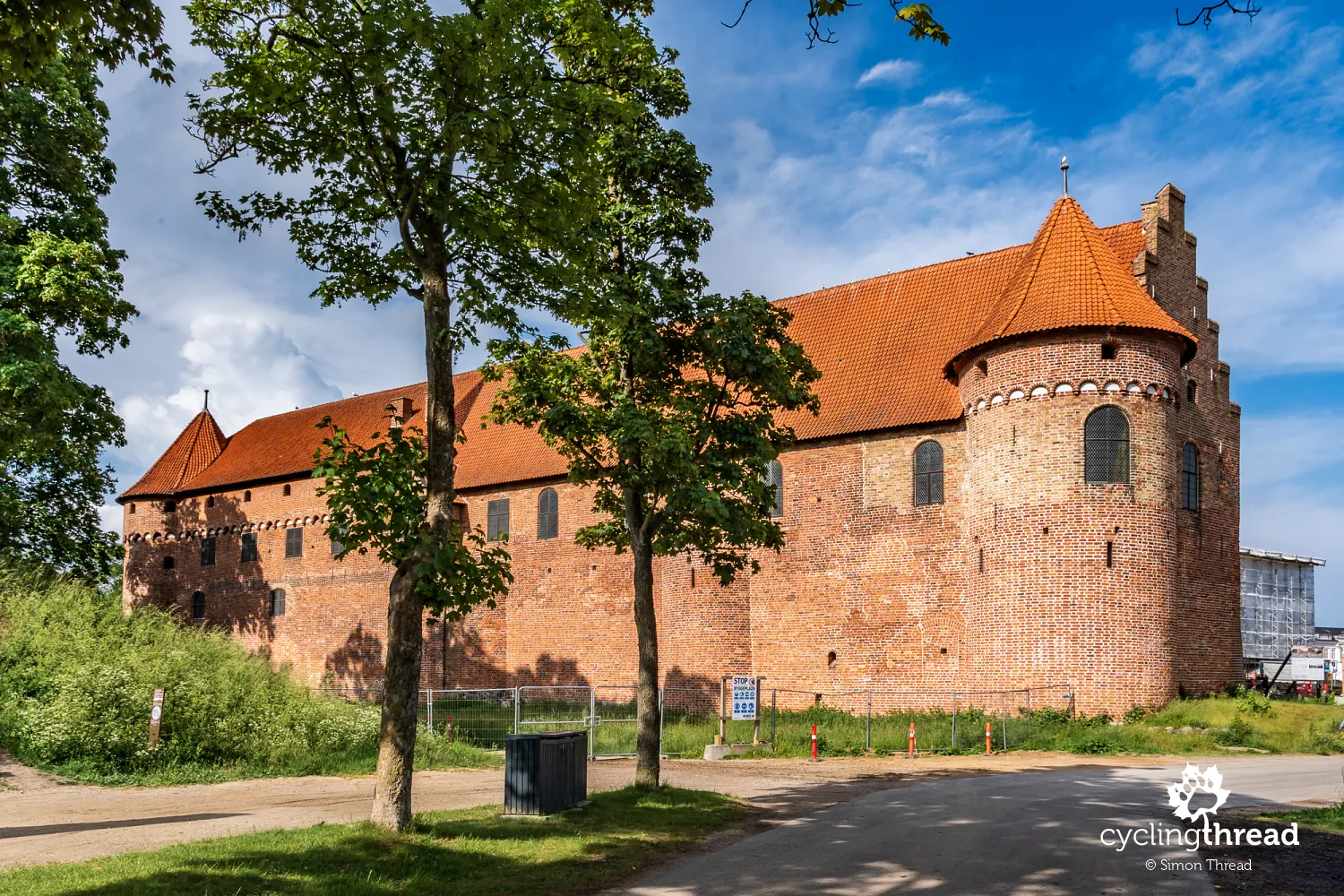
Nyborg marked the end of our journey. It is hard to imagine a better place to finish the Castle Route. The town combines some of the most important chapters of Danish history with the relaxed atmosphere of a seaside harbour and has long served as the natural gateway between Funen and Zealand. For centuries, this was the kingdom's main crossing point over the Great Belt, making Nyborg one of Denmark's most important towns. Its well-preserved medieval fortifications, historic centre and Nyborg Castle - one of the most important royal residences of medieval Denmark and the final castle on our route - are lasting reminders of that remarkable past.
For several centuries, the Danish kings did not rule from a single permanent capital. Instead, they travelled around the kingdom with their court, staying at different royal castles. Nyborg was one of their favourite residences and regularly became the political centre of Denmark. It was here that the Danehof assemblies brought together the king, the nobility and the bishops to make the kingdom's most important political decisions. In 1282, King Eric V Klipping signed a charter in Nyborg that is often regarded as Denmark's first constitution. It limited the monarch's powers and established the principle that the king, too, was subject to the law. During our visit, Nyborg Castle was still closed to the public. After years of bureaucratic delays and conservation disputes that stalled a major restoration project, work is finally moving forward again. The entire complex is now being restored ahead of its planned reopening in 2028.
Returning by Danish InterCity train
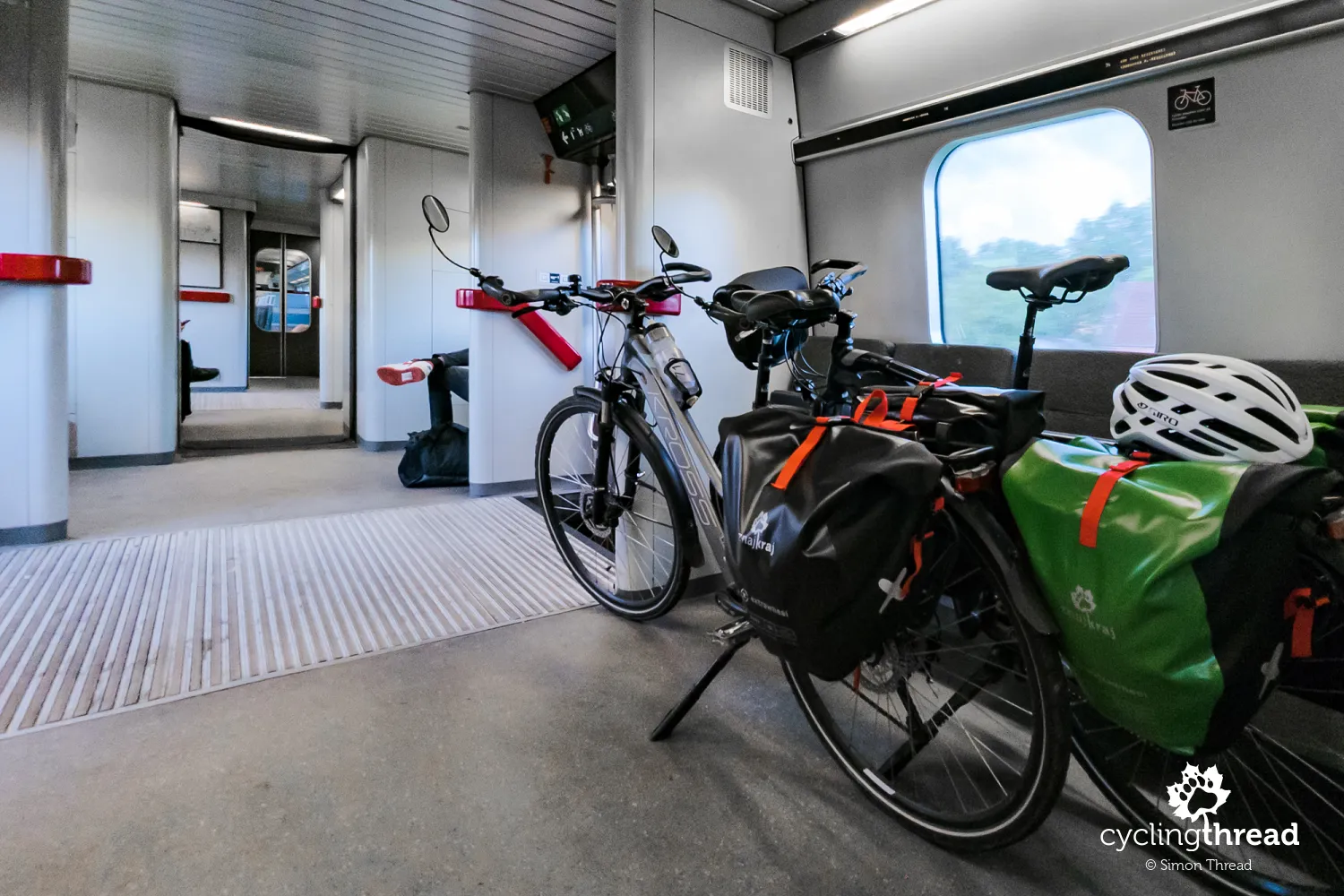
We returned from Nyborg to Middelfart by InterCity train, and overall it was a very positive experience despite a small logistical challenge. InterCity is Denmark's fastest category of conventional trains, and the "L" in the former ICL name stood for the Danish word meaning "lightning". The journey across Funen, from east to west, took only about 50 minutes. Bicycle facilities on board were excellent, but demand was high, and we managed to reserve bike spaces for only two of our seven bicycles on the first train. Fortunately, services run every hour in the afternoon, so the remaining five members of our group simply travelled on the next departure. One interesting feature of these trains is their length. The trains crossing Funen can consist of a dozen or more carriages, which are split into several shorter trains along the route to continue towards different destinations.
One of Denmark's best cycling holidays
The Castle Route showed us a very different side of Funen from the one most visitors associate with Copenhagen or Denmark's seaside resorts. This is a landscape of quiet villages, historic estates, small harbours and gently rolling countryside that often surprises first-time visitors. Although only parts of the route use dedicated cycle paths, cycling remains safe and comfortable thanks to light traffic and the considerate attitude of Danish drivers. The extensive network of local roads means that most of the journey is peaceful and free from heavy traffic.
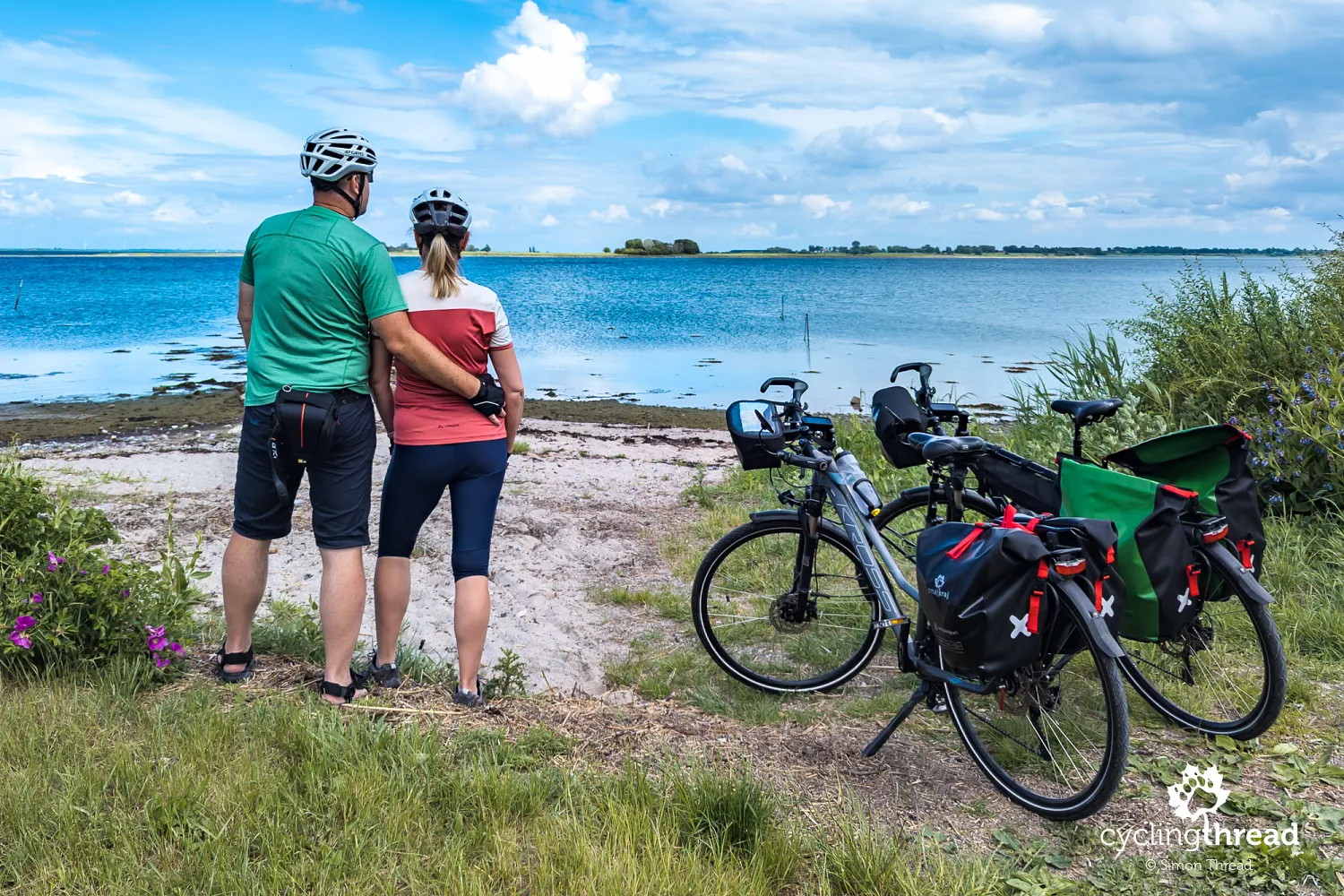
Add the island's mild climate, where even summer rarely brings excessive heat, together with its dense network of signposted cycle routes, and Funen becomes one of the best places in Denmark for a cycling holiday. Distances are short enough to combine castles and palaces, historic towns, coastal harbours and the peaceful landscapes of southern Denmark in a single trip without ever feeling rushed. The Castle Route is an excellent way not only to discover the history of Funen, but also to see why the Danish islands are among the most rewarding and cycle-friendly destinations in Europe.
Back to topHave a safe ride! 💚
Simon Thread
(Szymon Nitka)
I'm a passionate cycling traveler and the voice behind Cycling Thread. I explore Europe on two wheels, documenting the most scenic routes, inspiring places and cyclist-friendly practices. My writing blends personal experience with practical insights and a deep love of travel. I'm also a contributor to National Geographic Traveler magazine.